


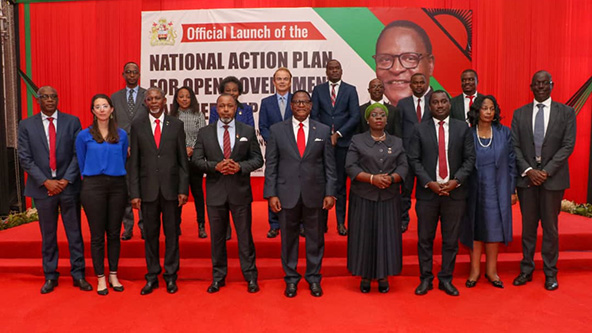
 From the launch of Malawi's National Action Plan on open government.
In 2020, a new government came to power in Malawi that was committed to reducing corruption, improving fiscal sustainability, and boosting transparency. NGOs working in the anticorruption space—as well as funders supporting good governance—saw a historic opportunity. However, the challenge for funders in this space would be how to support change on this scale. Supporting systemic change isn’t cheap or quick, and even for collaborative funders, guiding government leaders through the years of regulatory, policy, and constitutional reforms that would be necessary—not to mention implementation and monitoring to institutionalize good governance through all levels of government—would be a tall order.
We found a willing partner capable of supporting change at such a scale in the World Bank. While many foundations might think it strange to invest in a $300 billion dollar institution when there are so many NGOs and civil society organizations in need of support, the money and influence that the World Bank wields is precisely the reason why philanthropies should consider engagement. The World Bank has much to offer as a partner for the philanthropic sector: Not only is it unparalleled in its potential to achieve impact at scale, but the $39 billion it provides annually in aid to countries around the world has helped it win unmatched access to and influence with government officials.
The obstacles we faced (as well as our successes) during our four-year journey illustrate the challenges and benefits of working with the World Bank. The institution is set up to fund governments, generally on multi-million-dollar, multi-year projects, not time-sensitive, short-term civil society initiatives. Moreover, the World Bank doesn’t always have deep connections with local civil society leaders who have nuanced understandings of ground truth or international civil society organizations that can provide technical expertise.
However, all of this is what makes foundations the perfect partners with the World Bank, and the bank an overlooked sweet spot for philanthropy. Foundation funding is more flexible, less risk-averse, and can come with fewer strings. We generally have deep connections with local and international civil society organizations. We can nimbly build relationships across stakeholder groups such as government, civil society, private sector, and development finance institutions. We can help the World Bank respond to timely opportunities, connect with partners, and build and accelerate momentum. Our flexibility and rolodex of relations can serve a catalytic role, breaking down silos in the development space, bringing aligned parties to the table, jumpstarting collaboration, and triggering World Bank engagement to achieve impact at scale.
Collaboration on the Ground
The case of Malawi’s historic anticorruption reforms helps demonstrate what can be accomplished by collaborating with the World Bank.
In 2022, Malawi’s newly elected administration had identified “beneficial ownership” transparency reforms as a key first step their anticorruption efforts. Beneficial ownership is the legal term for who benefits from a company’s operations, shares its profits, or controls its activities, and transparency was sorely needed in Malawi to help prevent well-connected shell companies from winning inflated contracts with the government, bloating the government’s expenses and reducing government services. Helping Malawi implement beneficial ownership transparency could, for example, prevent a minister of transportation from secretly launching a shell company and awarding that shell company government contracts at inflated prices to covertly enrich themselves or their family.
The civil society organization Open Ownership had the technical skills and background in global best practices to advise Malawi’s newly elected officials on the required reforms.
But because the World Bank is set up to resource governments, it couldn’t quickly and easily fund the NGO to engage in this time sensitive and foundational work, a group of foundations stepped in to bridge the gap.
My organization, The Chandler Foundation, joined by the William and Flora Hewlett Foundation and MacArthur Foundation co-invested $2 million in a multi-donor trust fund within the World Bank, with the help of the Trust, Accountability, and Inclusion Collaborative. The trust fund’s flexible capital is meant to be strategically deployed to help the World Bank take advantage of windows of opportunity, like the one in Malawi, to advance governance and transparency. To jumpstart the work in Malawi, the trust fund allocated $75,000 to quickly connect Malawi officials with beneficial ownership experts at Open Ownership. This investment helped pave the way for a new $80 million World Bank grant to the government of Malawi, $6.5 million of which is focused on beneficial ownership implementation.
The World Bank’s grant payments over the next five years are tied to Malawi’s progress on governance and accountability as outlined in Open Ownership’s foundational work. As Malawi makes the necessary changes and progress, it will receive the World Bank funding to support further reforms, thereby establishing a self-reinforcing cycle of progress.
This partnership demonstrates how private foundation’s funds and civil society relationships can be catalytic in bringing aligned parties in the development space to the table, jumpstarting collaboration to grow resources and momentum.
This isn’t the first-time foundations have established a fund to deepen the World Bank’s work, better connect it with NGOs, and magnify impact. For example, the Bill & Melinda Gates Foundation and Omidyar Network established the ID4D Mult-Donor Trust Fund to support the World Bank Group’s Identification for Development Initiative in 2016. The fund, now with additional support from the UK Government, the French Government, and the Norwegian Agency for Development Cooperation, funds nonprofit support of governments as they build digital identification systems that help citizens access vital services like banking, healthcare, and social security and exercise their rights, such as voting and land registration.
“Given the size of the global identification gap, no single country, international organization, NGO, or private sector entity can surmount this challenge by working alone—coordination is needed at the global, regional and national levels,” according to a statement from the World Bank. The trust fund helps all of those actors align and work towards a common vision including which projects in the world should be prioritized and added to the World Bank’s pipeline portfolio of digital identification and civil registration projects. Following the foundations’ investment in what was once a fledgling topic at the bank, World Bank lending to countries for identification systems increased significantly. For example, in 2023 the World Bank announced $350 million of support for Ethiopia’s digital ID system
The Invest in Childcare Trust Fund is another example of foundation and World Bank partnership, demonstrating how such efforts can assemble an unrivaled group of global leaders. Launched in 2022 by the Bill and Melinda Gates Foundation, the Conrad N. Hilton Foundation, Echidna Giving, the Hewlett Foundation, and the LEGO Foundation, among others, the fund offers at least $180 million in new funding to expand access to quality, affordable childcare in low- and middle-income countries (LMICs). After the pandemic highlighted the importance of childcare (when the world faced a crisis as both the workforce and childcare facilities were brought to a halt), the fund sought to incentivize countries to design and implement better childcare programs, improve their policies, and build capacity, as well as build the evidence base for the impacts of childcare on women’s empowerment, early childhood development, and inclusive economic growth. The fund offered LMIC governments a 1 to 1 match in funding, up to $10 million, in addition to funding from the World Bank.
Another example of such collaboration, the Umbrella Facility for Gender Equality, launched in 2013, illustrates how such partnerships can create help mainstream an issue within the Bank and a create a ripple effect that reaches far beyond the World Bank. This trust fund, supported by the Bill & Melinda Gates Foundation and Wellspring Philanthropic Fund, among others, supports developing evidence for gender equality and better gender data. According to the World Bank, it has provided more than $169 million in funding for nonprofits and researchers to inform the design and implementation of over 300 World Bank projects, policy dialogue in 105 countries, and has influenced approaches adopted by more than 80 private sector companies to promote gender equality.
It is great news for the philanthropy sector that the World Bank is looking to broaden and deepen its philanthropic partnerships. For example, the Bank is now seeking to launch a new Civil Society and Social Innovation Facility, a new trust fund focused on climate, gender, health, and youth, which will offer strategic funders and civil society organizations a seat at the table and an opportunity for raising civil society voices and ideas that can sometimes get lost in big institutions.
Best Practices
If you are a foundation leader working in areas that overlap with the World Bank’s development priorities, from anticorruption and good governance to health and women’s empowerment, explore opportunities to influence, partner, coordinate, and align interests and priorities with the deep-pocketed giant. As you look for such opportunities, here are a few recommendations to consider:
1. Find internal champions.
The World Bank is not a monolith. Find the individuals or teams within the institution, either in headquarters or in-country or both, who are aligned with your goals. Coordinate with and support these champions. The World Bank has a private sector and foundations partnerships team that can help guide you to the right internal partners and facilitate collaboration at the global and country level.
In our case, the governance team at the World Bank proved to be committed partners who saw the value of connecting the window of opportunity we had identified with Bank operations. Bringing together that team with the anticorruption NGOs we have funded around the world was a win for all parties.
The World Bank team gained ground truth and access to experts with experience related to global best practices. Civil society leaders gained a voice and access to decision makers. The government gained a diverse group of committed partners. And, of course, the foundation saw its investments amplified and leveraged by an able and highly resourced partner.
Within the World Bank, we established relationships with both the global governance team in Washington headquarters, as well as with the World Bank’s country mission in Malawi. Collaborating with both the global team that led the trust fund allowed us to launch the technical assistance with Open Ownership, but we ultimately needed the World Bank’s in-country team to support the $6.5 million grant to the government. The World Bank’s headquarter and country teams are not always well coordinated. However, in our case we found allies in both, and perhaps more importantly they worked together effectively to build a pipeline between the trust fund and country grant.
While we were successful in our trust fund partnership, funders should be cautioned that not all trust funds can yield the same results. It is important to evaluate the leadership and the people behind the trust funds to see if they are willing to go above their own day-to-day priorities to work collaboratively and identify synergies. Philanthropy has much to offer in terms of local knowledge, effective interventions, and relational networks with non-governmental actors. World Bank staff who recognize this will leverage philanthropy’s strengths to accelerate their own work.
2. Recognize each stakeholder’s strengths and limitations.
Each stakeholder brings different skills, tools, and limitations to the table. By identifying where each stakeholder’s strengths and limitations lie, funders can more effectively collaborate with the World Bank.
Many outside actors perceive the World Bank to be an all-powerful, influence-wielding institution with Global South governments. While the bank can provide significant resources to government budgets and projects, it lacks the ability to collaborate effectively and efficiently with NGOs with subject area expertise or accountability mechanisms that are essential to effective government implementation. Governments can implement reforms at scale, but sometimes lack the expertise and innovation to execute programs effectively. Other times without a nudge from civil society or donors, they may be complacent with the status quo.
Philanthropy can serve as a bridge for the divide between these NGOs, the World Bank, and governments. Empowered with resources, funders can more easily access the World Bank and governments than NGOs, opening doors for grantees that otherwise might be closed. Serving as the connective tissue between the World Bank, governments, and global and local NGOs, philanthropy can bring the various stakeholders together and leverage each group’s strengths.
In our case, the foundation was well poised to support local civil society in Malawi, and even collaborate with government directly. Our investment in the trust fund, gave us the credentials to bring the World Bank into our long-standing relationship with both government officials and civil society leaders and broker a relationship between the various groups that would be needed to give this historic and ambitious transformation a chance.
3. Identify, align, and prioritize common goals.
Repeat key goals across various accountability mechanisms. The same benchmarks and performance goals should be used across a range of measurement and evaluation tools from civil society assessments, and government dashboards, to the World Bank’s funding triggers to help everyone work towards the same goals.
This specificity can ensure that everyone has the same vision of what success looks like and is willing to allocate time, talent, and dollars to necessary activities that can help achieve it. This not only clarifies goals, it informs resourcing decisions. This is especially helpful when engaging in systems change, which is, by its very nature, unwieldy. The repetition across interventions creates some safeguards, in the same way that, during the pandemic, officials promoted the “Swiss cheese model of prevention” (multiple layers of protection across multiple actors reduce the risk of failure).
Of course, aligning priorities isn’t a panacea. Government officials tend to be more responsive to those with the purse strings (the World Bank) than to frequent and long-time critics (NGOs). In our case, the Malawi beneficial ownership reforms were repeated as a key commitment across three platforms : within the Open Government Partnership National Action Plan (a voluntary mechanism through which government and civil society made commitments to open government and monitor implementation), the Open Ownership framework (the time-bound plan for reforming beneficial ownership), as well as the World Bank Program for Results milestones (which had real teeth).
The World Bank’s Program for Results instrument means that the government will only receive disbursements as they achieve the key outcomes and milestones outlined in the beneficial ownership reform framework and the Open Government Partnership National Action Plan. This provided an additional layer of incentives for the government to deliver upon its commitments.
During the Open Government Partnership process, we funded and collaborated with international NGOs such as Open Contracting Partnership, Open Ownership, and local NGOs focused on each commitment area to prepare the way for implementation of the National Action Plan. Having these NGOs on board helped provide both technical support and ongoing accountability to the Malawi government to ensure that its stated commitment to beneficial ownership transparency did not fall on the wayside. When the World Bank trust fund funded Open Ownership for its technical assistance, the relationships and groundwork came full circle and provided a foundation for the $6.5 million government loan.
Challenges on the Road Ahead
Philanthropists who join or establish trust funds within the World Bank must prepare to work within a massive and bureaucratic institution. Once your funds are held by the trust, you no longer have ultimate control over how they are used, and you will need to engage with other donors to negotiate priorities and best use cases. Managing the funds and these relationships inside and out of the World Bank, over the longer term, can be a time-consuming process and requires direct advocacy within the Bank and with your partner funders. Philanthropists should also be mindful that in some sectors, a partnership with or association with the World Bank may be unwelcome. Many civil society groups are critical of the Bank and see it as unresponsive to local community input.
However, at a time when we are all working in sectors defined by resource scarcity, we can ill afford to ignore opportunities to expand coordination, seize windows of opportunity, and grow momentum. Foundations should consider their often-overlooked strategic role of global connector and accelerator. We don’t need billion-dollar budgets to move billions of dollars. We can inform, influence, and equip the World Bank to respond at scale to timely opportunities and engage with local and international civil society organizations to build and accelerate momentum.
When we are at our best, philanthropy isn’t operating in a piecemeal fashion. It isn’t just making serial grants to NGOs and shoveling money out the door. When we are at our best, we are leveraging our influence and voice, connecting potential partners and opening doors for the champions of change. When we are at our best we are investing catalytically and cooperatively to ensure that the whole of everyone’s time and treasure is greater than the sum of its parts. Philanthropy can play an outsized role by opening doors, aligning incentives, and serving as connective tissue across stakeholder groups in government, civil society, and development finance institutions.
Read more stories by Leslie Tsai.