


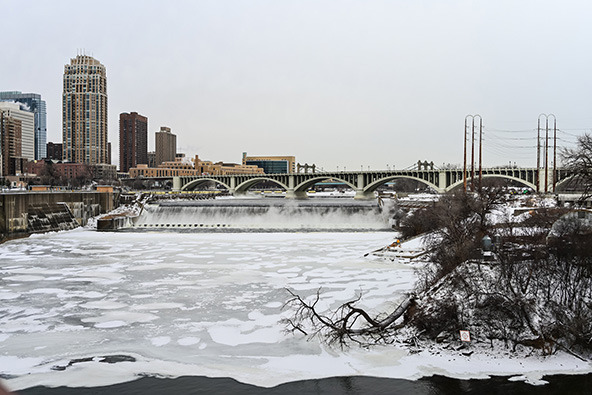
 The frozen Mississippi River in downtown Minneapolis. (Photo by iStocķ/JoeChristensen)
Minnesota has been my home, where I’m raising my family, volunteering, and doing my life’s work, for over 23 years. Living here means being part of something bigger than yourself. It means knowing your neighbors, making conversation with strangers at the grocery store, and knowing the parents at your kids’ school. It means showing up for school and community events not because you have to, but because that’s what people do. This is a state where people have built the habit of showing up for one another, across differences of background, belief, and political identity. That’s what it means to be “Minnesota nice.” It’s one of the reasons, today, that we find ourselves under attack.
You don’t have to live here to understand what U.S. Immigration and Custom Enforcement (ICE) are doing. Families are afraid. Children are scared to go to school. And communities have been disrupted by fear and uncertainty. This is more than a political flashpoint or disagreement over immigration policy. It’s forcing us to confront deeper questions: What do we expect from public institutions? What happens when trust erodes? And how do communities respond when people feel targeted rather than protected? This moment is not only a test of our democracy, but also a fight for our humanity.
Rather than shutting down, people are stepping up, even putting their lives on the line for their neighbors. From Seattle to Philadelphia, people are gathering peacefully, donating to mutual aid funds, and organizing strikes. Parents and educators are speaking out on behalf of students who are scared to go to school. One grassroots group in Minneapolis launched an Emergency & Rapid Response Fund that has raised over $275,000 to support families facing evictions because ICE operations make them unable to work. This mobilization is making a difference on the ground: stabilizing families, supporting community organizations, and offering a measure of hope in an otherwise terrifying moment.
History tells us that this surge of attention and generosity will probably not last. And while crisis response is necessary, long-term change does not happen at the height of a crisis. It happens before and especially afterwards. That’s where philanthropy needs to be looking, now.
What happens after attention fades.
After the murder of George Floyd in Minneapolis, protestors gathered in city after city, mutual aid funds provided support for local organizations, and big business publicly issued commitments to social justice. This period also catalyzed one of the largest shifts in philanthropy to date. According to a report published by the Center for Effective Philanthropy, “virtually all foundations” streamlined processes to reduce burden on grantees, provided more flexible support, made equity an explicit consideration, and increased representation on their board of directors to align more closely with the communities they serve.
I remember thinking that the Twin Cities were suddenly on the global stage, that we were offering a masterclass in people-powered democracy in real time. Led by neighbors, community leaders, and people from different walks of life, we demanded accountability and justice. People across the state came together to ensure that everyone has access to opportunity, safety, dignity, and a right to shape the systems that affect our lives.
That was all true, as it is now. But as headlines moved on, so did the investments. As the (then) president of Headwaters Foundation for Justice, I had a front row seat as millions of dollars poured into the state over the summer, and then, within a year, I saw the dollars slow to a trickle.
The pressures on leaders only continued to grow: The same organizations that were asked to respond day after day were left to carry the long-term work of rebuilding with less money. Maintaining staff, sustaining trust, and preserving the infrastructure that democracy requires only became significantly harder.
I won’t downplay Minnesota’s strength. Our civic muscle has endured—we are a hearty and resilient people who are not afraid to face frigid temperatures to do right by our neighbors. We have built the networks, coalitions, and organizing capacity rooted in lived experience. People know how to mobilize, support one another, and respond when harm shows up. Still, how much more could we have built—to prepare for today’s attacks on democracy—if the early surge of support had been matched with sustained, long-term investment?
The role philanthropy can play.
When my family and I talk about what we can do to step up, I tell my teenage children to find one thing they are good at—one talent, one strength—and take action. In this case, communities need philanthropy to show up with rapid response dollars and stick around to help everyday people build for the future.
If everyday people and organizations can put it all on the line, why can’t philanthropy? And yet the Philanthropic Initiative for Racial Equity (PRE) recently released a report—Derailed: Rising Attacks and Retreating Resources for Racial Justice—which documents a troubling decline in philanthropic investment in racial justice. The report is clear about what’s at stake: Decisions made inside philanthropic institutions right now will shape the democratic landscape for years to come. Choose well.
One place to start is to identify your organization’s superpower and run with it. Conveners can help share lessons learned across states and regions. Funders can provide multi-year support that allows community leaders to retain staff, build infrastructure at the organizational and ecosystem level, strengthen networks, and adapt as conditions change. Others can invest in leadership development, narrative work, or cross-sector partnerships that help communities build alignment and shared vision. At the Raikes Foundation, for example, our Resourcing Democracy portfolio invests in national networks, state, and local organizations that work year-round to bring people together around shared goals—not just during election cycles or moments of crisis.
In moments like the one Minnesota is experiencing now, that commitment gives me hope. We know what’s happening here could happen anywhere, and we know this won’t be the last time our democracy is tested. Philanthropy can help ensure that when those tests come, communities are not starting from scratch.
Our charge is simple: don’t just meet the moment. Stay for what comes next.
Read more stories by Maria De La Cruz.