


 (Illustration by Peter Grant)
Across the globe, humanity is facing a convergence of challenges, including rising inequality, shrinking civic space, climate instability, and growing anti-rights movements. These challenges are deepening just as foreign assistance declines and international commitments waver.
While the scale and nature of these disruptions have led some global funders to pause, think, and reassess their strategies, the local leaders with whom Co-Impact
partners across Africa, Asia, and Latin America have shared a different and consistent message: 1) These challenges aren’t new. 2) We’re getting on with the work. 3) Here’s what we’re doing and why it’s working.

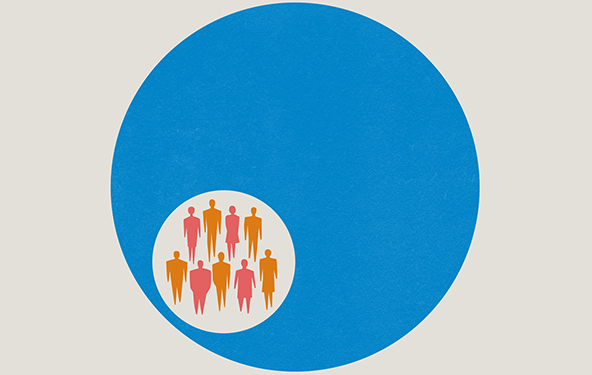
These leaders are transforming public systems from within—finding champions in government, building cross-sector coalitions, persisting through setbacks, and continuing to deliver impact for the communities they work with. What’s more, many were never heavily dependent on foreign aid to begin with. Despite global rhetoric, international funding has often failed to reach local efforts. Some global donors have signed a long-standing commitment to provide at least 25 percent of aid to local and national actors, but, in reality, little progress has been made toward this goal, and local actors receive an estimated 0.6 percent of global funding directly.
Where a baseline of rule of law and institutional accountability exists, these leaders have focused primarily on their own governments and communities—unlocking domestic resources, shifting and implementing policy, and building local ownership of solutions that last. They’ve built strategies to allow progress to continue regardless of political shifts, ensuring that systems are more responsive, resilient, and equipped to deliver lasting impact at scale.
Their work often starts within civil society—with locally rooted organizations, many led by women and other historically excluded groups, who are developing practical, grounded solutions to complex problems. Instead of working around public systems, they work to improve them by building trust, demonstrating what’s possible, and helping to embed lasting change into how governments and communities serve people.
They are our reason to be optimistic—not in spite of the challenges, but because they show what is possible: real, lasting improvements in people’s lives and the systems that shape them. Now is the time to listen, learn, and step up with confidence to back their work.
Philanthropy’s Path Forward
In moments of uncertainty, the world needs clear pathways. Philanthropy has a distinct and essential role to play: It’s not to replace public systems but to help make them better. No government can solve today’s challenges without partnerships with local leaders and organizations that are closely connected with the communities they serve. As the field moves forward, three principles can guide how philanthropy shows up:
- Invest in locally rooted leadership that can drive forward systems change. | Philanthropy can back leaders and organizations rooted in their contexts and working to shift how systems function, including how decisions are made, how resources flow, and whose voices shape policy. That means supporting leaders who are focused on embedding solutions into public institutions for the long term by working with governments to advance national ownership, increase domestic resource commitments, and shape priorities so that they’re inclusive and representative of all.
- Fund with abundance. | Support must match the scale of the challenge. That means providing long-term, flexible funding combined with strategic support that’s aligned with the vision and goals of those leading the change.
- Center gender as an essential, not optional, component of the work. | Systems change is about tackling the root causes of inequality and building institutions that work better for everyone, not just a few. A commitment to gender equality must be foundational across everything. Leaders and organizations need to center the experiences, leadership, and priorities of women and girls so that systems can truly deliver their promise for everyone.
Supporting systems change is long-haul work that requires a scale, geographical footprint, and combination of knowledge and skills that very few funders can have on their own. This is why pooled funds and collaborative models are particularly well positioned to do this. They allow donors to tap into existing expertise, share risk, and work together to support locally led change at scale.
Co-Impact is part of a growing field of such collaboratives. In our work, we fund long-term strategies developed by locally rooted program partners, with the aim of making health, education, and economic systems in their communities stronger and more inclusive, and advancing gender equality and women’s leadership. We invest in the partners’ organizations, in learning and measurement, and in the strategic support they tell us makes the greatest difference—including a design phase where they can think and plan for impact at the scale of the problem. Once that strategy is in place, Co-Impact walks alongside them with multiyear grants. We bring together funders from around the world and raise pooled capital to support more work like this, making it possible to extend impact across regions and issues.
Systems Change in Action
When these elements come together—local leadership, flexible funding and support, and a commitment to gender equality—they help create the conditions for change to take root and grow. The nonprofit initiatives we’ve supported alongside other funders, like the ones below, are demonstrating that lasting systems change is not only possible but already underway.
Take Gender Mobile Initiative in Nigeria, which is combating pervasive sexual harassment in higher education. Working with more than 125 institutions and the Ministry of Education, the effort has introduced a national prevention framework, survivor-centered reporting tools, and campus-wide education. The Nigerian government is now considering legislation that would establish nationwide accountability for both reporting and enforcement.
In Indonesia, PEKKA has been building a grassroots movement of women heads of families for more than two decades. The organization has supported more than 85,000 women-headed families across 1,600 villages in fighting for their education, economic, legal, social, and political rights. Now it’s partnering with Indonesia’s Ministry of Women’s Empowerment and Child Protection to embed a feminist learning model into a national, women-led development program, with the goal of training women leaders in all 74,000 rural villages.
In South Africa, the Early Childhood Development Coalition—including Ilifa Labantwana, SmartStart, and other partners—has helped unlock 10 billion rand (about $555 million) in public funding, enormously expanding children’s access to care and lightening regulations so that more women microentrepreneurs can open quality childcare centers in their homes. The coalition has achieved this goal by demonstrating what’s possible at scale, tracking measurable evidence of impact, supporting the government to strengthen its systems, and making a powerful case for early-childhood development as a driver of social justice, jobs, and national progress.
And in Brazil, Mapa do Acolhimento is embedding survivor-centered approaches into public systems to address gender-based violence. What began as a volunteer network (a still active online matching system of connecting volunteer lawyers and psychologists with female gender-based violence survivors) has since expanded from a direct-service model into a national effort piloting policy models in the state of Alagoas, with plans to expand to four other states in the northeastern region of Brazil. This effort includes strengthening women’s policy agencies, improving services, and expanding civil society’s role in shaping more inclusive state policies.
More Than Half Measures
Billions of dollars in philanthropic capital continue to remain on the sidelines. Why aren’t funders mobilizing it now, when it’s needed more than ever? It’s a common question that often meets the same response: While some funders are stepping up with urgency, many feel stuck; unsure where to begin or whether their contribution will be enough, they instinctively pause.
But that thinking sells short both the urgency and the possibility. This is the moment to accelerate giving, not delay it. Today’s challenges don’t call for caution or half measures; they call for resolve, and for action grounded in ambition and clarity.
Philanthropy already has the tools and platforms it needs to help expand the impact of local leaders through deeper collaboration and long-term support. If ever there were a time to act boldly—to accelerate giving and match the urgency of those already leading change—it’s now.
This series appeared in SSIR’s Fall 2025 Issue, including a new follow-up essay from MacArthur Foundation President John Palfrey.
Read more stories by Olivia Leland.