


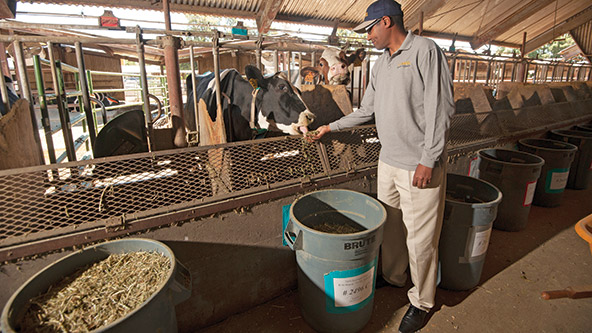
 UC Davis professor Ermias Kebreab conducts research with 12 dairy cows to determine if a small amount of seaweed added to cattle feed will reduce methane emissions from cows. (Photo courtesy of UC Davis Strategic Communications)
Methane emissions from farm animals, especially cows, significantly contribute to global warming. According to the Environmental Protection Agency, manure management and the digestive process known as enteric fermentation accounted for 36 percent of methane emissions in 2017. Methane is 30 times more potent as a heat-trapping gas than carbon dioxide. Rising global temperatures are melting the polar ice caps and raising sea levels at rates that threaten to wipe out coastal communities.
But the ocean itself is offering a way to fight back. Research has found that the simple act of adding an unassuming seaweed called Asparagopsis taxiformis to cattle feed can lower the amount of methane that cows produce by a stunning 60 percent.
“That was more than I expected,” says University of California, Davis, animal science professor Ermias Kebreab, who has conducted research using the seaweed supplements for the past two and a half years. “Usually when you use food additives and it works well in vitro, but you do it in live animals, the effect is usually much lower. Actually, it was even more effective in vivo than in vitro.”
Cows have a ruminant digestive system: a massive stomach with four compartments designed to maximize nutrients from grass and other roughage. Ruminant stomachs are a sort of factory production line, containing methanogenic microorganisms that help break down and ferment material—then release waste gases into the atmosphere.
Like most people, former Stanford Distinguished Careers Fellow Joan King Salwen wasn’t intimately familiar with ruminant digestive processes before she stumbled upon a 2016 paper by researchers at Australia’s James Cook University that described what was considered to be the first discovery of seaweed’s powerful impact on ruminant methane emissions. Salwen shared the research with a chain of scientists that eventually led her to Kebreab, telling him she was “interested in raising some money if you would move this to the top of your research agenda.” Now, Salwen’s Elm Innovations, a social venture that partners with farms to lower methane emissions, has helped provide $1 million in funding for research into Asparagopsis as a dietary additive.
“Raising the money was relatively easy; getting the seaweed was a major problem,” says Salwen. “There was no one cultivating it or growing it in the ocean. The only way we’ve been able to get it for trials has been to send out divers with scuba gear, to dive 6 to 10 meters in the water, clip and bag it, and you know—does this sound like a sustainable way to do science?”
Luckily, it doesn’t take much Asparagopsis to reduce excess gas. Just 1 percent of the seaweed additive in cattle feed is enough to be effective, thanks to an essential oil released during digestion that interrupts the final stage of a six-part methanogenic process. “If steers are eating 10 kilograms a day, they’re eating 100 grams of seaweed a day,” says Kebreab. “Female cows eat about 25 kilograms a day, and about 250 grams of seaweed.”
Cattle is a multibillion-dollar industry, one that Kebreab says has been overwhelmingly receptive to the idea of using seaweed supplements. Some of the funding for his trials has even come from dairy farmers. “Some of the progressive farmers are looking forward to it because they want to be more sustainable,” Kebreab says. “We haven’t had any pushback from others.”
Cows may be eating seaweed on a mass scale soon. Kebreab and his team have already completed the emissions testing and have moved on to testing the safety of milk from dairy cows that are fed Asparagopsis.
“We’re looking at approximately 20 to 24 months for this to go to market,” Salwen says. “One of the biggest barriers is not just the completion of all that testing, but standing up all of the ocean farms that would be needed to provide consistent quality supply to all of the farmers. They’re not going to adopt it unless there’s a steady supply.”
While the hope is that Asparagopsis use will eventually be adopted for cattle feed worldwide, California, which boasts the largest dairy industry in the country, will serve as a testing ground. That’s due in part to SB 1383, the state’s 2016 law that requires livestock and dairy producers to limit methane emissions by 40 percent by the year 2030.
Read more stories by Mary Emily O’Hara.