


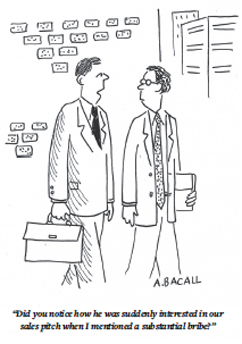
 Cartoon by Aaron Bacall/www.cartoonstock.com
“In India, as elsewhere in the developing world, the old business of corruption is meeting a new rival: the Washingtonstyle business of persuasion.” So commented columnist Anand Giridharadas in the May 18, 2006, edition of the International Herald Tribune.
Lobbying and bribery are both time-honored ways to seek influence. The most important difference between them, according to economist Bård Harstad of Northwestern University’s Kellogg School of Management, is not that one is legal and the other a crime. It’s that bribery doesn’t last as long.
Whereas successful lobbying changes the rules, bribery only bends them. Harstad built a mathematical model to track and explain why bribery is more common in poor countries and lobbying in rich ones. “If you are bribing, you get permission to break the rule only once,” says Harstad. “If you want to break the rule later, you have to pay again.” For a small firm paying a small bribe, that is cost-effective. But in a thriving economy, corrupt bureaucrats essentially price themselves out. “When the company grows, the bribes become bigger and bigger. Eventually it’s cheaper for the big company to lobby to change the rules,” says Harstad.
This analysis suggests a natural evolution away from bribery. But a closer look at the model shows that corruption can be self-reinforcing. “The problem is that the more you invest, the more you have to pay in bribes. This then discourages you from investing,” says Harstad. Without that investment, the firms don’t grow and may never reach the threshold where they would switch to lobbying.
So how can developing nations escape this trap? Harstad’s analysis paradoxically suggests that punishing bribery only reinforces it: High penalties for corruption merely increase the cost of bribing, further slowing growth. But that prediction is not necessarily borne out by the facts, says Charlie Monteith, counsel at White & Case in London and a key architect of the UK Bribery Act 2010. In the aftermath of 9/11, the US Department of Justice began enforcing the Foreign Corrupt Practices Act in earnest, says Monteith. “There has been a sea change in the last five to seven years. I see more ethical behavior, and it has, a lot of it, been prompted by enforcement action,” he says.
It’s not just a big stick that motivates change. “The carrot that’s involved for poorer countries is development aid,” Monteith says. For example, Sweden and the Netherlands recently withheld millions of dollars in health aid to Zambia after finding evidence of embezzlement. That loss has got to hurt. But if Zambia clamps down on bribery in response, losing development aid could ultimately turn out to be good for development.
Bård Harstad and Jakob Svensson, “Bribes, Lobbying, and Development,” American Political Science Review, 105, 2011.
Read more stories by Jessica Ruvinsky.