


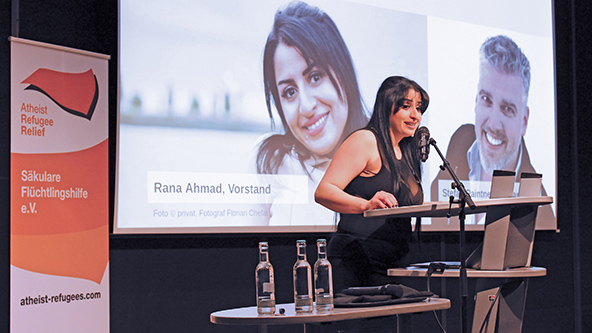
 Rana Ahmad, Atheist Refugee Relief cofounder, speaks at an event in Cologne, Germany, in February 2020. (Photo courtesy of Säkulare Flüchtlingshilfe E.V., Atheist Refugee Relief)
When Worood Zuhair renounced Islam, her brother threatened to kill her. “I knew he would do it,” she says; he had beaten her so badly once before that she suffered a broken back. “So I fled.”
Zuhair left her home in Karbala, Iraq, in May 2015. She hid for months in shelter homes in Turkey and, later, in Portugal, but they provided no solace because she was surrounded by Muslims who harassed and threatened her.
In February 2016, a friend told her about Rana Ahmad, a Saudi Arabian refugee residing in Germany who has dedicated her life to helping ex-Muslims forced to flee their homes.
“I sent a message to Rana and asked for help,” Zuhair says. Ahmad quickly booked train tickets for Zuhair to travel from Porto, Portugal, to Cologne, Germany. Zuhair has lived there as a refugee since September 2016. The 33-year-old biologist knows she never would have made it without Ahmad’s help.
Approximately a year after helping Zuhair, in November 2017, Ahmad cofounded the nonprofit Säkulare Flüchtlingshilfe—Atheist Refugee Relief (ARR)—with, Stefan Paintner and Dittmar Steiner, two Cologne-based Germans who she had met through her activism. The Cologne-based NGO now has several outposts throughout the country—in Hamburg, Stuttgart, and Munich—as well as in Vienna, Austria, and has assisted more than 70 refugees from 15 countries to find sanctuary in Europe.
Atheists are a small but rapidly growing minority among refugees from Islamic countries who migrate to Europe. Hundreds of people like Zuhair flee their home countries for fear of persecution from family and prosecution from the government. Twelve Islamic countries, including Zuhair’s home country of Iraq, punish apostasy by death; capital punishment is meted out for blasphemy in six others, according to the 2019 “Freedom of Thought” report by the NGO Humanists International.
But problems don’t end for ex-Muslims once they arrive in Europe. If their atheism is discovered in refugee camps, they risk torture and assault by other Muslim co-dwellers. Most live in constant fear of being found and murdered if information leaks about their whereabouts to their family or embassy.
Ahmad has experienced these forms of violence. In 2015, she fled Riyadh, Saudi Arabia, to escape both her fundamentalist Muslim family and Islam’s suppression of women’s rights. The 35-year-old arrived in Germany at the end of 2015, only to spend her first six months in a refugee camp near the outskirts of Cologne being repeatedly harassed by fellow Muslim women for not offering daily prayers or fasting during Ramadan. One day, a Muslim woman assaulted her for being dressed in shorts and a T-shirt. “I was really angry,” Ahmad says. “I knew that I didn’t run away 6,000 kilometers to be with the same people again.”
In the weeks that followed, she reached out to Mina Ahadi, an ex-Muslim Iranian activist and the founder of the Central Council of Ex-Muslims, which works primarily with Iranian atheists and is focused on improving human rights conditions in Iran. Ahadi offered Ahmad a public platform to talk about her experience; it was at this event that Paintner heard Ahmad’s speech and later offered to rent out his vacant flat to her so she could move out of the hostile camp.
Building Community
While Ahmad was fortunate to have had people to help her, she found Germans to be largely ignorant about the difficulties experienced by atheist refugees. Outside of Ahadi’s organization, no one was assisting ex-Muslim newcomers from diverse countries who wanted to make Germany their home.
Missing a “reliable network and community” for ex-Muslim asylum seekers in Germany, Ahmad decided to make one. She found a like-minded friend in Paintner, who says he was “keen to do something for the refugees” after more than a million of them arrived in Germany in 2015.
Paintner is a human rights activist and a supporter of the humanist foundation Giordano Bruno Stiftung (GBS), where he met Steiner, a computer programmer. The two had discussed finding a way to help nonreligious refugees. Meeting Ahmad gave them direction about what they could do.
“On meeting Rana, I realized how easy it was for me to be an atheist in Germany and how dangerous for someone who renounces Islam,” Paintner recalls. “Rana opened the doors to ex-Muslim networks in Islamic countries, making it easy to connect with those who need such an organization.”
By the end of 2017, the trio had already offered assistance to seven or eight people, including Zuhair. They used their own money to support more refugees with food, shelter, and paperwork for the integration process.
Around this time, GBS was discussing the need for a relief organization dedicated to atheist refugees. When GBS witnessed the work of Ahmad, Steiner, and Paintner, it decided to invest 10,000 euros ($12,000 USD) in their effort—which secured the initial funding necessary to register and launch ARR as an NGO.
“Refugee aid in Germany is largely determined by religious organizations that lack a sense of what it means to live as a secular person in religiously dominated groups,” Michael Schmidt-Salomon, the chairman of GBS, says. “For this reason, they are often unable to deal adequately with the trauma of nonreligious refugees.”
Currently, ARR relies on the volunteer work of their 76 members, 43 of whom pay a voluntary minimum annual membership fee of 60 euros ($70 USD). Donations from GBS, the Berlin-based organization House of Resources, and individuals cover the remainder of ARR’s average yearly expense budget, which ranges between 20,000 and 40,000 euros ($24,000 and $47,000 USD).
Death Threats
ARR’s work begins when they are approached by an asylum seeker. The nonprofit assists with navigating the bureaucratic process—a tremendous challenge for these individuals because apostasy is not easily accepted as a valid reason for asylum by the authorities at the German Federal Office for Migration and Refugees (BAMF), especially if the asylum seeker’s home country is considered safe, or if the authorities cannot see a severe threat to the individual’s life or human rights.
“We have found that BAMF authorities are not well informed about the consequences of abandoning religion in all Islamic countries, probably because apostasy cases presented to them are rare,” Paintner says.
The interpreters at BAMF, therefore, play a crucial role in conveying asylum seekers’ stories with authenticity and conviction. However, a few atheist refugees have complained to ARR about Muslim interpreters fudging facts, due to conflict of religious interest. “When I read the German transcript of one refugee’s BAMF interview I was present for, I found that the interpreter had left out important pieces of conversation,” Paintner says. Non-Muslim interpreters are now on ARR’s request list of accommodations for atheist refugees to BAMF.
Yahya Mustafa Ekhou, who fled the Islamic Republic of Mauritania, has been struggling to get asylum in Germany for more than two years. He even hopes that the recent fatwa issued against him—which grants permission to every Muslim in his country to kill him—might help his case.
“[ARR] has explained my case to my lawyer and updates him on new developments to make it stronger, like how I recently lost my nationality due to the fatwa,” Ekhou says. ARR provides lawyers with information about why atheism is credible grounds for asylum and informs refugees about German law.
The nonprofit also submits an endorsement letter to strengthen an asylum seeker’s application to BAMF. “We then keep following up on applications’ statuses, so that the authorities know someone is watching over them,” Paintner adds.
For Ekhou, the biggest assistance from ARR came when he was attacked at a refugee camp in early 2020. Paintner requested the camp’s authorities to grant Ekhou permission to move out. Then, Paintner found Ekhou a place to stay with an ARR member; it took almost four months for Ekhou to find safe shelter because relocation is not an option without special permission for those in the asylum process.
Ekhou’s attack is not unique, and ARR has been in discussions with authorities about changing policy to ease movement restrictions for those who are at risk from other refugees in the camp.
“We have been requesting the migration authorities to stagger ex-Muslim asylum seekers to different parts of the country for their safety, instead of clubbing them together with their own country folk,” Paintner explains.
Once asylum seekers are out of camps, ARR requests that the police protect their personal information in order to prevent their families, their embassy, or Islamic militia from finding them.
This measure is especially necessary for those refugees who have gained prominence as activists. For instance, Zuhair gives talks across the country and is very active on social media to educate Iraqis about religious suppression and misogyny. Consequently, she receives hundreds of death threats a day. ARR has helped her and other activists like her by securing each one an assigned police official they can call if they need help.
ARR also assists atheist asylum seekers in other small but significant ways. Team members join them on their appointments to secure proper documentation, connect them to doctors and therapists, find them integration courses, and assist them with home rental applications.
“It’s a relief to know that someone has my back if something happens,” says Mohamed Nofal, an atheist asylum seeker from Egypt. ARR gifted him a laptop when he arrived in Germany, since he couldn’t afford one.
The COVID-19 pandemic has slowed down relocations of refugees, Paintner notes. Also, there have been no arrivals of new refugees in recent months due to movement restrictions.
Despite the pandemic, ARR has promising funding leads, which may come through by mid-2021 and boost their operations throughout Germany. “With more finances there would be paid jobs, training for BAMF authorities, camps, politicians, and ministries,” Steiner says. Educating the decision makers would advance the organization’s efforts toward their goals of validating atheism as a reason for asylum and of formulating safety policies for secular refugees.
“As we grow a more diverse society, we have to work on how we can live together,” Paintner says.
Read more stories by Priti Salian.