


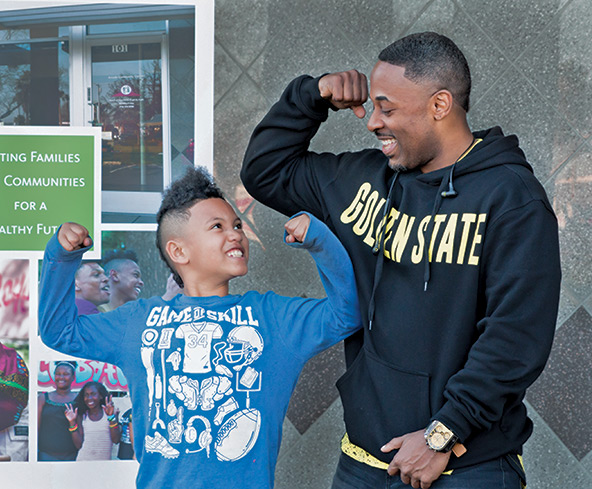
 Latrell Ludd, Jr., and Latrell Ludd, Sr., are community members working for the Black Child Legacy Campaign. (Photo courtesy of Black Child Legacy Campaign)
On June 9, 2016, 19-year-old Deston “Nutter” Garrett was shot in his home in the Oak Park neighborhood of Sacramento, California. He had a friend over, and they got into a fight over a YouTube video.
“Nutter thought of this friend as a big brother, and I thought of him as my son,” says Garrett’s mother, Tanya Bean-Garrett. “It was an argument that went bad, and my son got the worst end of it.” Nutter died two days later in the hospital. He was one of eight teens killed by homicide that year—and one of 114 teens killed by homicide between 2007 and 2017—in Sacramento County.
Beginning in 2018, however, the trend shifted. For two years—until January 2020, when a 16 year old was shot and killed in West Sacramento—there were zero youth homicides in Sacramento County.
The credit for this change goes to a coalition that has prioritized Sacramento’s seven most disenfranchised neighborhoods—Arden-Arcade, Oak Park, Del Paso Heights/North Sacramento, North Highlands/Foothill Farms, Fruitridge/Stockton, Meadowview, and Valley Hi. The coalition includes Sierra Health Foundation, the city of Sacramento, and a consortium of Black Child Legacy Campaign (BCLC) partners, which have worked together to decrease community violence through intervention, education, and a variety of programs.
Leading this coalition is BCLC, a community-based movement with the goal to reduce the death of black children by 10 to 20 percent in Sacramento County by 2020. Established in 2013 by the Steering Committee on Reduction of African American Child Deaths and managed by the Sierra Health Foundation, BCLC focuses on four factors that disproportionately cause the death of black children: perinatal conditions, infant sleep death, child abuse and neglect, and third-party homicides.
Arguably BCLC’s greatest success is its effort to eradicate youth homicides in those seven neighborhoods through its initiative, Healing the Hood. Since its launch in July 2018, after a previous year of terrible violence, Healing the Hood has served approximately 105 high-risk youth to safeguard them against violence by helping them create pathways toward a better life.
“Those gun violence homicides rip the soul out of a community,” BCLC’s project director, Kindra Montgomery-Block says. “So we had to pivot quickly to design a strategy that got deep in neighborhoods and aligned us with some of the work that was already going on there that was good.”
A Community Intervention
In 2017, the Sierra Health Foundation Center—the nonprofit arm of the Sierra Health Foundation—applied for funding to allocate more resources into community violence prevention, which would operate through a new initiative: the Healing the Hood program.
Significant funding came from the California Board of State and Community Corrections (BSCC). It awards California Violence Intervention and Prevention (CalVIP) grants to community-based organizations in cities that are disproportionately impacted by violence. The Sierra Health Foundation applied for and received the maximum amount ($500,000) from BSCC to create Healing the Hood.
“BCLC has the county dollars, which are $1.5 million a year over the past five years. [The] CalVIP was a $500,000 grant, and it’s a 1:1 match,” Montgomery-Block explains. “So, we used the big umbrella grant to support this new gang violence intervention prevention work.”
The success in eliminating black youth homicides in this two-year time period rested with individuals from the neighborhoods who could liaise as community intervention workers (CIWs)—people like Bean-Garrett who know this kind of violence firsthand.
“There are many things that we’ve done, but nothing more important than our community intervention workers,” says Montgomery-Block.
The CIWs are the linchpins of the program. They are “folks who have real walkabout [or credibility] in communities and the trust and respect of folks who are challenging to be comfortable around,” explains President and CEO of the Sierra Health Foundation Chet Hewitt.
As an essential part of Healing the Hood, they lead neighborhood programs and services that include job training, programs for students who have gotten into trouble at school, community service, case management, and mentoring, in addition to a host of other initiatives. Hewitt says it’s the combination of training and the CIWs’ lived experience and knowledge that encourages the youth to place trust in the program and take advantage of its offerings.
To identify which young people could most benefit from their services, BCLC received referrals from a host of sources, including law enforcement and schools. Some of the young people who are hardest to reach—in terms of connection and trust—are then managed by “a cultural broker of sorts,” Montgomery-Block says. “Someone who has a lived experience, a community message,” who can serve as a kind of mentor to guide youth through the program’s offerings.
To strengthen the potential of reaching youth, Healing the Hood established what they called “outstations”—or field offices—in these seven neighborhoods. These offices are staffed by individuals ready to help youth in need—including probation officers, eligibility workers, child protective services social workers, nurses, pregnancy coaches, and an employment training agency. “It’s about putting everybody’s hands around a young person and figuring out ways to create pathways for success,” explains Montgomery-Block.
Bean-Garrett remembers a time when her neighborhood was safe, and the lines that stratify the community—mostly drawn by gangs—didn’t exist. “We used to be able to go to different neighborhoods and different school dances,” she says. “They can’t have anything like that now because of the territorialism.” She’s hopeful that the work BCLC is doing will help not just curb the violence now but pave the road to a brighter and safer future. “With [BCLC] we can bring these different communities and these different youths together,” she adds. “And what happens [is] when they know each other, they’re going to ask, ‘Why do we have to be at war with one another? That’s that kid who was at that softball game.’”
Hewitt knows the importance of people like Bean-Garrett to the successful curtailing of youth homicide numbers. “One of our elected officials said, ‘Oh, it’s good luck and police suppression,’ and I’ll tell you that’s not what it’s been,” Hewitt says. “It’s been a combination of interventions that aren’t just focused on reducing gun violence—clearly that’s an important part, but we are focused on getting people a sense of self efficacy and a pathway to thrive.”
Bean-Garrett underscores that point and articulates the root causes of it: “These are kids that have no life; they come to school to get a life. These are kids that might not have a meal all weekend; these are kids who might know someone who got killed; these are kids who might be dealing with some domestic violence issues. If we fail these kids,” she says, “who do they have?”
New Challenges, Same Goal
With Healing the Hood’s 2020 goal achieved just as the first round of CalVIP funding concludes, Hewitt and his team are now in the process of reapplying for the CalVIP grant, as well as applying for other grants.
“We’re hoping the data speaks for itself,” Hewitt says of the promise for a second CalVIP grant. “But hope is not a strategy. We are planning, given our success, that this is what will actually happen. But if not, we are going to go back to our philanthropies and show them what we were able to achieve. We’re going to go back to the cities, we’re going to go back to the counties, the folks that have partnered with us, and encourage them to do more funding as well.”
BCLC was originally only a five-year financial commitment from the county, and under normal circumstances, the organization would have needed to reapply in March. Due to COVID-19, however, BCLC was granted a one-year continuance, which has been extremely helpful to sustaining their work.
With the arrival of COVID-19, a new set of problems has emerged in Sacramento that the Sierra Health Foundation and BCLC are trying to solve. “The BCLC network is providing crisis response to vulnerable families and youth,” Montgomery-Block says of the changes made to navigate their broader Sacramento community through the pandemic. “Everyone has turned into crisis responders in major ways at this point.”
“The communities that we’ve been focused on where issues were very challenging and worrisome have now become acute,” Hewitt explains. “The issues related to health indicators—things like asthma rates and diabetes and hypertension, which all find their sociological impetus stemming from poor housing, poor air quality, sometimes unusual density within households because families are sharing spaces—they’ve made COVID-19 even more effective as an agent of both morbidity and mortality.”
Operationally, for staff and volunteers it is now all hands on deck to help with emergency aid and funding to service BCLC’s community. The Sierra Health Foundation is focusing largely on providing food and cash aid. “We have launched three funds: Donate4Sacramento, Donate4NorCal, San Joaquin Valley Health Fund,” Hewitt says. “We’ve raised now close to $5 million that we have put in the hands of families. We’re working with United Way and have transferred some of the resources we raised to them, and they’re making $400 payments to over 200 families. We’ve restocked food banks so that we are buying food boxes that will be able to feed 2,000 families a week for the next eight weeks.” The organization is also focusing on helping immigrant populations who are not eligible for federal assistance programs.
Despite the turmoil brought on by the pandemic, there have only been two youth homicides in Sacramento County in a span of two and a half years, even as opportunities for in-person aid have diminished. Young people being case managed before the coronavirus hit are still being managed, and the CIWs are still working. “The goal remains the same,” Montgomery-Block says, regardless of the pandemic. “Stop youth gun violence deaths. No gun violence youth deaths equals success.”
Read more stories by Elena Sheppard.