


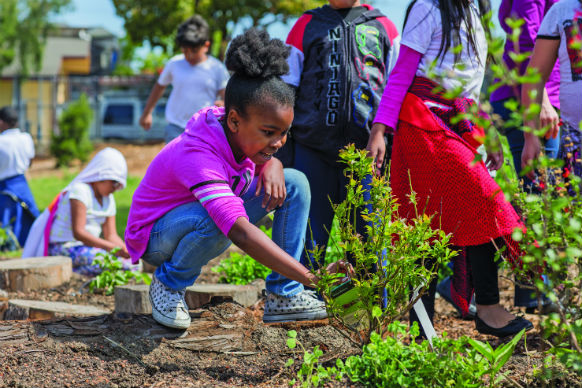
 Students at Hoover
Elementary School in Oakland,
California, tend to their
school garden, help to water,
and look for insects (Photograph by Paige Green)
Students at Hoover
Elementary School in Oakland,
California, tend to their
school garden, help to water,
and look for insects (Photograph by Paige Green)
What are we growing in our garden?” Wanda Stewart asks a class of third graders at Hoover Elementary School in Oakland, California. The room erupts with a garden medley: “Watermelon!” “Cherries!” “Spinach!” “Eggplant!” Then someone yells, “Mangoes!” and Stewart, Hoover’s gardening teacher, holds up her hand. “Can we grow mangoes in California?” she asks. “Mangoes need to grow in a really hot place, like Central America or Mexico.” Someone else yells, “Sacramento!” and Stewart pauses. “Maybe in Sacramento,” she considers. A twinkly-eyed eight-year-old shares that his favorite place to read is in the garden, adding that he tried making a Hoover-grown eggplant-and-strawberry smoothie in the school’s outdoor kitchen, but that “it didn’t taste very good.”
Hoover may not grow mangoes, but it devotes 5,600 square feet to the cultivation of at least 50 different kinds of fruits, vegetables, herbs, bushes, and fruit trees. Even though it’s a cash-strapped inner-city school, its garden yields enough organic produce to merit inclusion in West Oakland’s farmers’ market.
Sharon Danks looks to Hoover as a model for other K-12 schools. Danks is the founder and executive director of Green Schoolyards America, a Berkeley, California-based, nonprofit that seeks to expand and strengthen the green schoolyard movement currently flourishing in cities such as Tokyo and Berlin and beginning to take root in the United States. The idea is to transform schoolyards from a 1940s-era asphalt-and-grass model to ecologically diverse landscapes that connect nature and environmental sustainability with place-based, hands-on learning while building community and democratic participation.
“The goal of Green Schoolyards America is to use school land to improve the well-being of children and the environment at the same time,” Danks explains. “We’re equally interested in outcomes for children’s learning and health and social-emotional well-being as we are in watersheds, habitats, air quality, and climate change.” Ultimately, the green schoolyards movement is about modeling ecologically rich cities of the future that we might like to live in and, in the process, restoring our relationship with the natural world.
The Politics of Equity
The gold standard for schoolyards in the United States, especially in urban areas, is a play structure grounded in cement or rubber, encircled by a fence to keep students on one side and community members on the other. Danks sees this template as a problem on many levels. “If something is not funded enough, it’s easier just to lock it up,” she says, pointing out that many schools resemble prisons because asphalt and chain-link fencing are inexpensive and low maintenance. “But in an ideal world, the public cares about public space. … There is an underlying citizen-participation philosophy in planning for a green schoolyard.”
This philosophy conceives of school land as a community resource. Instead of expecting school districts to try to manage all their land without the requisite resources, the community assumes stewardship of the land and decides what should be planted and where, and in turn creates an infrastructure capable of evolving over time to meet the community’s needs and desires. The children also have decision-making power, which effectively deepens their knowledge about their own environment. For Danks, this empowerment is an antidote to a culture in which “environmental issues are so negative and the way they’re portrayed can be scary for kids.”
Indeed, Hoover’s garden is a communal effort. Members of a nearby church, students from the University of California, Berkeley, local nonprofits, and a few national brands have contributed money, tools, and sweat to the garden. And the garden gives back. “No one who works in the garden goes home empty-handed,” says Stewart, who adds that they feed anyone who walks by, especially the local homeless population.
A growing body of research indicates that having access to green space at school has a direct impact on student achievement. Research by William Sullivan, a professor and head of the landscape architecture department at the University of Illinois, shows a correlation between urban design and well-being. One of his projects involved giving high school kids mentally fatiguing tests in one of three environments: a room with no windows, a room with a view of a “built space” but no vegetation, and a room with a view of vegetation. In the room with no windows, the students reported the highest stress and made the most errors on the tests, while kids in the room with the view of trees reported the lowest stress and made the fewest errors.
Marcella Raney and Bevin Ashenmiller, both professors at Occidental College and members of Green Schoolyards America’s collaborating research team, examine which schoolyard design features decrease surface temperature and pollution levels; for example, schoolyards covered with soil, rather than cement, absorb rainwater and thus help keep school grounds cooler while improving the watershed. Raney and Ashenmiller also study what features might promote physical activity for children in poor areas. “In urban low-income neighborhoods, children have very few opportunities to engage in physical activity outside the school campus,” Raney observes. “Fortunately, substantial green schoolyard programs are under way and large-scale investments in school-ground transformations are accelerating.”
Schoolyards are a vast resource that most communities have barely begun to tap, Danks says. Despite its ubiquity, the exact amount of land public schools occupy is unknown—even to city planners. “Cities are essentially planning with gaping holes in their maps where all the schools are,” Danks notes. “They’re not talking to the schools about it, because the land belongs to the schools.”
Danks emphasizes that this movement is hardly the sole domain of schools and their local communities. Broad impact requires buy-in not only from local school districts but also from the county and state. She has devoted a good portion of the past 20 years to figuring out what’s needed to shift the norms of school-ground design and use, and to building a “partner network” of the people required to enact policy change.
Green Schoolyards America has been working across school, city, and state levels to make this movement happen. For example, it started a Principals’ Institute in 2016 to provide professional development for principals to adopt and sustain green schoolyard programs, and to encourage the integration of schoolyards into lesson planning. Danks is also forging partnerships with the Trust for Public Land and school districts like Oakland Unified to assist them in framing their school grounds as land that can help mitigate the impact of global warming and thus qualify for climate-related funds.
Which brings us to the elephant in the room: How can a public-school system pay for this? Danks concedes it’s not cheap—$150,000 currently equals about a quarter acre of redesign per schoolyard—but indicates that the money is there, just in the wrong “silos.” “Water agencies are trying to protect the watershed, but they don’t have the land, and schools have the land but no money. So how do we match those two needs to have water agencies unpave the ground to improve the watershed?” Danks asks. There are urban-greening grant programs and, at a state level, a billion or so dollars of cap-and-trade money to potentially tap as well.
“We need to think about this as park planning and apply infrastructure-scale budgets that we would normally apply to a park or a stormwater project,” Danks says, adding that meeting this infrastructure need “could be designed in a way to benefit children.”
Forging Connections Around the World
Danks cofounded another nonprofit, called the International School Grounds Alliance (ISGA), which works to enrich children’s learning and play by improving the design and use of school grounds. She was inspired to form ISGA after traveling to different countries to visit green schoolyards as part of her master’s thesis research. The results of those travels are now printed in an annually updated guide, to which schools around the world contribute ideas for outdoor educational projects.
Birgit Teichmann, a Berlin-based landscape architect and engineer who is also part of the ISGA, credits Danks with turning it into an international effort. “It’s a big movement and very different in different countries, but, in the end, many people are very concerned about their cities and are into the same idea,” Teichmann explains. She describes Berlin as a model for other cities: Twenty-five years ago, all of Berlin’s school grounds were paved, but now, thanks to a law that says that any rainwater diverted to a public pipe needs to be paid for, 60 to 70 percent of school grounds have been unpaved and transformed into “green play landscapes.”
There’s also a US-specific edition featuring schools across America, one of which is Golestan Education, a Berkeley-based private school that Ashoka recognized as a “changemaker” school in 2016. Golestan cofounder and executive director Yalda Modabber participated in Green Schoolyards America’s 2016 Principals’ Institute, which, she says, “helped us realize how regulated and inhibited the educational system is in this country. Things that are basic to our programming and school environment are not the standard at other schools.”
Golestan is in the process of scaling up to a larger facility, a former Catholic school that needs a lot of work to transform it from 18,000 square feet of concrete “without a single tree” to a lush landscape. Modabber, who used some of what she learned at the Principals’ Institute to redesign Golestan’s school grounds, is eager to begin this work.
“Kids need to feel nurtured and loved and respected and cared for,” she says. “If you create an environment that reflects that, then they are more likely to feel that way and can pay it forward to other people.”
Read more stories by Adrienne Day.