


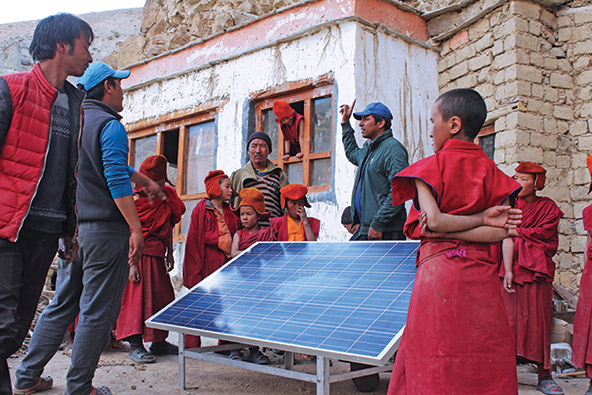
 Global Himalayan Expedition Founder Paras Loomba and Phugtal Monastery monks set up a solar grid in Ladakh, India. (Photo courtesy of Global Himalayan Expedition)
As Tsewang Dorje grew up without electricity in the remote Himalayan village of Maan, his life revolved around sunlight. He studied until sunset and went to bed by 9 p.m. By the time he was an adult, lack of electricity limited his options. Young people like 29-year-old Dorje usually migrate to urban centers to earn a living.
For those who stay in Maan and similarly remote villages, lack of access to reliable light and basic power sources does not just constrict lives. The kerosene oil—a fossil fuel—they burn in lamps contributes to global warming and causes health problems.
However, fortunes changed for Maan in March 2019 when 10 international travelers on a trip with Global Himalayan Expedition (GHE) came and installed 35 solar nano-grids—one for each household. “We used to have very little light in our village,” Dorje says. “Getting electricity was a blessing for us.”
Founded by entrepreneur Paras Loomba in August 2013, GHE leverages tourism to electrify remote villages in India’s mountainous Ladakh region and equip education centers with solar-powered electricity, low-powered computers, and online educational resources, as well as school-specific, customized content stored on offline servers. An electrical engineer, Loomba had been searching for a way to use technology to promote sustainability. He found his answer on a 2012 trip to Antarctica with the polar explorer and environmental ambassador Robert Swan. That journey to Earth’s remotest continent made him realize that he could combine his professional skills with tourism to mitigate climate change by delivering clean energy to Himalayan communities.
Loomba launched GHE’s first expedition in Leh, Ladakh’s largest city, in 2013 with Swan’s help. The explorer lent his credibility to the mission, helped recruit volunteers who paid for the trip, and participated in part of it. On the two-week expedition, 20 people from nine countries built a technology and sustainability education center made of sustainable natural materials and powered by solar panels. They also trekked to the village of Sumda Chenmo to provide and install solar lanterns. Thanks to the effort of a second trip in 2014 by 20 new travelers, the village was fully electrified. With the lights on in Sumda Chenmo, news about GHE’s successful electrification mission quickly spread across the region.
From Idea to Investment
In its first year, GHE generated a list of potential villages to electrify based on suggestions from the company’s trip leaders and other experts. Before launching a trek, the for-profit social enterprise sends a representative to a village to survey its electrification needs, as well as interest and ability in maintaining a power source. “Once you physically go to a village, you can mobilize the community and create awareness,” Loomba says. Establishing trust with villagers—some of whom have never used electricity—is essential to the start of each mission. “Giving light and electricity is one thing, but you also need to have the understanding in the community to accept it,” Loomba explains. “It’s 95 percent social mobilization and 5 percent technology.”
Once villagers approve a proposal to adopt solar installation, GHE puts together a tour; fees are based on specific destinations and the cost of the village’s hardware needs. This includes a combination of micro-, nano-, and pico-grids; two years’ worth of maintenance; assorted costs affiliated with upkeep and training; and tour services for a trip based on 20 people. If that 20-person quota isn’t filled, GHE turns to funding and grants from a variety of corporations (through corporate social responsibility commitments), philanthropic organizations, and foundations.
Since 2015, IEEE Smart Village, an organization supporting energy-impoverished communities, has helped fund GHE’s electrification model with hardware support. “There are three pillars in our program—electrification, education, and enterprise development—that GHE also sees as critical to the success in what we’re trying to do,” says Mike Wilson, senior program manager for IEEE Smart Village.
The profitability of tourism—increasing worldwide, until the COVID-19 pandemic hit—attracted investors to the project. “We were looking to tread into waters which weren’t saturated either in terms of funding or other support from the corporate world,” says Vikrant Kalra, who met Loomba and learned about GHE when he worked in India with Aon, a professional services firm that supports GHE, in 2017.
Aon’s leadership was interested in GHE’s sustainable model of providing electrification, digital education access, and training through tourism, which can lead to income-generating opportunities through additional tourism offerings. “The fact that GHE was collaborating to put these villages on the ecotourism map was the clincher for us,” Kalra says.
The tourism component not only helps fund the organization but also leaves a lasting impression on the travelers. “You can make a big impact if you think simple and you think small,” says Rolf Palgaard, a Dane who traveled with GHE in 2014. Palgaard subsequently served as a team leader on treks from 2015 to 2018 and continues to serve as an ambassador for the company. Travelers like Palgaard have helped GHE electrify more than 100 villages in Ladakh, all of which had no grid-based electricity.
“We don’t just give them light. We give them electricity,” Loomba says. “Light is just one bulb. Electricity means you not only have a light bulb in every room, but you also have street light, you have electricity to run a television.” In electrified communities, productivity and sociability increase; people can work more hours, study later into the evening, and watch television together.
More Than Light
Electrification has also enhanced daily life in Ladakh’s remote villages, whose residents have enjoyed greater employment and higher incomes. In addition to electrifying villages, GHE created service centers that employ locals who GHE trains to become solar engineers and who can then maintain the solar panels. Localizing this skill set ensures that installation and operation are sustainable.
“These microgrids have been in the communities for more than five, six, seven years now, and they are still running because the community owns them,” says Vilayat Ali, who grew up in Ladakh. Ali, who runs a regional tour company, notes that he’s seen similar projects in the region fail when outside organizations donated products to communities without providing the training necessary to maintain them. “[GHE] wants to revive the local economy and community, which can be lost in the race for development,” he says.
In 2017, GHE helped establish Mountain Homestays, a community tourism initiative that invites travelers to stay in locals’ homes within GHE-electrified communities. “The financial model is unique in that there’s no way that the local villagers can pay for the electricity themselves,” Wilson says. The villagers’ traditional sources of income—such as agriculture—are limited due to terrain and climate, but electrifying villages meets travelers’ needs in the region while also providing a new opportunity for cash flow. Last year, 1,440 tourists took part in the program, injecting financial resources into communities that didn’t have economic stimulus from tourism prior to electrification.
This entrepreneurial venture also gave youth a reason to stay or return to their home villages. “The idea of migration, which was initially happening because there were no jobs and no basic infrastructure, started reversing because tourism started helping these homestay owners with money, and this money is coming back and helping [the youth] earn income,” Loomba says. “Light is a basic human right, and with light, [villagers] are able to compel the youth to come back as well.”
Capitalizing on the homestays, these youth have launched their own ventures, such as selling gifts and providing transportation to travelers. “The youth used to go to Leh to work as guides, helpers, or cooks, and now they can earn enough money with the homestay,” Dorje says. In Maan, Dorje and four women now offer astro-tourism experiences to show off the Himalayas’ night sky.
Focusing on one region has allowed GHE to perfect its model, from energy access and mobilizing communities to setting up homestays. Yet Loomba is eager to scale the social enterprise beyond Ladakh. With materials and knowledge transferred to Ladakh’s locals, GHE is considering expanding to other places that need electrification, including other regions in northeast India, Nepal, and Indonesia.
“We are using energy access as a tool to create new tourism destinations that local tourism operators can use,” Loomba says. Palgaard adds that scaling the company so that more travelers can participate also requires making it more affordable. However, greater affordability widens the potential demographic, raising some concern: “You need people who are not just seeing this as adventurism but [who are] actually passionate about [GHE’s mission],” Palgaard explains.
The pandemic could positively impact GHE’s mission, Palgaard suggests, because it may make people more mindful about how their actions affect others. Now, he says, “we think a little bit harder about the need to travel, and, if we do, does it have a purpose? Or are we just doing it for ourselves? Here, GHE might be in a good position.”
Despite the coronavirus lockdown, the company hasn’t slowed down. Even though GHE has postponed most expeditions until 2021 (the Women Leaders Expedition, a women-only expedition, is tentatively scheduled for October 2020), it continues to support electrified villages. It provides this support in two main ways: by strengthening their infrastructure and providing them with essential medical instruments and standard operating procedures for homestays, so that when tourism picks up again, these areas are not vulnerable to infection.
GHE has provided more than 55,000 people in India’s remote villages with light, electricity, access to digital education, income generation, and—for people like Dorje—a reason to return home. “Many youth in the village are inspired by this,” Dorje says. “We are confident when we talk with the tourists. We are meeting people from every corner of the world.” GHE has made this possible, one traveler at a time.
Read more stories by Joanna Haugen.