


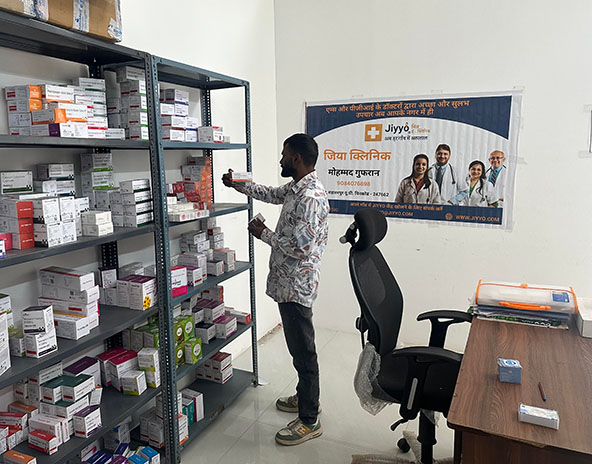
 Mohammed Gufran is a pharmacist and Jiyyo Health Partner from Chhutmalpur Town in the Saharanpur District of Uttar Pradesh. (Image and identity details published with consent)
Ashok (name changed for anonymity), an 8-year-old boy from a remote town in Jharkhand, India, had a set of persistent symptoms. He felt nauseous all the time and refused to eat. His parents had taken him many times to see the local doctor, a general practitioner 20 miles away, but despite several drug injections, he showed no improvement. Eventually, during a visit to a nearby pharmacy, the family discovered they could consult with a gastroenterologist via a digital health platform, Jiyyo. The gastroenterologist diagnosed Ashok’s condition as a treatable form of viral hepatitis and prescribed oral medications that led to rapid improvement.
Meanwhile, Savita (name changed), a 35-year-old woman from Uttar Pradesh, India, suffered from chronic fatigue, as well as joint pain and swelling. She visited a hospital more than 500 miles away from her home but was not able to follow up owing to the distance. She then worked with a local, non-allopathic physician but experienced no improvements. Finally, at a pharmacy near her house, she consulted with a rheumatologist via Jiyyo. The rheumatologist diagnosed her with systemic lupus erythematosus, a chronic inflammatory disease that has no cure but can be managed with appropriate medicines. Savita has started her treatment and is already experiencing improvements. Through the platform, she is now in regular contact with the rheumatologist.
Difficulty accessing specialist health care isn’t unique to India; the problem is common in other South Asian, most African countries, and elsewhere. However, in India, a country with more than 1.4 billion people, 900 million (more than 60 percent) of whom live in rural areas, the problem is outsized. While government health care providers are present in most of these areas, service gaps such as stockouts of essential medicines and the absence of health care personnel force people to seek out alternatives.
At the same time, income inequalities in India are extreme. Recent analyses suggest that 10 percent of Indians residing, for the most part, in urban areas enjoy per-capita annual incomes close to 1.4 million Indian rupees ($17,500, equivalent to $70,000 in purchasing power terms). This allows them to access specialists even for routine care, including through telemedicine. Powerful platforms such as Practo, 1mg, PharmEasy, and DocOnline work well for predominantly urban patients who can connect and converse directly with remotely located doctors and specialists using their own digital tools.
However, the other 90 percent of people in India earn only about 100,000 Indian rupees ($1,250), with most living in rural areas. This makes rural India a thin, unviable market for organized, private-sector health care providers to enter. Formally trained physicians also find the economics of operating in this market unattractive, even in their individual capacities. Consequently, untrained local providers offer much of the care. Evidence indicates that these local, informal care providers can provide a reasonable degree of primary care—for example, managing seasonal coughs and colds and even early stages of chronic diseases such as diabetes and hypertension. However, few real solutions to providing advanced treatments for low-income patients like Ashok and Savita are available.
The mobile Indian health care platform, Jiyyo Innovations (also known as Jiyyo Mitra e-Clinic), aims to fill this gap by taking a new, deeply collaborative approach to connecting medical specialists to patients who lack access to appropriate care.
Filling the Treatment Gap
In 2019, Siddharth Angrish and Avil Tyagi, two engineers with strong backgrounds in technology and operations, came together to create a new kind of medical service.
They observed that most well-intentioned telemedicine initiatives aimed at low-income populations in India did not sustain their initial momentum, principally because they failed to select an appropriate set of partners and did not recognize that attempting to bring patients to telemedicine services is far less effective than making services available in locations where patients already seek care.
Their travels through rural India also revealed that more than a million pharmacies dominated the informal health care market, operated even in the remotest of settlements, and already served large groups of patients. Most were content with their current scale of operations, but several were ambitious and wanted to grow their businesses by offering a wider range of services to their clients. Angrish and Tyagi recognized that: a) traditional approaches such as scorecards (rating potential partners according to parameters like academic qualifications, years in business, and financial skills) would not effectively pinpoint the pharmacies with the strongest desire and ability to scale, and b) given the sheer scale of the market, outreach using physical approaches would not be cost-effective. Instead, they determined to develop a new platform, as well as a plan to leverage India’s network of pharmacies for distribution that involved three main parts: identifying the right partners, building in sustainability from the start, and empowering their partners.
Identifying the Right Partners
First, to appeal to the partners that already had an existing flow of patients and were enthusiastic about engaging more deeply and broadening their services, Angrish and Tyagi built a set of products to offer pharmacies and providers such as nurses and practitioners of Indian systems of medicine (including Ayurveda, Siddha, and Unani)—a group they referred to collectively as Health Partners (HPs). The product’s approach, which had clearly defined offerings such as the Jiyyo app, was easy to understand and gave the HPs a clear sense of the potential value they could expect from a partnership with Jiyyo. The app and associated technologies were built by Jiyyo in-house and refined based on continuous feedback from the HPs.
From there, the Jiyyo team asked potential HPs to purchase the core product offering, Jiyyo Mitra E-Clinic in one of two variants, one priced at 35,000 Indian rupees ($400) and the other at 60,000 Indian rupees ($700). While both offer a standard set of benefits—including lifetime access to the Jiyyo telemedicine app, a dedicated pharmacist-HP relationship manager, and continuing medical education webinars—the higher-priced variant also includes a computer screen and printer to use with the app. A willingness and ability to make this small investment indicated which HPs were serious about using Jiyyo and interested in its further development. It also gave Jiyyo a standardized platform in each e-clinic to which partners could later add other devices, such as hand-held electrocardiogram machines and scanners, and having the product closely identifiable with its brand built consumer confidence and recognition.
Making It Sustainable From the Start
Recognizing it would take time to build up the network, the Jiyyo team prioritized financial sustainability by limiting its number of outreach points. Rather than spending money on billboards or television advertisements, they focused on making their offerings more visible to potential HPs through Facebook and YouTube—both of which have a deep presence across India, including rural areas. This reduced their cost of partner acquisition considerably and allowed them to engage with a large set of providers simultaneously.
Empowering Partners
Once the team identified the pharmacies and providers committed to using the platform, they worked hard to empower them. Because primary care in rural India has meagre per-patient revenues, many direct-to-patient telemedicine initiatives over-emphasize hospital referrals so that they can earn a portion of the income the hospital makes from treating the patient. By contrast, Jiyyo’s approach focuses on enhancing the capabilities of HPs and working with them to serve their patients effectively by offering both primary and specialist care at the HP’s location. During the onboarding process, Jiyyo’s online managers build and maintain close relationships with HPs, thus creating a pathway for continuous learning and knowledge exchange with each partner. Jiyyo also offers weekly webinars HPs can join, featuring experts on topics like lung disease, mood disorders, immunization, and maternal health.
Jiyyo also connects its HPs to a dedicated telemedicine network of general physicians and specialists, which the HPs can use to offer services to their patients. (The government of India's telemedicine guidelines legally enabled this during the COVID-19 pandemic.) Jiyyo’s network of physicians and clinical pharmacists are well-versed in the local vernacular so that HPs and their patients feel comfortable contacting them, and Jiyyo’s team of clinical pharmacists carefully monitor all consultations for call duration, proper documentation of patient health, the behavior of specialist providers, and the quality of prescriptions generated on the platform.
Impact and What Lies Ahead
This unique development process ultimately yielded a platform similar to RubiconMD (which gives US primary care providers remote access to specialists that they can, in turn, make available to their patients) and the University of New Mexico’s ECHO (which seeks to directly enhance the capabilities of the primary care providers while making sure that the specialists are available as needed).
Since Jiyyo began operations, about 1,500 HPs have acquired Jiyyo Mitra E-Clinic. Of these, 70 percent are formally certified as pharmacists, nurses, non-allopathic physicians, or registered medical practitioners. The platform now has a presence in more than 200 districts of India, with more than 90 percent of HPs located in the states of Bihar, Uttar Pradesh, Madhya Pradesh, Chhattisgarh, Rajasthan, and Jharkhand—the lowest-income Indian states with the least access to health care.
A recent snapshot from June to August 2024 showed that 604 of Jiyyo’s HPs performed at least one patient consultation during the three-month period, and together serve more than 4,500 monthly patients, more than 70 percent of whom have high-severity conditions. Of these HPs, most (283) have worked with Jiyyo for 2.5 to 3.5 years and about 10 new HPs joined the network monthly.
While growth is slow, Jiyyo is already financially sustainable, and aims to make its products and services visible to many more of the million-plus network of pharmacists and other potential HPs. If it succeeds, it will transform the nature of secondary care in rural India. Real-time, anonymized data from a robust network of this type could also prove useful for broader health care initiatives like national disease surveillance that serve all of India, including low-income patients in rural areas like Ashok and Savita.
Read more stories by Nachiket Mor.