


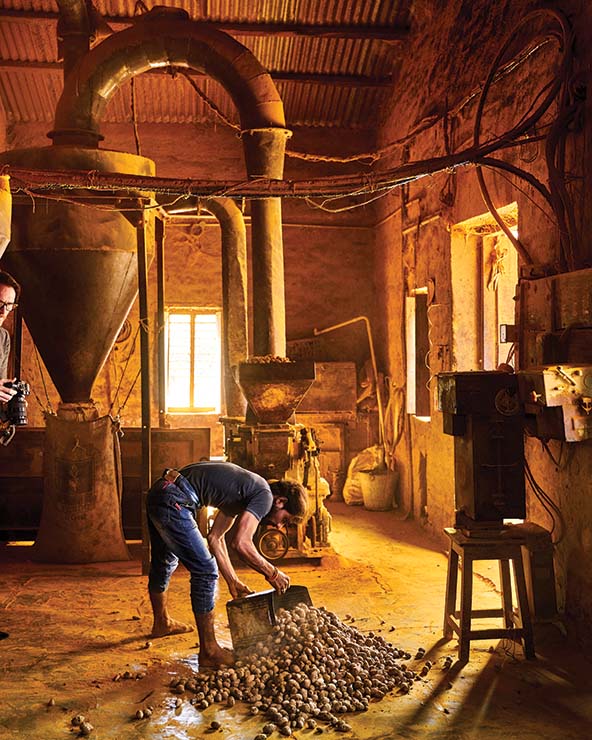
 A farmworker milling heirloom Pragati turmeric during the 2020 harvest at the Kasaraneni family farm in Vijayawada, Andhra Pradesh, a coastal region in southeast India. (Photo courtesy of Diaspora Co.)
For Sana Javeri Kadri, CEO and founder of Diaspora Co., it all started with a turmeric latte. Kadri was born and raised in Mumbai and moved to the United States for college in 2012. Living in the Bay Area in the 2010s, Kadri saw turmeric, a spice she knew from childhood, becoming a trend at cafés and health-food stores.
“I started seeing turmeric lattes everywhere,” Kadri recalls. “Something in the back of my head was like, ‘Who is growing the turmeric for all of these turmeric lattes? If these $8 turmeric lattes are all over San Francisco, is a farmer somewhere in South Asia benefiting from this?’”
Kadri returned to India in 2016, seeking answers to these questions. Her research led her to 19 farms across the country and deep into South Asia’s colonial-era archives. What she discovered led her to found Diaspora Co. the following year when she was just 23 years old. Today, the spice company is one of the most influential sustainably sourced and equity-focused brands on the market. Its first product was a single-origin turmeric.
Turmeric is native to South Asia, where it has been used in food and medicines for millennia. The same is true of other popular spices and aromatics, such as black pepper and nutmeg. These goods became coveted luxuries in West Asia, the Mediterranean, and parts of Europe as early as the fourth century, as seafaring merchants carried them across the Indian Ocean and western Pacific Rim. In the 15th century, European empires sent expeditions to South Asia that laid the groundwork for colonial empires, which enriched European regimes at the expense of Indigenous peoples for centuries. From the time that the British East India Company took control of trade from the Indian subcontinent in 1765 until 1938, Britain extracted an estimated $44.6 trillion from the territory, according to economist Utsa Patnaik.
Colonization in South Asia also shaped the development of the spice trade. When Kadri began visiting farms in India, she realized how little had changed. “One hundred and fifty years later, farmers are still making no money growing spices,” she says. Today, Indian farmers usually sell their spices to a trader through a local auction house. The product then changes hands several more times and gets mixed with spices from other farms before being exported and sold to retailers in the United States as a blend. Farmers receive only a negligible fraction of the final price of their product, and the individual characteristics of their spices are no longer discernable in the resulting spice blends. Plus, the blends end up on store shelves long after peak freshness has waned. This system leaves farmers with little incentive to grow a high-quality product. In another remnant of colonization, many farmers have turned away from ancestral and Indigenous knowledge about their lands and crops to the detriment of the spices and aromatics they produce, Kadri says.
In an industry where low wages for producers, convoluted supply chains, and stale spice blends are the norm, Kadri says, “there was the feeling of, ‘How can we completely reimagine that?’” Her answer was Diaspora Co.
Shaking Things Up
After returning to Oakland, California, in 2017 following her research trip to India, Kadri launched Diaspora Co. with $3,000 from her tax refund and a small loan from her father. That same year, in India, she founded Diaspora Trading, an export company to complement Diaspora Co. Having both a US-based import company and an India-based export company allowed Kadri to eliminate many of the links in the usual spice supply chain to benefit farmers and consumers. Diaspora Trading offers farmers premium prices, then exports spices to Diaspora Co., which sells to consumers. Sometimes, the company sells spices as little as two weeks after harvest.
The farmers that Diaspora Co. contracts with are paid an average of six times above the commodity price for their spices.
Once the companies were established, growing Diaspora Co. was a matter of scaling up from a single spice to the dozens it offers now. The company’s first product, heirloom Pragati turmeric, comes from the third-generation Kasaraneni family farm in Vijayawada, Andhra Pradesh, a coastal region in southeast India, which Kadri visited in 2016. When Diaspora Co. began selling the spice in 2017, it was the only product in its line. By 2019, Diaspora Co. had begun offering Baraka cardamom, Aranya black pepper, and Guntur Sannam chili, bringing its total product line to four spices. By 2022, the company’s inventory had skyrocketed to 40 spices and masalas sourced from 26 partner farms across India and Sri Lanka.
Diaspora Co. had a new funding model to thank for helping it make a tenfold jump in its product line in 2022. The company relied on a preorder model during its first five years, offering opportunities for customers to purchase spices before they had been harvested and wait for them to arrive. “People ultimately want to buy spices for next week, not for four months from now,” Kadri says.
To transition away from its preorder model, Diaspora Co. pursued impact-aligned investors who cared about its commitments to regenerative agriculture, farm partners, and unique and high-quality single-origin spices. One of its early supporters was Ben Jacobsen of Jacobsen Salt Co. (JSC), a Portland, Oregon-based company selling handmade finishing salts harvested from the Oregon coast. Ben Jacobsen, JSC’s founder, says he identified with Diaspora Co.’s mission. “The spice trade globally, throughout history, has been one of the most inequitable trades known to people, and so I found it interesting that Diaspora Co. was tackling that head-on,” he explains. JSC launched a turmeric popcorn seasoning using Diaspora Co. turmeric in 2022, making Diaspora Co. a JSC supplier.
Diaspora Co. closed a financing round of $1.37 million in 2022. Alongside Jacobsen, other like-minded investors include Gjelina Group, which operates the popular Los Angeles restaurants Gjusta and Gjelina. The cash infusion allowed the company to expand its supply chain, hire new team members, overhaul its product packaging, and launch in a limited number of grocery stores. The company also moved more of its processing tasks from Oakland to India to be closer to its partner farms.
Supporting the farms and farmworkers who tend and harvest Diaspora Co.’s spices and aromatics has always been central to the company’s mission. The successful funding round also allowed Kadri to launch the Farm Worker Fund, which uses earmarked profits to improve the health, education, and livelihoods of agricultural laborers on the company’s partner farms.
Meeting Stretch Goals
When Kadri looks back at the seven years she has led Diaspora Co., she is proud of the company’s rapid growth and steadfast commitment to its founding principles. The farmers that Diaspora Co. contracts with are paid an average of six times above the commodity price for their spices. The company also offers advances, allowing farmers to cover operational expenses without taking loans. With higher revenue and less debt, farmers can focus on growing for quality rather than quantity and practicing some of the regenerative agricultural methods that Diaspora Co. champions. Farmer Prabhu Kasaraneni has implemented cow-based farming on his pest-prone Pragati turmeric farm in Andhra Pradesh, utilizing cow by-products at different stages of plant growth to help control pests without chemical pesticides.
Still, Kadri says the company is only halfway to reaching the loftiest goals she set years ago. Her ideal spice trade is one where farmers and farmworkers are “paid what they need to thrive,” she says. The Farm Worker Fund facilitates that for the more than 1,000 laborers employed on Diaspora Co.’s partner farms.
Kumud Dadlani was hired to lead the Farm Worker Fund when it was established in 2022. “It was important for us to start from the ground up and not go simply by our understanding of what should be improved upon,” she wrote in a blog post about the fund’s first months. Dadlani partnered with researchers to survey and interview farmworkers about their needs in November 2022 before launching the fund’s first programs. Based on their feedback, in 2023 the fund provided financial literacy courses for farmworkers on three partner farms and a medical camp for Pragati turmeric farmworkers, where staff from a local hospital offered free medical and dental examinations and information.
To meet its goals on the consumer side, Diaspora Co. is focused on getting its spices to customers as fast as possible and fostering a better understanding of the products and their origins. Diaspora Co. products are currently on shelves in about 700 supermarkets nationwide, and the company plans to expand to a total of 1,800 stores by the end of 2025. The company is also building the infrastructure needed to accommodate more business-to-business bulk sales so that its products could feature in items on franchise restaurant menus or supermarket staples, such as granola or seasoned popcorn.
To help customers learn the origins of their spices, the Diaspora Co. team is compiling a book of recipes from its farm partners, showcasing how the spices are used in home-cooked dishes in India and Sri Lanka. “I think we have a [long way] to go on spices still culturally,” Kadri says. One day, with the right combination of transparency in the supply chain, direct trade, marketing, and education, Kadri believes consumers who pick up black pepper at the supermarket will think of the hills of Kerala along India’s Malabar Coast, where Indigenous peoples have harvested the native Malabar pepper for centuries.
Read more stories by Marianne Dhenin.