


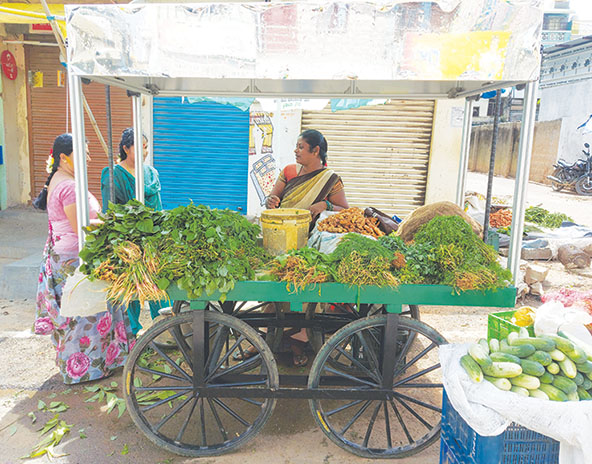
 Anuradha, who received a prototype of the cooling cart in September 2022, uses her cart to sell produce, in Kolar, India. (Photo courtesy of Trane Technologies)
Vegetable hawkers across urban India buy fresh produce in wholesale markets or from rural farmers to sell from a cart or the sidewalk. Unfortunately, a lot of their produce—up to 18 percent, especially in the summer and during monsoon seasons—spoils due to lack of cold storage. Furthermore, municipalities discourage makeshift methods to protect vending carts, such as tying plastic sheets supported by poles. “This leaves street vendors and their produce unprotected, [and] they suffer from ill health as well as loss of income,” says Arbind Singh, national coordinator at the National Association of Street Vendors of India.
Access to cold storage would extend the shelf life of produce, thereby reducing both food waste and lost inventory. However, since most vegetable hawkers earn less than $5 a day, they cannot afford conventional cooling devices like refrigerators and chillers.
Passive radiative cooling presents a solution to this problem, because it works without any energy input (electricity). Radiative cooling occurs when a surface reflects more solar heat than it receives. Passive radiative cooling occurs at night, when the incoming infrared radiation is less (because of the lack of sunshine) than the outgoing radiation to space. Since the universe is below -275 degrees Celsius, there is no limit to the radiative cooling possible.
Climate-solutions company Trane Technologies has utilized passive radiative cooling to develop a cooling cart for hawkers of perishable produce. “The cooling cart is a 6-foot-long and 4-foot-wide vending cart with a canopy made of aluminum topped with a reflective, thermally emissive film that can lower the temperature beneath by 10 degrees Celsius,” says Zubin Varghese, senior director for innovation at Trane Technologies.
Varghese’s concern about the coexisting challenges of food waste and hunger led him to propose the idea for a cooling cart in September 2021. The cart’s canopy was engineered with a slant to drain rainwater as well as to minimize the solar heat gain. It was also designed to be foldable, so that it could collapse to create a lockable box to store the produce at night. “We wanted the solution to be easy to use and easy to fit to a new cart or retrofit on an existing cart,” Varghese adds.
In September 2022, Trane Technologies piloted the prototype in Kolar, a small town in South India. Anuradha, a beneficiary, used to sell leafy green vegetables from the sidewalk. With the cooling cart, she now loses only 1 kg of 60 kg of produce daily, compared with losing 10 kg a day previously. She also uses her cart as a platform for selling her vegetables—she used to offer her produce on a sheet of canvas or plastic on the sidewalk.
The passive radiative cooling film is the most expensive component of the cooling cart. Developed by Stanford University and SkyCool Systems, it costs $50-$80 per square meter; each cooling canopy requires roughly 2.2 square meters of film. Trane Technologies is now in the process of identifying partners to help scale the idea for the marketplace. “We want to share our intellectual property with like-minded partners who will understand the need to keep the solution affordable for hawkers,” Varghese says.
With millions of street vendors, many of whom sell perishable produce, the market in India for the cooling cart has huge potential, “provided it is made available at a low cost … and can be retrofitted on existing carts,” says Anil Gupta, visiting faculty at the Indian Institute of Management Ahmedabad.
Read more stories by Charu Bahri.