


 (Illustration by Peter Grant)
Nonprofits sometimes complain that US-based foundations treat the government’s 5 percent payout requirement as “a ceiling, not a floor.” Lawmakers designed the policy to allow space for strategic flexibility, but the 5 percent payout settled as a norm. Over time, that norm has hardened into a mental block that has capped ambition and constrained impact.
Foundations in the United States that choose to grant more than 5 percent are, therefore, making more than just a financial choice; they are breaking a psychological barrier. These funders see good reasons for that choice. In his article for this collection, MacArthur Foundation President John Palfrey has articulated a rationale for increasing payout that is based on two ideas: countercyclicality and crisis response. The first recognizes that when economic or social forces dampen other sources of nonprofit revenue, foundations can help stabilize the system. The second accepts that some moments—such as a pandemic—demand an urgent, concentrated response.

These arguments are compelling and offer an important foundational framework. In an age of immense change, we have an opportunity to go a step further. In particular, we can build a more systematic approach to payout logic—one that considers the varying nature of the issues that foundations seek to address.
Philanthropy Contains Multitudes
In 1987, the Aaron Diamond Foundation found itself facing down the AIDS crisis. The HIV virus was spreading rapidly, and a feasible medical intervention to contain the pandemic did not exist yet. The exponential nature of transmissible disease made one thing clear: Action soon is mathematically better than action later. So the foundation acted boldly, choosing to spend all of its money in a single decade. By 1997, it had given out $220 million across 2,290 grants, devoting the vast majority to AIDS research. That research proved essential to the extraordinary medical progress we have seen in the fight against AIDS.
The Aaron Diamond Foundation did not seek institutional immortality. It achieved something more meaningful: immortality of impact.
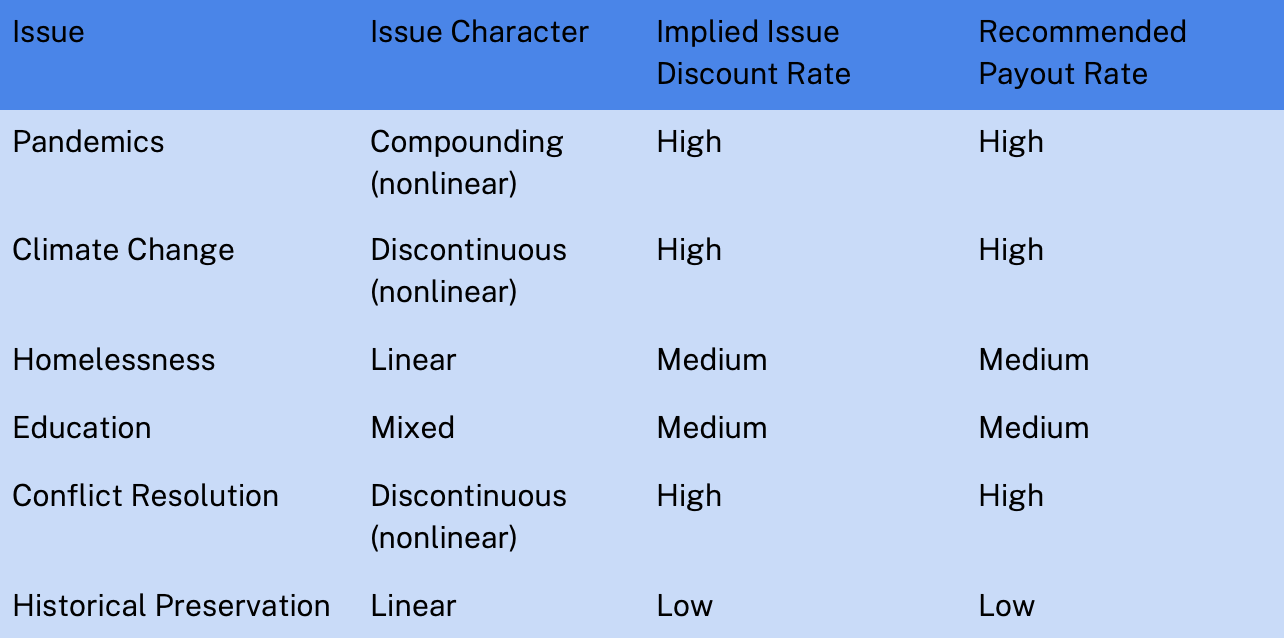
This case highlights a critical truth: Time behaves differently across different issue areas. Some problems—like homelessness—are largely linear in nature: They are the sum of a discrete set of human stories. Others—like infectious disease—are exponential: They grow nonlinearly if left unaddressed.
A few issue areas call for saving for the future, not racing against it. If a foundation’s mission is to preserve rare languages, for instance, it may be appropriate to build endowments that support long-term stewardship. Similar arguments can be made for archives and historical preservation.
But such cases are rare exceptions. In most issue areas, delayed action carries hidden costs. Many key social challenges are systems issues, including education, criminal justice, and health care. Even if these issues are not explicitly exponential (like a pandemic), early action can be more valuable than later action. This is not simply a question of avoiding harm. Benefits can compound, too—consider the advantages brought to a community by high-quality education.
This consideration suggests a basic framework. Each cause area has an issue discount rate that captures the relative value of action now, versus action later. This framework draws on the idea of social discount rates, though differs in key ways. A social discount rate allows comparison of outcomes now, versus later. Analysts use it as a way to think about trade-offs across time. But users of social discount rates quickly find themselves facing moral and analytical challenges: Can we really say a future life is more or less valuable than a present one? In contrast, issue discount rates consider the dynamics of the problem (or opportunity) itself.
Thresholds and Payout
The cost of inaction is not simply time lost—it is impact foregone. In many cases, delay compresses the timeline for effective intervention.
Certain social and environmental issues add another, weighty wrinkle: discontinuity. When it comes to strategic complexity, discontinuous problems are even knottier than exponential ones. Some social issues are characterized by tipping points. Consider an ethnic conflict: A massacre by one side may shift the situation to an entirely new state of mutual violence. Perhaps an earlier investment in cross-ethnic connection might have prevented that massacre.
Climate change offers perhaps the most sobering example. Earth’s systems are laced with planetary tipping points. If the linear warming from fossil-fuel emissions causes the Greenland ice sheet to collapse, it could kick-start a new mechanism: Reflective ice will be replaced by absorbent land, shifting warming into a new gear. Similarly, more than a trillion tons of carbon are stored underground in permafrost circling the Arctic. If that permafrost melts past certain thresholds, it will launch a new, potentially irreversible cycle of accelerated warming.
The challenge is that we can’t reliably predict when we might cross these thresholds. Funders cannot base payout decisions on explicit knowledge about if and when tipping points will tip. However, they can act now with the knowledge that the climate system is not linear. Nor does it simply compound continuously. The climate system is discontinuous, a fact that could determine the course of world history.
To a degree, we can formalize this set of dynamics. Of course, we have no simple way to precisely calculate issue discount rates. But we can categorize issues and, to a certain extent, rank order issue discount rates from lower to higher. Then we can think of issue discount rates as representing the strategic cost of stockpiling assets devoted to addressing a particular issue. (See “Aligning Payouts and Issues.”)
Compound Impact
The basic logic could have been presented a century ago. Indeed, perhaps it was. But our changing context has radically magnified the need to think anew about payout rates. Centuries of globalization have entangled humanity within complex flows of goods, information, capital, and people. Moreover, we have reached a planetary age when we can no longer act as if it is only these human systems that matter. We must confront nonhuman forces that do not care about arbitrary human frameworks: Viruses and carbon molecules do not stop at the borders of nation states, nor do they care about IRS payout requirements.
These complexities will only magnify. The growth of artificial intelligence means that we may soon confront even more pressing ethical and strategic dilemmas. In this roiling context, philanthropy must reconsider how it relates to time itself. Grantmaking confronts entangled past, present, and future: Our situation is rooted in history, our future is uncertain, and the only moment we can ever act is now.
So, four proposals: First, in those rare cases where low payout is justified by the needs of long-term preservation, set aside money with pride. But, second, recognize that most issues benefit from action sooner, rather than later. Match spending to the nature of the problems at hand. Third, trust more. Multiyear general operating support can position grantees to get to work with a boldness that matches this moment—not to mention that it makes getting money out the door easier. Fourth, let us get ready for an uncertain future. We can invest in new forms of strategy and governance that position humanity for the planetary challenges to come.
Math and morality demand action. For years, we’ve compounded financial capital. It’s time to compound impact. The longer we wait, the harder the work becomes—and the more lives, ecosystems, and possibilities we may lose.
This series appeared in SSIR’s Fall 2025 Issue, including a new follow-up essay from MacArthur Foundation President John Palfrey.
Read more stories by Jacob Harold.