


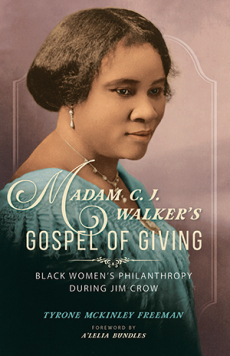
Madam C. J. Walker’s Gospel of Giving
Tyrone Freeman
304 pages, University of Illinois Press, 2020
Tyrone McKinley Freeman’s biography of Black entrepreneur and philanthropist Madam C. J. Walker arrives at a time when the philanthropic sector is finally addressing its lack of racial diversity and inclusion. This awareness has galvanized the sector, notably with the recent increased media visibility of prominent Black philanthropists like Robert F. Smith and events like Black Philanthropy Month, which broke records in giving and growth this year amid a global health pandemic.
In Madam C. J. Walker’s Gospel of Giving: Black Women’s Philanthropy during Jim Crow, Freeman expands the traditional definition of philanthropy beyond financial giving to show the rich history of Black philanthropy that informed the life and work of Madam C. J. Walker—a Black woman who was born on a cotton plantation in Delta, Louisiana, in 1867; was orphaned at age 7; and by 1910 had incorporated her own hair-care and beauty products company. Freeman demonstrates how Walker learned the ethics of giving from the many Black women who supported her as well as Black communities in Jim Crow America to become the nation’s first self-made female millionaire.
Freeman applies his inclusive definition of philanthropy—“voluntary action for the public good”—from his and his colleagues’ work at the Indiana University Lilly Family School of Philanthropy to argue that Black giving is as extensive and historical as white giving. The mission of racial uplift—central to Walker’s philanthropy—included both monetary and nonmonetary forms of giving, from time and food to education and employment to spiritual guidance. By upending this traditional understanding of philanthropy, Freeman interrogates the belief “that African Americans were mostly recipients of philanthropy by whites and not agents of it themselves”—that “they have a tradition of being helped but not a tradition of helping.”
Walker’s life is exemplary of this inclusive philanthropy. Walker, born Sarah Breedlove (she took the name of her third husband, Charles Joseph Walker, when they married in 1906), began working as a washerwoman when she was just a child. Married and widowed with a young daughter by the age of 20, she migrated throughout the region for work, arriving in St. Louis, Missouri, circa 1889, with only $2. Walker and her daughter found refuge with the local African Methodist Episcopal (AME) church and were supported in particular by the network of Black women who ran its social services, connecting Walker to the St. Louis Colored Orphans Home, which cared for and educated her daughter while she worked as a washerwoman.
“The home’s support was tremendously helpful to [Walker] and gave her a firsthand view of the power of the self-help ethos among Black people to address community needs despite the widespread neglect and exclusion by the dominant white social service providers and larger society,” Freeman writes. “The church, the orphans’ home, and the Court of Calanthe [a Black charitable organization] had all given her access and exposure to new friends, new resources, and new ways of being from her close proximity to—even from the tutelage of—Black women who were educated, had social standing, and were very involved in the local community.”
From these Black church women, Walker learned firsthand the power of Black women as givers in the broad philanthropic sense of giving—what Freeman refers to as Walker’s “gospel of giving.” This gospel, or way of life, Freeman observes, consists of three tenets: “(1) give as you can to be helpful to others, (2) spare no useful means that may be helpful to others, and (3) give more as your means increase to help others.”
It was through her cosmetics manufacturing business, the Madam C. J. Walker Manufacturing Company (the Walker Company), founded in 1910, that she was able to carry out the second and third tenets of her philanthropy. Earlier in the decade, Walker had worked for Annie Turnbo, a Black female entrepreneur who sold hair treatment products for damaged Black hair—Walker herself suffered from hair loss. In her dramatic retelling of her business’ origins, Walker claimed to have had a divine vision in which a “Black man appeared to [her] and told [her] what to mix for [her] hair.” Traveling around selling her—and not Turnbo’s—products, Walker launched her business.
Walker created an “ethnic niche economy” by building a company that not only filled a much-needed gap in the supply market but also launched the “Black beauty culture” industry. According to Freeman, this culture emerged from racial segregation as well as Black women’s “unique cultural attributes (e.g., hairdressing needs) that were difficult for white merchants to understand.” Walker created a space for Black women to identify as both workers and consumers with culturally specific needs of their own.
Inside her company, Walker organized clubs for Black women to gather together around shared experiences, from career to family. These women took advantage of what Walker offered and, in turn, gave back to their own communities as donors—not just as wage-earning women—which renewed their confidence and self-worth. “Through her philanthropy,” Freeman writes, “[Walker] connected working-class Black women to each other through associationalism to bond and leverage their collective power in support of a better quality of life for themselves, their families, and their communities.”
Walker’s agency and visibility were conduits not only for Black Americans but for the growing influence of Black women worldwide.
Freeman details Walker’s strategy of giving. She learned from her washerwoman days how employment could provide the “pathway for black women to autonomy and pride” without subjecting them to abuse by white employers. Order and alignment also were important to Walker, evident in her hiring of lawyer Freeman B. Ransom as her advisor.
Further, she used her giving to develop relationships with prominent Black civil rights leaders like A. Philip Randolph, Booker T. Washington, and Marcus Garvey. Freeman reveals that Ransom expressed reservations about Walker engaging with these highly visible Black leaders and subsequently becoming a government target. Yet Walker believed that giving to the many causes connected to the Black civil rights movement could secure her a more significant place in the male-dominated movement.
One major area for Walker’s giving was education, particularly industrial education, which had been largely funded by white people with the intent of confining Black people to manual labor. White philanthropists in the North and South, according to Freeman, “believed industrial education was the best method for preserving the racial hierarchy and social order of the South.” It produced unlicensed workers that helped to uphold white comfort and status. Walker worked within the system’s limits to create Walker schools inside industrial colleges that produced credentialed workers and then hired them. In effect, Freeman asserts, Walker doubled her giving by providing a job “in a discriminatory labor market” and, through this employment opportunity, by fostering the dignity that came with supporting oneself.
While Freeman ties the strings of Walker’s life together to illustrate the vast and monumental approach of her giving, additional historical and gender contexts about Black and white giving would have painted a richer story of Walker’s innovative and extraordinary life and impact.
According to Freeman, one major difference between Black and white giving was culturally based, with white Western models seeing giving as “philanthropic only when given to strangers.” This sharply contrasts with Black giving, which, Freeman explains, was based on a shared consciousness of American racism where “little distinction exists between gifts to family, friends, and others”—an approach that Walker embodied.
Freeman examines how Walker navigated the constraints of Jim Crow to move somewhat freely between Black and white circles, although he leaves the reader wondering how she remained safe doing so. He suggests that Walker may have been inspired by America’s leading white male philanthropists, including her contemporaries Andrew Carnegie and John D. Rockefeller. He also mentions that these philanthropists were aware of Walker’s giving, and there are occasions where she appeared in photos with them—Gospel of Giving includes photos of Walker posing with white male philanthropists as well as snapshots of her name listed on the same donor roll as theirs. This is notable, considering that the names of these philanthropists’ wives were prohibited from being included on those very donor rolls.
Walker’s alliances with male philanthropists raise the question of whether she had any significant professional relationships with white female philanthropists—or if this type of alliance was even possible. According to Freeman, white women had limits imposed on their giving by their husbands, from whom they inherited wealth and then “stepp[ed] into philanthropy after the patriarch’s death.” Black women did not have the “protections of the household nor the conditions that allowed them choice about labor force participation.” This is mostly because many Black men struggled to find and keep a job under Jim Crow. White women’s giving was also seen as a responsibility and status symbol for women of leisure. For Walker, who had worked all her life, she gave on her own terms. She had other interests for her race that focused on the collective experience of being Black in America.
Furthermore, the efforts of white women to keep Black women out of the labor force undermined the potential for productive relationships between them. These barriers included boycotting companies that hired Black women, resulting in these companies’ refusing to employ Black women in order to stay in business. In perhaps one of his most direct observations about white women in the Jim Crow era, Freeman states that they “also affirmed white supremacy in their own failure to acknowledge the womanhood of Black women in their brand of feminism.”
Walker’s feminism—a part of her gospel of giving—was inclusive. She had a high-level view pointed toward social change, social good, and equality for all—including men. “Walker’s spaces privileged women but were in direct engagement with men,” with whom Walker interacted “as equals,” Freeman writes. He successfully documents how Walker made giving accessible to anyone, and how her style of giving reflected her character, more so than her resources. Walker’s agency and visibility were conduits not only for Black Americans but for the growing influence of Black women worldwide.
Many of today’s Black women philanthropists, such as Oprah Winfrey, have been directly inspired by Walker’s efforts. Interestingly, this includes Walker’s goal of opening a school in Africa, which she was unable to do in her lifetime. In 2007, Winfrey established the Oprah Winfrey Leadership Academy for Girls in South Africa. Walker’s aim to broaden her giving globally may not have come to pass, but her values live on in Black women philanthropists’ global philanthropy today.