


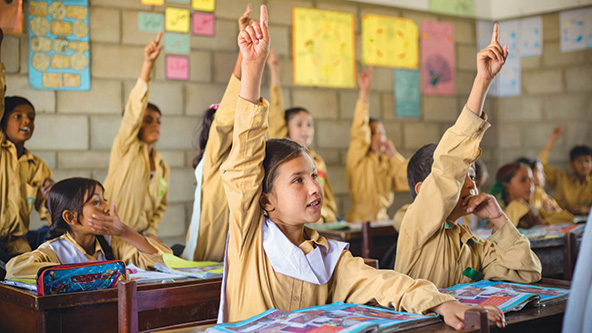
 The Citizens Foundation encourages its students to be curious and ask questions of their teachers. (Photos courtesy of The Citizens Foundation)
Kainaat Ansari began her life in a low-income settlement (katchi abadi) in Orangi—the world’s largest slum, with nearly 2.5 million inhabitants—which stretches along the northwestern outskirts of Karachi, Pakistan. The eldest of three children, Ansari had limited life prospects. She came from a poor family in a country with little upward mobility.
Even though Ansari’s mother had little schooling, she instilled the value of education in her daughter by telling her inspirational stories about women changemakers and influential figures like Benazir Bhutto, Pakistan’s first and only female prime minister. “I always told my mom I will get an education [to] become like them,” Ansari remembers. “My mom would laugh and say, ‘It’s so hard to even complete [final exams].’” But, Ansari adds, “I think she kind of encouraged it deep down.”
By the time she was 13 years old, in 2014, Ansari and her younger brother, then 11, had only ever attended a government school, where students sat on the floors in overcrowded classrooms and teachers were often absent. The pedagogy emphasized rote learning, primarily through memorization of English-language textbooks. Since 94 percent of primary and middle school teachers in Pakistan are not proficient in English, however, most teachers do not comprehend what they are teaching and thus are unable to educate their students about what they are memorizing. It is no surprise, then, that the nation has one of the lowest literacy rates in the world—at 58 percent—according to the most recent data from the World Bank. Compare this with other countries in South Asia: Bhutan and Nepal’s literacy rates are both 71 percent, India’s 74 percent, Bangladesh’s 75 percent, and Sri Lanka’s 92 percent.
Then, one day that year, a friend of Ansari’s father recommended that he send his son to a school run by the education nonprofit The Citizens Foundation (TCF), founded in 1995 by a group of six Pakistani civil activists. TCF’s coeducational school system—now operating 1,833 primary and secondary schools nationwide—had by then built a reputation for delivering quality and affordable education. Ninety percent of TCF graduates pursue higher education, and about half enroll in tertiary education. This data stands in marked contrast to 2022 national data, which reported a 33 percent dropout rate for primary school and a 73 percent dropout rate for secondary education. The country had a 12 percent tertiary education enrollment rate in 2019, according to data from the World Bank.
Ansari joined her mother and brother the day they enrolled him at TCF. “I still vividly remember walking to the school,” Ansari, now 23, says. “There was such a big playground, where, for the first time, I saw girls playing basketball and badminton. And I was like, ‘Damn, what is happening here? Do people really do this?’ I was so happy!” It was also the first time Ansari saw a library. She was so excited that she asked her mother if she could enroll, too.
“My mom said, ‘No, have you lost it? You cannot travel this far,’” Ansari continues. But she challenged her mother’s authority and managed to persuade the principal to give her the entrance exam that day. She failed it. But because of her passion and the nonprofit’s commitment to help underserved children, she was told she would be accepted if she agreed to repeat the eighth grade. With that offer, Ansari persuaded her parents to allow her to attend the TCF secondary school through her graduation, in 2017.
TCF’s secondary schools had ended with 10th grade, but in 2016 they introduced TCF colleges, the local term for the 11th and 12th grades. Many TCF graduates, including Ansari, have completed high school at non-TCF institutions. She was accepted into the highly competitive United World Colleges, a global network of schools that offers the International Baccalaureate, the international equivalent of a high-school diploma.
Ansari was then accepted into Whitman College and spent her study-abroad semester in 2022 at Oxford University’s Lady Margaret Hall. Ansari chose this specific Oxford college because it boasts Bhutto and Nobel Peace Prize laureate Malala Yousafzai as alumnae. A portrait of Bhutto hangs in the college, and during her time there, Ansari would often stop and stare in disbelief at the promise fulfilled by her younger self.
Ansari’s story is remarkable, but it is not singular. Hers is one shared by so many of the more than 57,000 children who’ve graduated from TCF schools. Success of the nonprofit’s mission is witnessed in the story of Muskan Amjad, a child of a rickshaw driver, who went to a top Pakistani university after graduating from TCF and now works at a software company. And Javaria Yousaf, who discovered her love of math at TCF, obtained a master’s degree in economics at Punjab University, and then returned to TCF as a math teacher. And Asad Ahmad, the son of a fruit seller, who graduated from TCF and then pursued a degree from Ghulam Ishaq Khan Institute of Engineering Sciences and Technology, one of the country’s leading universities. He was hired by a software company upon graduation.
Activists’ Vision for Society
TCF’s cofounders first met as civil activists in 1993. They were part of a larger activist group—informally called “the Wednesday group”—that gathered weekly in Karachi, Pakistan, to formulate civic responses to the nation’s worsening social and political deterioration.
Pakistan had been reeling from a decade of rule under the religious fundamentalist General Muhammad Zia-ul-Haq, who orchestrated a coup in the late 1970s and died in a 1988 air crash under mysterious circumstances, widely suspected to be sabotage. Zia-ul-Haq transformed a relatively liberal Pakistan into a closed, conservative, and splintered one. He introduced Sharia law—a legal system based on a regressive interpretation of the Quran whereby, for example, women who are raped can be incarcerated for unlawful intercourse—and catalyzed the Islamization of the economy, including eliminating interest from the banking system. (Charging interest is considered un-Islamic.) The threat of economic sanctions was compounded by his frequent calls to develop a nuclear bomb, which further destabilized the nation’s markets.
Despite the efforts to rebuild the economy in the late 1980s and 1990s, Pakistan was “trapped in a vicious circle of poverty, low growth, low savings, and low investment,” explains economist and former Pakistan Commerce Minister Mohammad Zubair Khan in his 2000 report “Liberalization and Economic Crisis in Pakistan.” This economic instability fueled greater social and political unrest.
TCF’s cofounders knew that entering the education sector would be met with resistance from both government officials and educators, who championed the existing national policy agenda.
“Pakistan has always been facing challenges, but they were really bad in those days, in terms of lawlessness, kidnappings, [and] people being shot,” civil activist and TCF cofounder Mushtaq Chhapra recalls. The activists, he says, “were personally threatened, our children were at risk, our families were at stake, a lot of our friends were kidnapped—so it was like an awakening of sorts.”
The Wednesday Group initially floated vigilantism as a course of action. But cooler minds prevailed, and the group pivoted their discussions to sustainable, nonviolent approaches to the nation’s problems. Education, they determined, was the critical lever to building and buttressing a stable civil society—this became the foundation of TCF’s mission to deliver quality education to all.
For Chhapra, the nation had an appalling track record when it came to education, so he believed it was his civic duty to act. “[The lack of] education is something that is the root cause of a lot of evils,” Chhapra says. “If you look at a society, a community, or country [where] people are educated, they will be more tolerant, patient, and they’ll listen.” Education, he notes, is a significant indicator of multiple social determinants, including improved health outcomes and reduced likelihood of criminality.
Chhapra, a business magnate in manufacturing, currently serves as chairman of TCF’s board and serves on the board alongside the two other surviving founders: Ateed Riaz, codirector and cochair of the business house Imrooz, and Ahsan M. Saleem, CEO of Crescent Steel & Allied Products Limited. Businessmen Hamid Jafar and Rashid Abdulla, and Rashid’s brother and the group’s lone architect, Arshad Abdulla, are the three other cofounders. Arshad Abdulla designed the first group of TCF schools.
The cofounders wanted a proof of concept before embarking on fundraising, so they pooled their personal funds to build five schools in Karachi’s katchi abadis in 1996. The schools enrolled 800 children on a first-come, first-served basis. They also established a fee system whereby a family’s total tuition is an annual fee based on a sliding scale, with fees starting at 10 rupees ($0.036) for primary school and 20 rupees ($0.07) for a secondary school. Today, the minimum fee for both schools is 25 rupees ($0.09).
“When you remove that constraint and say, ‘Send everyone—we’ll charge you the same,’ things change,” says Zia Akhter Abbas, TCF’s executive vice president of development and partnerships. “The absolute amount doesn’t increase; instead, it keeps going down per child. So there’s a built-in incentive to send all your kids.”
The schools attained such immediate popularity that the cofounders invited potential donors to visit them within a year.
The Promises and Perils of Education
TCF’s cofounders knew that entering the education sector would be met with resistance from both government officials and educators, who championed the existing education infrastructure and national policy agenda to increase enrollment rates rather than improve the quality of education.
 TCF has redesigned its classrooms for younger students to emphasize student-led inquiry and play. Here children gather at TCF’s Lab School on the outskirts of Karachi, Pakistan.
On the surface, the national agenda made sense: Pakistan ranks among the top three countries in the world for the most out-of-school children. Around 44 percent—or 23 million—Pakistani children between the ages of 5 and 16 are not in school, according to the United Nations Children’s Fund (UNICEF). Regional disparities make access to education even harder for certain populations: In Sindh, the province in which Karachi is located and where Ansari is from, 52 percent of children—and 58 percent of girls—ages 5 to 16 are not in school.
However, Pakistan’s decentralized government put provincial governments in charge of educational policy, resulting in significant regional disparities in the quality, uniformity, and accessibility of education. Decades of political corruption have exacerbated these disparities. A 2010 Save the Children report estimated the existence of 30,000 ghost schools, or schools that exist only on paper so that government officials can embezzle federal funds. And of operational schools, according to TCF senior advisor Nadia Naviwala in her report “Pakistan’s Education Crisis,” exist in areas represented by senior politicians. This corruption also extends to educators. Teaching jobs in government schools are sometimes given to supporters of a ruling party, despite their lack of qualifications. Over the course of 2015 in Sindh, the Pakistan People’s Party (PPP)—the political party in power in the province—gave 14,000 of its supporters teaching jobs. Unqualified teachers at government schools are frequently absent. When they do show up, they often treat children badly, ordering them to give them massages or fetch them meals.
Consequently, “Pakistan has one of the most fragmented, iniquitous education systems in the world,” says Faisal Bari, associate professor for education and economics at the Lahore University of Management Sciences School of Education.
Additional structural challenges have factored into parents’ refusal to enroll their children in school and to dropout rates. Poor physical infrastructure—lack of school-boundary walls, potable water, electricity, and access to toilets—is a significant issue. Nearly 30 percent of primary public schools in Pakistan do not have usable toilets. Instead, children are forced to relieve themselves in fields. “Every time I go to the fields with my friends, I pray that we return to our school safely,” an 11-year-old girl in Punjab told Assembly, a Malala Fund publication. “Fear of being molested or bitten by a snake or scorpion makes us very tense,” she added. “The thought of being watched by someone also increases my anxiety.”
Other barriers, especially for girls, have included school proximity, the presence of male teachers, and climate-related disasters. Proximity to schools is a significant determinant for girls’ education, as parents fear for their daughters’ safety when traveling to and from school. The Learning and Educational Achievement in Pakistan Schools Program at the Harvard Kennedy School found that if a girl lives 500 meters away from a school, she is 15 percent less likely to attend school than a girl who lives near one.
Poor and unethical management was at the root of so many problems in the education sector. TCF’s cofounders—five of whom were businessmen—believed that most, if not all, of the structural challenges could be resolved through quality management in the delivery of education. Thus, their design approach for the school system, Chhapra says, was to “create and operate the system from the paradigm of management rather than a paradigm of education.”
Flexibility for Functionality
Management is the cornerstone of TCF’s educational system. While the nonprofit has a traditional organizational structure—a CEO, executive vice presidents, and regional and area managers—the school system was designed to empower staff at all levels. TCF operations are fairly standardized; school principals determine and execute their own school-improvement plans on the condition that communication is open and teachers can give feedback. This structure was intentional, as the cofounders wanted to ensure that the organization would outlast them and contribute to the rebuilding of civil society. “What Pakistan lacks more than anything is not schools but institutions, which survive the individuals who created it,” Abbas says of the cofounders’ intentions.
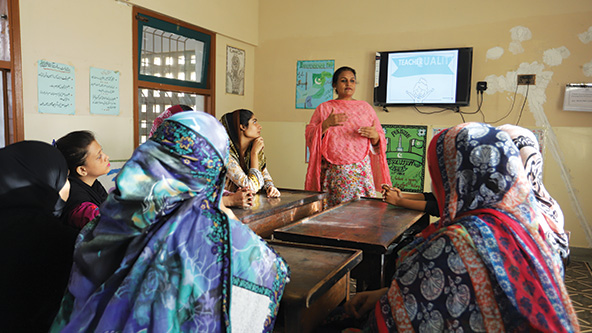 TCF has centralized its teacher trainings, which are led by the principals of their respective schools. Here a principal at a school in Korangi built on land donated by the Pakistani Coast Guard instructs her teachers on pedagogy and etiquette.
TCF’s organizational structure emphasizes uniformity to avoid many of the consequences of state-run-school decentralization. Every primary school has one principal, six teachers, and a maximum of 180 students. There is one teacher per grade—kindergarten through 5th—such that there are never more than 36 students per classroom. Similarly, each secondary school has one principal, five teachers, and a maximum of 180 students. Running from the 6th through the 10th grades, secondary schools have one class per grade, with one teacher and a maximum of 36 students in each classroom. And, to ensure uniformity and for the sake of quality assurance, all TCF teachers must pass TCF-designed entrance exams that were developed by their human-resources team.
TCF also decided to employ retired military personnel as regional and area managers. Naviwala claims that having military in visible leadership positions incentivizes employees to take their roles seriously and cultivates a sense of accountability often lacking in the education sector. “Having retired military as field managers creates a sense of national service and discipline,” she adds.
Technology has streamlined the management of such a massive school system. “With an organization of this size, it’s become next to impossible to use a paper-based system,” says Ghazala Nadeem, TCF’s executive vice president of human resources, technology, and organization excellence. The management system operates via smartphone app, through which principals can access three modules—for students, employees, and finances—to conduct all administrative work. Only principals can access the operating management system, which adds quality control by centralizing management oversight. For example, only principals enroll or disenroll students, which guarantees that each school never exceeds the maximum number of students per class or per school.
Although TCF maintains a uniform school system, it also strives to be adaptable. For example, TCF’s first external assessment, by the Aga Khan University Institute for Educational Development in 2012, identified two major weaknesses: teacher content knowledge and school leadership. TCF responded quickly. First, it communicated the results with its stakeholders and donors. For the organization, transparency is mission critical to garner and sustain trust with its community members. In fact, some advisors, such as Shashi Buluswar, founder and former CEO of the Institute for Transformative Technologies at the Lawrence Berkeley National Lab, have told the organization that while transparency is important, TCF management overemphasizes its weaknesses. Abbas, however, disagrees: “I think it’s a great superpower to have, for an organization to be very real with itself and authentic.”
After the poor assessment, TCF introduced content testing twice a year for all of its teachers and connected their results to their compensation. Clear targets for improvement were set for each teacher, based on their results, and the new incentives succeeded in increasing test scores. TCF also provided teachers with resources to help improve weaknesses, including printed resources as well as links delivered to their phones with educational videos.
To address the second issue of leadership, TCF instituted an annual academy held every summer to train principals on leadership and management, and it established a principal quality index, determined during a daylong visit by a certified assessor who evaluates a principal’s performance and provides feedback.
A Learning Process
TCF pedagogy prioritizes critical thinking, problem-solving, and emotional learning through a student-centered and interactive approach. In contrast to government schools, it de-emphasizes rote learning and memorization-based testing and evaluates students on reading comprehension, textual analysis, and logic.
Contrary to Western myths about Pakistanis not wanting to educate their girls, the gender disparity is not a demand-side issue but a supply-side one.
In the early years, TCF relied on government-issued textbooks for lessons in Urdu and academic publishers like Oxford University Press for math and science books. But TCF quickly grew dissatisfied with the quality of government-issued textbooks and, in 2009, developed its own books in collaboration with the education resource nonprofit Educational Resource Development Centre. In 2016, TCF’s academic team designed TCF textbooks to reflect its pedagogy. These books are published in Urdu and include culturally relatable content.
“The books that were in English would show, let’s say, an ice cream truck rolling down the street, with ‘Sam the ice cream man’ selling cones,” Abbas observes. “But not in our books. Our books have the kulfi wala [local frozen confectioner] on a bike, and that makes the student think, ‘This is for me. I’m the center of this universe.’ It’s really important not to disconnect the child from where they come from.”
The rationale behind the Urdu-based curriculum is largely practical, to reach the most children. Yet TCF also believes it has cultural and emotional benefits. Its Urdu-based curriculum is intended to upend the dominant messaging of an English-based education that English—none of the children’s native tongue—is superior and that Urdu is a language reserved for inferior, less nuanced or complex interactions and thought. To promote its national language and culture, TCF offers free use of its textbooks. Today, its books are used by more than 300 private schools throughout Pakistan.
Emotional learning is the latest addition to TCF’s pedagogy. “There are specific student development periods where students are taken through activities which allow them to express their feelings, like getting in touch with what they’re grateful for and expressing what they’d like to have done differently,” Abbas explains. For example, students are taught that anger often masks shame and embarrassment, and they are given the space to discuss these feelings—a particularly valuable lesson for boys who are generally enculturated to believe that masculinity demands the suppression of their emotions. Newer classrooms for younger students have been redesigned to elevate peer interaction and socialization, by having students’ desks facing each other instead of being pointed at a teacher at the head of the classroom.
TCF is amending its student testing process by switching from the local examination board to the more demanding federal examination board. While the nonprofit would have better exam results if they remained with the easier local examination board, it has committed to this transition to improve the quality of educational standards and outcomes in the long run. “Right now, we’re going through a lot of turmoil,” Abbas comments of the change, which has required more teacher training to adapt to the more rigorous curriculum.
Gender Ratios
TCF’s inclusion of emotional learning in its pedagogy speaks to its commitment to educate students about how gender structures relationships and society. It also reflects the cofounders’ understanding that achieving gender parity in the classroom must be a priority to realize their mission.
The barriers to girls’ education are often practical. The lack of school proximity, poor school infrastructure, and threat of male-teacher predation are all major deterrents for parents of school-age girls. Contrary to Western myths about Pakistanis not wanting to educate their girls, the gender disparity is not a demand-side issue but a supply-side one.
TCF believed it could close the gender gap if it solved for these barriers in the design of the schools and how education is delivered. First, TCF decided to hire only female teachers and principals to alleviate parents’ fears about sending their daughters to school with men on the campus. TCF management was intentional about establishing schools in rural areas to minimize travel time for girls, which also meant that underserved children had access they wouldn’t otherwise have. Every TCF school has potable water and functioning toilets, so girls don’t have to leave the premises to relieve themselves. And each TCF school has a boundary wall, which is also for girls’ protection and to further assuage parental anxieties about harassment, molestation, or violence against their children.
TCF reached gender parity quickly, although it cannot identify precisely when parity was attained. This achievement differs greatly from World Bank data indicating that girls from poor backgrounds are about 22 percent less likely to be sent to school than boys in Pakistan.
Working to overcome gender barriers also had ripple effects. TCF is “Pakistan’s largest single employer of women outside the public sector,” according to a splashy 2018 article in The Economist on TCF. This statement was and continues to be factually accurate, with the latest data from TCF reporting that it remained the largest private employer of women in the country. Of the 18,000 TCF employees, approximately 13,000 are the all-female school staff—11,800 teachers and 1,200 principals.
Diaspora Dollars
TCF has prioritized cultivating a loyal donor base by focusing on three communities: wealthy individuals, the Pakistani diaspora, and those who believe in the power of education. And while TCF’s initial goal was to secure 1,000 donors to fund 1,000 schools, it was surprised to learn that it needed far fewer individual donors, thanks to repeat donations.
“Once [a donor] sees the impact, they want to do more than one school,” Abbas says. “And what the founders built was a community of people, and the management would return to them every year and treat them like owners.”
The Pakistani diaspora—of which there are approximately 9 million people globally—is a significant fundraising source. TCF has nonprofit chapters in cities around the world, including in North America (there are 42 chapters alone in the United States), the United Kingdom, and the Middle East, all of which regularly fundraise for the central organization through events like galas and sports tournaments.
Shehlah Zaheeruddin, who is based in Karachi, learned about TCF via local theater performances held as fundraisers nearly two decades ago. Before each performance, a TCF stakeholder would say a few words about the organization and its mission. Zaheeruddin soon became a regular donor. Her investment in TCF deepened 15 years ago, when she helped TCF devise a mentorship program for eighth and ninth graders—the Rahbar program—in 2008. Zaheeruddin says that volunteering with and donating to TCF are part of her civic duty. “I think it [contributing to TCF] is the single most important thing that we [Pakistanis] can do,” she explains.
The nonprofit’s focus on individual donors has allowed it to be nimble and iterative in ways that are conducive to providing quality education, rather than being constrained by conditions associated with larger grants. “We are not funded by a lot of institutions,” Abbas says. “The nature of the funding [via grants] ... is that it’s very focused and very time-bound—and that’s not the nature of education. Education is an 11-year journey for each student, so you have to keep the funding rolling in.”
TCF does receive some funding and support from corporate donations and grants. For instance, this year, the Bill & Melinda Gates Foundation awarded a $500,000 grant to TCF’s United States nonprofit organization to conduct a two-year study on how communities’ sustained exposure to quality education informs their perceptions of gender.
Another—arguably surprising—revenue source has been the national government. In 2016, TCF partnered with the government, which contracted the nonprofit to operate schools—now, approximately 400 schools in 11 school districts—in government buildings. TCF recruits and trains the faculty based on its own standards; the government subsidizes TCF for all costs.
Pakistan’s autocratic turn poses a threat to TCF’s government partnership. The next general election, planned for October 2023, could alter or even eliminate the partnership.
Bari recognizes the problems of government absolving itself from providing public education, but he is also pragmatic and believes this partnership is a way that the state can honor its responsibility to deliver quality education. “We can have qualms about whether education should be a business or not, but I think in Pakistan that decision was taken a long time ago,” he says.
The organization has an annual budget of $30 million, nearly two-thirds of which pays the school staff’s compensation and benefits. Approximately 5 percent is allotted for staff training and transportation to and from school. Only 12 percent is spent on fundraising and administrative costs—a nod to TCF’s operational efficiency. The remaining funds are used for building maintenance, research and development, field supervision and monitoring, textbooks, school uniforms, and teaching supplies.
Chhapra says that accounting transparency has been a TCF mandate from the beginning. As part of its commitment to transparency, TCF is audited annually by a rotating list of the world’s largest accounting firms—Deloitte, Ernst & Young, KPMG, and PwC. “As per corporate-governance best practices,” Abbas explains, “we have to keep changing the firms … so that a new set of eyes looks at the accounts and operations and validates them.”
Community Investment
TCF’s dedicated donor base has allowed it to expand its education mission beyond primary and secondary schools to contribute to communities where TCF schools are based.
“It’s not a humanitarian organization. It’s an education organization,” Buluswar says. “But I would say that its most interesting evolution has been figuring out that it’s not just a school system. If you’re going to be a pillar of the community, you have to be willing to step outside the core of what you do.”
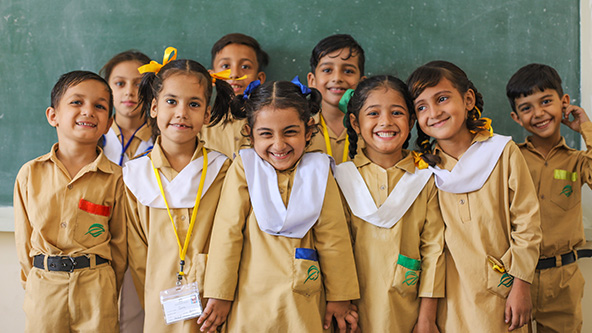 TCF has achieved gender parity among students in its schools. It attributes part of this success to employing only women as principals and teachers.
In 2005, TCF launched its first community program, the Aagahi program, for women in slums and rural areas to learn basic literacy and numeracy—skills that have a broad range of benefits, from financial empowerment when shopping to being able to read bus numbers when commuting alone. The free four-month course runs biannually at 4,300 locations—from TCF schools to community centers to residents’ homes—across the country. Each year, 20,000 women enroll in the program, and 160,000 women have completed the program to date. In 2017, the Aagahi program won the UNESCO Confucius Prize for Literacy, awarded to governments, NGOs, and individuals who are making remarkable inroads in literacy in rural areas. The $30,000 was a financial boon as well as an excellent endorsement for the program.
In 2015, TCF launched a free, four-month vocational-training program for women, with the aim of teaching them marketable technical skills. The program focuses on fashion design, including tailoring, embroidery, and entrepreneurship skills—all of which are in high demand and also lend themselves to microenterprise and working from home. Fifteen vocational centers, located in communities where there are TCF schools, offer this program, which has so far produced 3,000 graduates. These centers also accept work orders, including requests for TCF uniforms, for which the women in the program are paid.
Humanitarian relief is a growing aspect of TCF’s community investment. After last year’s floods that devastated Pakistan’s infrastructure and economy, and rendered millions of Pakistanis homeless, TCF launched the Flood Relief Appeal, which has provided more than 5 million meals and helped more than 65,000 households rebuild across 32 districts. And during the COVID-19 pandemic, TCF created the COVID-19 Response Appeal, which gave cash donations to the poorest, hardest-hit families and provided personal protective equipment to frontline workers.
Managing Through Uncertainty
While TCF has established itself as A bastion for delivering quality education to Pakistani children, several challenges lie ahead for the organization, from political instability to the rise of artificial intelligence.
Political turmoil reached an apex last year when former Prime Minister Imran Khan was ousted via a vote of no confidence in April 2022 and arrested in May this year on corruption charges by the National Accountability Bureau. Since then, Prime Minister Shehbaz Sharif, head of the Pakistan Muslim League (Nawaz) party, has taken the country in an autocratic direction, and the military—already the nation’s most powerful institution—now exerts greater state power. Pakistan’s autocratic turn poses a threat to TCF’s government partnership. The next general election, planned for October 2023, could alter or even eliminate the partnership.
This is to say nothing of the country’s dire economic crisis, which threatens the funding of the partnership program. Inflation, rising costs, and the depreciation of the rupee have all devastated the economy. In June, Pakistan managed to secure a much-needed $3 billion loan from the International Monetary Fund, but experts warn that this is merely a stopgap and not nearly enough to save the country’s economy in the long run.
A perennial challenge for TCF is balancing its mission to deliver quality education and its pace of growth. Its 2023 target to open 130 new schools is ambitious considering the current political and economic climate. Additionally, its decision to expand by building schools, rather than renting preexisting properties, means that more money must be raised per school, which slows the pace of growth. Bari notes, however, that there are qualitative benefits to this model: The new buildings provide children with a sense of being cared for and valued.
Like education systems around the world, TCF is also beginning to grapple with AI’s impact on education. “I think the biggest challenge they’re going to face is with technology,” contends Buluswar, whose doctorate is in AI. With ChatGPT, which operates in Urdu, students could have AI complete their homework and even write their essays—meaning that they would only need to engage with the learning material on a superficial level and leave the thinking to the machine. Students’ increasing reliance on AI has created a challenge for teachers, who are unable to determine when programs like ChatGPT are being used by their students. Nevertheless, Buluswar asserts that AI must become “a fundamental part of TCF’s education model” for the nonprofit to be both relevant and successful in the next decade.
For Bari and Nadeem, TCF’s success has been driven by its systemic flexibility, which includes its capacity to harness new technologies. They not only are optimistic about TCF’s ability to adapt to the AI revolution but also believe that its school system will continue to serve as a leader in developing—as well as democratizing—Pakistan’s civil society.
Read more stories by Noor Noman.