


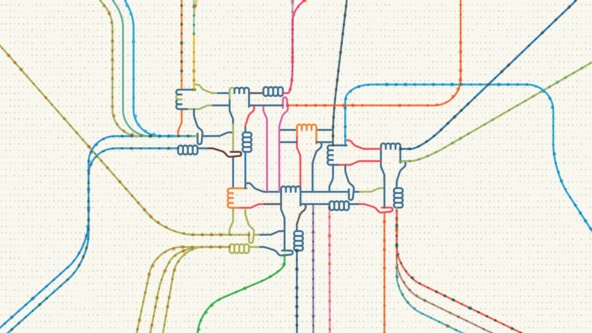
 (Illustration by John Hersey)
We editors at SSIR have long conceived the magazine as a nonpartisan platform for the social sector. No matter which side of the political spectrum contributors and readers occupied, they could share their perspectives on how to better address social problems through philanthropy, nonprofit programs, business initiatives, public policy, and cross-sector collaborations.
The first months of US President Donald Trump’s second term, however, have brought this self-understanding into question. His administration has seized powers normally under the purview of Congress and the courts to target organizations, institutions, initiatives, and principles that have been mainstays of our pages: USAID and foreign assistance; multilateral institutions such as the World Health Organization; the flow of ideas, goods, services, and people across borders; investments in scientific and medical research, green infrastructure, and public health; the freedom and autonomy of universities and foundations; the rights of all to speech, assembly, association, and due process, to name a few.
As promoters and defenders of a free civil society, we at SSIR today find ourselves taking sides: We stand with you as allies against the rise of authoritarianism in the United States and abroad.
What can we do to resist the waxing tide that threatens to drown us? We have seen what failure looks like: Those who attempt to seek their own path and appease the forces against them at the expense of rivals—whether trade unions, universities, or law firms—find themselves weak and isolated. No, the way to address the crisis is the same as it has always been in our pages: We must join together and protect our common interests.
Our cover story, “The Future of Innovation Is Collective,” highlights the way forward. Cynthia Rayner, Sophia Otoo, and François Bonnici, affiliates of the Schwab Foundation for Social Entrepreneurship, analyze 10 case studies of collective efforts to solve major social problems and explain their distinctive values, structures, and ways of operating.
“Global challenges—such as climate change, economic inequality, escalating conflict, and the privacy and security of new technologies—are collective action problems,” the authors write. “They depend on our ability to come together, not on silver-bullet solutions designed by individual heroes.”
The cases they examine include the Amazon Sacred Headwaters Alliance (ASHA), a partnership launched by Indigenous organizers in Ecuador to advance Native interests against the threats of extractive mining companies.
“Whenever there was division, we had to go and unite,” says Uyunkar Domingo Peas Nampichkai, ASHA’s leader. “Whenever there were power struggles, I would go and speak to each one separately and find out why.”
The political turn in the United States and its ramifications worldwide may have already reached you. If so, know that others have confronted threats just as dire. They speak in our magazine’s pages, and we are proud to give them a platform.
Read more stories by David V. Johnson.