


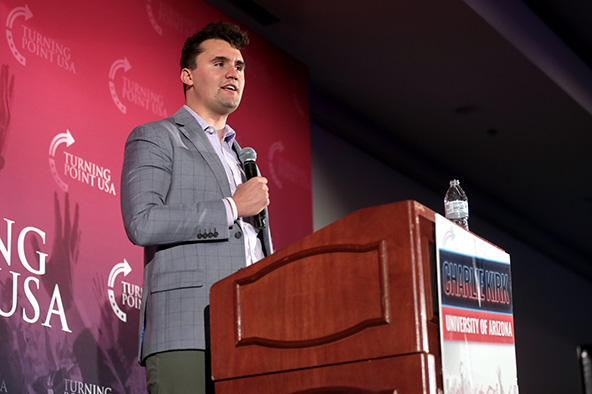
 Charlie Kirk speaks at a Turning Point USA campus event in 2021. (Photo by Gage Skidmore via Flickr CC BY-SA 2.0)
In the wake of conservative political activist Charlie Kirk’s murder last year, many of his obituaries made mention of the same curious fact in his origin story: At age 18, Kirk set out to build a conservative equivalent to the progressive campaigning powerhouse MoveOn.org. There is no question that Kirk went on to build a tremendously influential organization in Turning Point USA (TPUSA). But, as researchers with expertise in the study of digital political associations, this reference struck us as both incorrect and interesting. TPUSA is no conservative MoveOn. Its structure, campaign strategies, and tactics are quite different. Yet, both organizations have successfully mobilized their members, both on-line and off-line, and shaped US politics in the process. There are meaningful lessons to be gleaned from the differences between these organizations.
We suspect that, just as the American right never managed to build its own MoveOn, the American left will not build its own TPUSA. Successful political organizations respond to, and are shaped by, both the changing political context and the evolving media environment. Just as MoveOn’s structure was forged in the politics and digital media of the 2000s, and TPUSA adapted to the politics and digital media of the 2010s, the next wave of advocacy organizations will have to seek answers to how to communicate and build power in the late 2020s.
The MoveOn Model
MoveOn was founded in 1998, the work of two software developers—Wes Boyd and Joan Blades—who had recently sold their company. It began as a single online petition, calling on Congress to “censure [Bill] Clinton and Move On” from the Monica Lewinsky scandal. Over 500,000 people signed. When Congress was unmoved, Boyd and Blades had a realization: Every online petition signer had provided their email address. They could reach out to all their fellow petitioners with proposals for future actions. The e-petition became the equivalent of a member list for a new type of digital advocacy organization.
During the mass mobilization against the Iraq War in 2003, MoveOn emerged as the largest and most powerful progressive advocacy organization in the United States. It built a list of several million members who took aggressive action together, both online and offline. It did so by engaging in a then-new style of nimble, responsive, multi-issue political campaigning. As Ben Brandzel, a MoveOn staffer who would go on to found the Online Progressive Engagement Network (OPEN) put it, the key to the organization’s power was a “sticky, light-touch structure that captures kinetic energy from high-energy moments. It stores that energy and grows it as movement power, then re-energizes and redeploys it elsewhere.”
The MoveOn model proved remarkably successful for progressives and it was the cutting edge of digital political activism in the 2000s. The model was replicated by other progressive groups in the United States, elements of it were adapted by well-known NGOs, and the model spread internationally with activists in over 20 countries creating their own versions of MoveOn.
Given MoveOn’s impact, it makes sense, then, that Charlie Kirk started his career looking at MoveOn as the model that conservatives needed to emulate. A “MoveOn of the right” would be an organization with a massive list that it mobilizes primarily via email to take collective political action. It would focus on applying pressure to the existing political system through rapid response campaigns. It would also engage in digital listening, accepting that it would be both guided and constrained by its members. MoveOn’s power is based in its capacity to get members to repeatedly take action, meaning the organization cannot stray too far from the interests, tastes, and preferences of its membership. MoveOn staffers have historically referred to this guiding philosophy as “Strong Vision, Big Ears.” That’s the core of the model. There is more to it, of course. But if you were looking to build a minimum-viable-version of MoveOn, that’s what you would do. Rapidly respond to political events, giving your membership an outlet for their shared concerns and values. Build a large email list. Repeatedly mobilize them to take political action.
The Turning Point USA Model
Charlie Kirk founded Turning Point USA in 2012. He referenced MoveOn in his pitch to conservative donors and philanthropists. The pitch worked. He raised millions in donations. But the organization that he built had little in common with the one he intended to replicate.
TPUSA focused on university campuses and in-person events. Arguably the most important element of TPUSA’s model was Kirk’s charismatic leadership. Kirk became widely known for his roving campus tours, where he would set out to debate left-leaning college students and make a full-throated case for conservative orthodoxy. These events, which had a touch of Christian Revivalist preaching, were filmed and then edited to go viral on social media. This is what Ezra Klein was referring to when he described Charlie Kirk as having “practic[ed] politics the right way”: “He was showing up to campuses and talking with anyone who would talk to him. He was one of the era’s most effective practitioners of persuasion. When the left thought its hold on the hearts and minds of college students was nearly absolute, Kirk showed up again and again to break it.”
There is, again, of course, more to it. There were conferences and trainings and a super PAC. There was the professor watchlist. But the minimum-viable-version of the TPUSA model is to focus on college campuses and build a network of student groups that expand the zone of legitimate debate, with the goal of normalizing a set of political and social beliefs among young people. Center that network around a charismatic leader and create momentum through media moments designed for viral spread on social media. This, to our eyes, is an entirely different model from what MoveOn built.
Three Critical Differences
The differences in organizational form can be summarized along three dimensions: youth-focused vs. full populace; 2000s internet vs. 2010s internet; and conservative vs. progressive political organizing traditions.
TPUSA is an expressly youth-focused organization. It set out to develop a new generation of conservative activists, and has largely succeeded in doing so. This places it in a similar mold as Young Americans for Freedom (YAF) and the College Republicans—organizations that served as the training ground for previous generations of conservative political leaders. But it bears little similarity to internet-mediated issue generalists like MoveOn. A conservative MoveOn would build the largest feasible supporter list, and then activate that list around a mix of local, national, and international campaign opportunities. The focus on campus activism would be a limitation, rather than a strength, for such an organization.
Both TPUSA and MoveOn strike us as remarkably successful products of the digital media environment they were built in. MoveOn rose to prominence in the early Web 2.0 era—a media system dominated by political blogs, Google search, and mass email lists. Communities of online hobbyists were beginning to find each other and organize offline. Mainstream media outlets were still relatively stable and influential (compared to today). The best way to reach a large number of people was to have a large email list, and to plan tactics that would generate mainstream media coverage.
By the early 2010s, when TPUSA was getting off the ground, the internet of blogs and search was being replaced by an internet of algorithmic feeds and social media sharing. In a social media-dominated environment, the best way to reach a large number of people was to create media content designed to go viral, often by generating outrage. Mainstream media was taking its cues from viral social media trends by that point as well. A campus-focused organization that produced media clips of its charismatic founder besting his opponents in verbal debate could, in that decade, reach a much larger audience than a mass-members organization with a large email list. Media change leads to new organizational forms.
The difference in political ideologies also matters. As Jen Schradie notes in her 2019 book, The Revolution that Wasn’t: How Digital Activism Favors Conservatives, conservative social movements often have different strategic goals than their progressive counterparts. TPUSA was built for political persuasion—expanding the Overton Window and normalizing a set of political and cultural views that otherwise had been treated as outside the zone of legitimate debate. Imagine what a leftwing TPUSA would have looked like during the Biden years. A campus tour where a charismatic leader debated conservative students and demonstrated that climate change is real, the Laffer Curve is ineffective tax policy, or people shouldn’t go bankrupt because a family member gets sick? None of these claims are especially edgy or transgressive. They are broadly popular and accepted political claims which already sit within the zone of legitimate debate. The hard work for advocates lies in designing policies and pressuring politicians to enact those policies. A progressive mirror image of TPUSA would not be hailed as accomplishing nearly what TPUSA has accomplished, because it would be structured to solve the wrong problem.
TPUSA was (and is) a top-down organization, with a clear message and a charismatic messenger (Kirk). It is hierarchical. MoveOn, by contrast, was built for political mobilization, with the ultimate goal of passing progressive laws. MoveOn is a less hierarchical organization, which seeks to channel and mobilize its grassroots membership, rather than relying on a charismatic leader (many MoveOn members probably could not name the MoveOn executive director, the same is not true for TPUSA). The Internet is many-layered—a multitool, if you will. But, as Schradie demonstrated, the internet is especially effective as a broadcasting machine for charismatic figures. Converting public discourse into legislative results is quite a bit harder, and requires different institutional capacities, than injecting new perspectives into the online discourse.
Should Progressives Try to Build Their Own TPUSA?
Following Kirk’s death, it was reported that TPUSA rapidly increased its presence in high schools and campuses across America. According to the New York Times it doubled the number of chapters in high schools from 1,200 to over 3,000. Donations also surged immediately after Kirk’s death, with one donor pledging $1 million. Tucker Carlson, a friend of Kirk’s and former Fox News broadcaster, also sent a fundraising appeal on the organizations behalf. However, TPUSA now faces a more contentious landscape within the conservative movement. It has also been attacked by far-right influencers, including former TPUSA employee Candice Owens, who have spread conspiracy theories and attacked TPUSA staff and Erika Kirk. TPUSA has also allegedly suffered from being too close to Trump and the institutionalized MAGA movement. Some TPUSA followers have drifted to other far-right influencers who are more critical of Trump. Hence, while the organization may still galvanize many students, its centrality to conservative youth politics is less clear since Kirk’s death.
Nevertheless, we suspect that there are some left-wing progressives considering a similar path that young Charlie Kirk did—meeting with potential funders and pitching plans to construct a progressive equivalent to Turning Point USA. This is unlikely to succeed, for the very same reasons that Kirk never replicated the MoveOn model. The digital media environment circa 2025 is different from the one that Kirk first operated in. We no longer orbit around the Facebook feed and the Twitter algorithm. The future of digital media—given the decline of the centralized website and platforms and the rise of AI slop—is more fractured, more fractious, and more fake than what came before. It is unclear whether TPUSA’s iconic tactics will work nearly as well under these conditions.
What strikes us as more likely is that progressive movement entrepreneurs will set out to emulate the success of the opposing side but then find themselves building something quite different. New social movement organizations are a product of their political moment, the media environment, and the needs of the broader progressive (or conservative) movement. They rarely directly replicate what their opponents have built, even when they try. They can look to them for ideas, but then they have to reach for something new.
Read more stories by Nina Hall & Dave Karpf.