


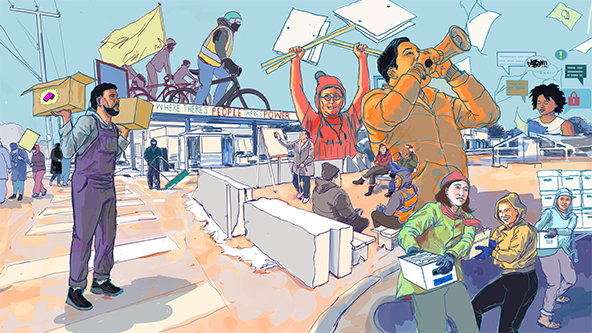
 (Illustration by Mike Hoyt)
I. The Recognition Problem
When national leaders and funders describe a successful social movement, they tend to name the same organizations repeatedly. The largest ones. The most centralized. The most institutionally connected. This is not driven by bad intent. It reflects the pull of visibility. But repeated enough, a partial story hardens into the accepted version, and the accepted version shapes what lessons get drawn for the next community under pressure.
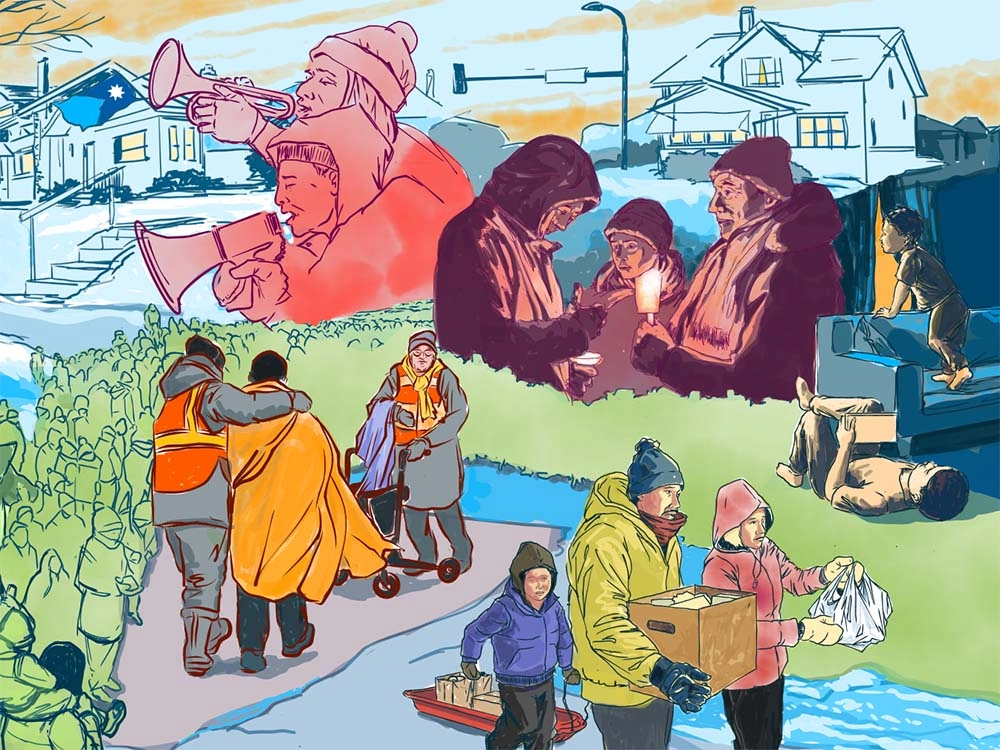
This is not only a narrative problem, it is a resource allocation problem. Organizations that receive recognition receive investment. Organizations whose work remains invisible remain underfunded, even when their relationships and their presence made the visible success possible.
The racial dimension of this pattern is not incidental. In Minnesota, as elsewhere, the organizations most likely to be named and celebrated after a successful campaign are disproportionately white-led, professionalized, and institutionally connected. Those most likely to be overlooked are disproportionately led by people of color and immigrants who built their organizations from within the communities they serve. This follows the same lines of power and visibility that shape philanthropic resource flows more broadly.
Minnesota’s response to Operation Metro Surge in late 2025 and early 2026 offers one of the sharpest recent illustrations of this dynamic. It also offers a way to think clearly about what civic infrastructure is made of, why the recognition problem persists, and what it costs.
II. What Happened in Minnesota
In December 2025, the US Department of Homeland Security deployed what it described as the largest immigration enforcement operation in United States history into the Minneapolis–Saint Paul metropolitan area. Operation Metro Surge eventually involved more than 3,000 officers from Immigration and Customs Enforcement (ICE) and Customs and Border Protection (CBP). The operation explicitly targeted Somali and Southeast Asian refugee communities, the overwhelming majority of whom hold legal status. Federal agents killed two United States citizens on camera, sparking national outrage. A federal judge found that ICE violated at least 96 court orders in the first month of the operation. The City of Minneapolis estimated more than $203 million in economic damage in January alone.
Community resistance was immediate and sustained. On January 23, 2026, between 50,000 and 100,000 people marched through temperatures cold enough to cause frostbite as part of a coordinated general strike. Over 700 businesses closed in solidarity. More than 100 clergy submitted to arrest through civil disobedience. Labor unions, immigrant rights organizations, faith communities, student networks, and mutual aid groups sustained daily action for weeks, contributing to the federal government’s eventual drawdown of forces. The Immigrant Rapid Response Fund raised approximately $14 million from more than 65,000 donors across all 50 states and 45 countries. Millions more were raised by mutual funds across Minnesota, as well as from the independently created website standwithminnesota.com.
From the outside, this response looked like something that appeared suddenly. It did not. It was built.
Before going further: Minnesota’s response should not be understood as an uncomplicated victory. More than 4,000 people were arrested. Two were killed. Families were separated, businesses collapsed, households were evicted, and workers lost months of income they will not recover. The harm was real, and the effects are ongoing. This piece focuses on the organizing infrastructure that made the resistance possible, and that focus should not be read as a claim that the resistance was sufficient, or that the people who bore the greatest cost share equally in any sense of triumph. Both things are true. The infrastructure worked, and far too many people paid a price that no amount of organizational readiness could prevent.
III. Two Types of Organizations, One Ecosystem
The organizing literature has long described the spectrum between centralized and decentralized organizational models. These are not always separate organizations—historically, federated civic associations have held both functions simultaneously. The distinction matters here because the current funding environment has increasingly separated them, concentrating resources in centralized organizations while underinvesting in the place-based work that makes centralized coordination possible. Centralized organizations—think large statewide immigrant rights coalitions, labor federations, or established legal advocacy nonprofits—offer scale and coordination. They aggregate power across geography, communicate to broad audiences, activate allies, and engage institutional actors (media, government, philanthropy) in ways that smaller organizations cannot. During Operation Metro Surge, these organizations played essential roles coordinating large actions, amplifying legal challenges, and connecting the Minnesota response to national attention.
Decentralized, place-based organizations offer something different. They hold what sociologists describe as bonding social capital: the dense networks of relationship through which information travels, trust extends, and collective action becomes possible at the neighborhood level. When a family does not know whether to open the door, the voice they listen to is not a statewide organization they have never encountered; it is the pastor who has been present for years, the worker center organizer who helped resolve a wage dispute in 2022, the neighborhood organization that ran a renters’ rights workshop in their building, the food shelf director who knew to switch to home delivery because she understood how afraid her neighbors were to leave the house.
Earlier this year, the McKnight Foundation convened leaders from precisely these kinds of organizations. What stayed with me was not what they said about the crisis itself but something more basic. Metro Surge, they explained, was not only a crisis happening to their communities from the outside, it was a crisis unfolding inside their organizations, because their staff were members of those communities. The person answering phones was also someone whose family member had been detained. A program director was also a parent keeping a child home from school out of fear. The line between the org chart and the community was not a metaphor; it was a structural description of how these organizations are built.
These two organizational forms are structurally interdependent. Centralized organizations rely on communities already in motion, with trust already built and people already prepared to act. Decentralized organizations rely on the coordination, communications reach, and resources that larger organizations provide. That interdependence is real, and so is the friction. Centralized organizations do not always see decentralized ones as partners. Resources flow toward legibility. Trust built over decades in a neighborhood does not automatically translate into a seat at the coordination table.
IV. The Gyms on the Corners
Political scientist Hahrie Han argues that people are not born knowing how to be civically active; they learn it through structures and relationships that build that capacity over time. Her research distinguishes between organizations that mobilize, activating existing capacity when a moment demands it, and organizations that organize, building new capacity through sustained relational work. Both are necessary, and neither replaces the other.
Han uses the metaphor of a gym to make this concrete. People do not become strong by wanting to be strong. They need a place to train, equipment, coaches, and other people to work alongside. Civic capacity works the same way. Many of the people who marched in the Twin Cities on January 23, some for the first time, had been in training long before that moment. They had attended meetings at worker centers, volunteered with faith groups, participated in get-out-the-vote drives, or shown up in smaller ways that taught them collective action was possible and meaningful. The gym was already open. They already knew where it was.
Minnesota has invested in those gyms for a long time. By “Minnesota,” I mean a combination of philanthropic funders, state and local government programs, and community-generated resources, each playing different roles at different scales. That investment has supported organizations on street corners, in community centers, and inside small, under-resourced groups that rarely produce outputs fitting neatly into grant reports, including culturally specific and community-rooted organizations that seldom appear in published research. The results of that investment are not always legible in advance. When a moment like January 2026 arrives, they become unmistakable.
Data from the ground reflects how place-based infrastructure functioned under pressure. Food shelf visits across Minnesota dropped 7% in January 2026 compared to the prior year, and by 17% in Ramsey and Hennepin counties, as people became afraid to leave their homes. The organizations that reached those families were the ones that had built trust over years through consistent local presence—they switched to home delivery, made door-to-door calls, and worked through the relationships that government agencies and larger nonprofits could not replicate.
One illustration of how decentralized organizing infrastructure operates in practice: a rapid response network in northern Minnesota began with approximately 30 people in October 2025. By January 2026, after federal agents killed Renee Good, it was filling entire church sanctuaries. Its model is not coordination from a central hub but distributed capacity-building, training people to train others until knowledge is held broadly and locally. The work is difficult to measure precisely because of how it operates. That difficulty is not accidental. It reflects the decentralized nature of the model.
The Latino Economic Development Center, a community development financial institution operating on a major commercial corridor in Minneapolis since 2003, said they received hundreds of calls a day in the first weeks of the operation, from clients, former clients, and people who had simply heard of the organization and knew it could be trusted. That trust was not manufactured in a crisis. It was built over more than two decades of presence.
That is not a communications strategy. It is infrastructure.
Analysis by Candid underscores this pattern. Minnesota organizations entered Metro Surge with institutional muscle memory developed through COVID-19 and the civil unrest following the murder of George Floyd. The capacity that surfaced during the surge had been practiced under pressure. Funders that treated the post-2020 period as infrastructure investment rather than disaster recovery contributed meaningfully to that readiness.
V. How Distortion Works
The response to Operation Metro Surge was not a story of one organizational model outperforming the other. It was a story of an ecosystem functioning, after years of investment across its many parts. The version of this story that names only the larger, more visible organizations distorts our understanding of what occurred and risks misguiding future investment.
The distortion operates through a familiar mechanism. Centralized organizations are easier to identify, easier to contact, and easier to evaluate using conventional metrics. They produce press releases, maintain communications staff, and interface with media and institutional funders in legible ways. Place-based organizations often lack the capacity to tell their own story in the formats that national audiences consume. Their value is relational, embedded, and slow to build. It does not translate easily into the evidence frameworks that philanthropy relies on. So when the story gets told, the same organizations appear. The ecosystem narrows in the retelling. Funders, drawing lessons from the story as told, invest in what they can see.
The ecosystem itself is not undocumented. McKnight Foundation Program Director Muneer Karcher-Ramos has outlined principles for recording this moment with integrity, including the imperative to give credit broadly and specifically across immigrant-led networks, mutual aid hubs, labor coalitions, and community-based organizations that carried the response. His account names dozens of organizations operating across legal services, worker support, culturally specific protection, and neighborhood-level mutual aid. The breadth is there. The question is why that breadth keeps collapsing in the retelling, and what structural forces drive the collapse.
There is a deeper dimension to this, and it cuts closer to the present moment. Forces working against democratic systems have their own logic of erasure. Many of the people who took the greatest risks during Operation Metro Surge, especially those who organized from inside their communities, who moved information and resources and protected their neighbors, benefit from anonymity; publicizing their role in full could harm them, personally or professionally. What gets written down is what was safe to write down. The people with the most to lose, whose organizing was often the most consequential, are structurally absent from any published account.
The result is a story where undocumented people appear primarily as recipients of solidarity rather than as architects of their own resistance. That framing reproduces the very erasure that anti-democracy forces depend on.
When funders and movement leaders draw the wrong lessons from a successful campaign—crediting the visible actors while ignoring the underlying infrastructure—they reproduce the conditions that make the next response slower and less effective. The story told shapes the investment made.
VI. What This Asks of Funders
The lessons of Minnesota’s response are not primarily about crisis management. They concern what must be in place before a crisis arrives.
First, funders must commit to the full ecosystem. Place-based and culturally rooted organizations require general operating support, multi-year commitments, and relationships grounded in proximity. Investing primarily in centralized organizations because they are easier to evaluate leaves the underlying infrastructure underfunded. The Immigrant Rapid Response Fund’s prioritization of culturally responsive, linguistically accessible, deeply rooted organizations reflected a clear theory of how change occurs. The McKnight Foundation has oriented its civic power grantmaking around this same theory.
Second, funders must adopt a longer time horizon. The capacity that emerged during Operation Metro Surge was built across many years and funding cycles. Organizations present in a community for a decade develop trust, institutional memory, and relational density that cannot be manufactured in a moment of crisis. Annualized funding tied narrowly to short-term deliverables is poorly aligned with infrastructure of this kind.
Third, and most directly connected to the argument here, funders and researchers must take responsibility for how the story is told. Which organizations are named, and which are not, shapes what counts as infrastructure. Post-campaign analysis that centers only the visible actors produces a distorted map of what worked. Correcting that distortion requires deliberate effort, including seeking out organizations beyond press releases, asking who built the relationships that enabled visible action, and documenting the full ecosystem.
VII. What Minnesota Teaches
The response to Operation Metro Surge will be studied for years. It mobilized extraordinary numbers of people under extreme conditions. It generated philanthropic and mutual aid responses at unusual speed and scale. It applied sustained pressure that contributed to a drawdown of what had been described as the largest immigration enforcement operation in United States history.
Minnesota was not lucky. The capacity did not appear fully formed in the moment. Minnesota had built something over years, across many kinds of organizations and communities, that was ready when it was needed.
Reproducing that capacity elsewhere, or sustaining it in Minnesota, requires clarity about what it is made of. Worker centers, mutual aid networks, culturally specific community organizing and community development organizations, faith communities that have shown up year after year in the neighborhoods where people live. Those organizations deserve the full story. The full story begins with recognition, and recognition begins by remembering what the gyms on the corners already built.
Read more stories by Neeraj Mehta.