


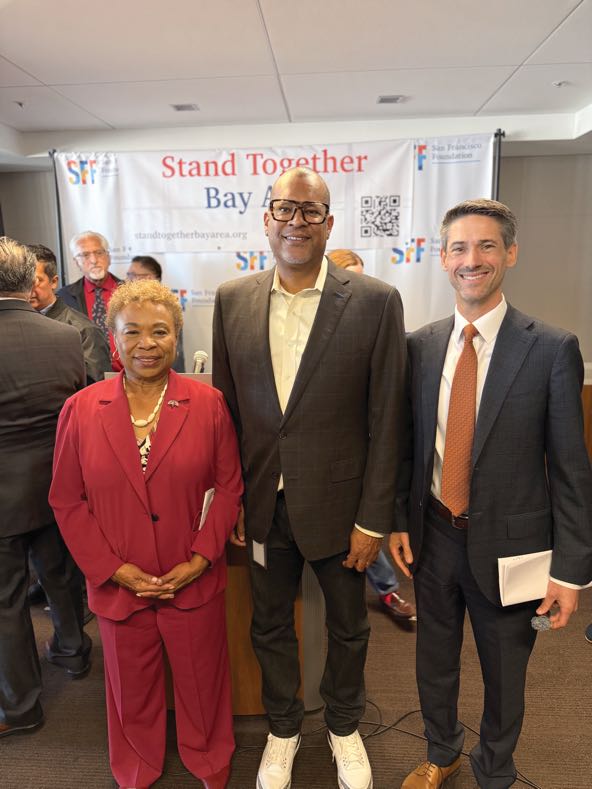
 Oakland Mayor Barbara Lee, San Francisco Foundation CEO Fred Blackwell, and San Jose Mayor Matt Mahan spoke at fund announcement on September 19, 2025. (Photo courtesy of Stand Together Bay Area Fund)
Alicia was sound asleep when agents from US Immigration and Customs Enforcement (ICE) detained her mother outside their San Francisco home. When she woke up the next morning, the 20-year-old was suddenly responsible for herself and two younger sisters, ages 10 and 14. Without her mother’s primary income to support her family’s daily needs, Alicia turned to a local nonprofit to receive a small grant to keep food on the table.
“There’s a lot of people out there who are just like me,” she says.
A surge of aggressive federal immigration enforcement has separated people like Alicia from their parents and cut families’ income overnight. Fear among immigrant communities has prompted some families to avoid driving, shopping, and even visiting the doctor. Others are hesitant to search for work, fearful that they will be exposed on-site. Scenarios like Alicia’s are playing out in every county across the San Francisco Bay Area, where one-third of the population was born outside the United States.
In September, faced with a rapidly growing need for support for immigrant families, the San Francisco Foundation (SFF) and a coalition of Bay Area mayors, community groups, and faith leaders struck an unprecedented collaboration. The coalition launched the Stand Together Bay Area Fund, a region-wide effort to provide urgent financial support and solidarity to families suddenly facing detention, deportation risk, job loss, and disruptions to daily life.
The fund raised $1.9 million in its first weeks, and Judith Bell, chief impact officer at SFF, is optimistic that they will hit their $10 million target. As of January 2026, they’d reached $2.8 million in donations and commitments. “We’re providing a platform here for individuals to give,” Bell says, emphasizing that many Bay Area residents watching the crackdown have said they feel helpless. “It gives people something that they can do—something concrete to lighten the burden even a little bit.” So far, donations have ranged from $5 to $300,000.
Regional Approach
The need for such support became impossible to ignore after Bell and her colleagues had conversations with representatives from SFF’s grantee organizations, policy partners, and their Latine Kitchen Cabinet, a collaborative of Latine nonprofit leaders in the Bay Area that advises the foundation on key issues for the Bay Area’s Latine communities. They provided early warnings about the severity of the crisis. “There is this incredible level of fear of being detained at any moment,” Bell says. “Parents worry about dropping their kids off at school. People worry about going to the grocery store or going to church. People are afraid to be outside their homes.” Even Bell’s colleagues who are citizens and ethnic minorities are carrying their passports with them as a precautionary measure, given that the administration’s immigration-enforcement policies have relied greatly on racial and religious profiling.
“These are incredibly well-founded fears,” she says. “People should be afraid. The fact that they’re reacting this way is a perfectly rational response to an incredibly serious situation.” Bell says her team at SFF felt a call to action to organize and provide different avenues to give and distribute funds quickly.
A key to the program’s success is that it spans across cities and counties. While many public programs are city-based, the Stand Together initiative was intentionally designed as an effort across the six central Bay Area counties: San Francisco, Marin, Alameda, Contra Costa, Santa Clara, and San Mateo. The pooled fund collects contributions from individuals, philanthropies, corporate partners, and public institutions. “People identify as living in the Bay,” Bell says. “This is a way of saying that we are a region. These are our friends, our neighbors, our families who we want to support.”
Bell’s team directs funds to trusted community-based organizations including Faith in Action, San Francisco Interfaith Council, and local food banks, already embedded in local communities and equipped to protect client identities and quickly assist those who need it the most. “We’re choosing groups who have done this before,” Bell says.
At the September announcement of the effort, mayors of San Francisco, Oakland, and San Jose stood alongside nonprofit and faith leaders.
“This fund is a common-sense solution to a very real problem our neighbors are facing,” said San Jose Mayor Matt Mahan at the launch. “But it’s about more than money—it’s a reminder to our immigrant families, the same families who have made the Bay Area what it is today, that we have their backs.”
In addition, two Alameda County supervisors each pledged $50,000 contributions from their offices. This public-facing moment, Bell says, visibly conveyed the message that “the community around the region is putting our arms around them.”
Direct Relief
Bell’s colleagues at the San Francisco Foundation feel confident they can make a difference given their success managing high-impact pooled funds during the COVID-19 pandemic and supporting boots-on-the-ground operations. Its first major grantee was the Mission Asset Fund (MAF), a nationally recognized community lending organization based in San Francisco’s Mission District, that has built culturally relevant financial tools for low-income immigrants to borrow money, build savings and credit, and avoid predatory lenders. The resources help people pay for living, business, and immigration expenses, as well as earn approval for apartments, credit cards, and jobs.
During the pandemic, MAF deployed more than $70 million in small emergency grants, and that efficient, on-the-ground experience now can strengthen the Stand Together effort. “We will transfer money the Stand Together fund raises over to the actual individuals that are experiencing some ICE-impact event,” says MAF founder and CEO José A. Quiñonez.
Assistance is not limited to people directly detained or deported. Many immigrant families are experiencing financial hardship because they are fearful of reporting to work, are avoiding attending school or seeking health care, or are suffering from the psychological effects of constant uncertainty. Depending on the situation, families may receive grants of $1,000 to $3,000 to stabilize rent, utility payments, and immigration legal aid.
For example, Rosa’s family was already stretching every dollar before her husband was detained and swiftly deported. Overnight, her household budget in her San Francisco apartment felt tighter as she supported her sister, her three children, and her 5-year-old niece. Now as the main provider of her household, she cleans houses whenever the work appears, and for months she spent every dollar before she earned it. A $3,000 grant funded by MAF offered a respite, allowing her to save her wages toward rent. “I felt that support from [MAF] quickly, and it made a big difference financially,” she says. She hopes that a year from now she can give her children a stable home, though fear still lingers.
Quiñonez is careful to note that similar efforts shouldn’t look identical everywhere in America. “We have to allow for different forms to take shape because we’re different in different cities,” he says. He points to other emergency efforts by leaders in Chicago and the California Community Foundation in Los Angeles who have stepped up in their own ways, especially as ICE raids have ramped up in those regions. People are not just waiting to be saved, Quiñonez says. “They are already organizing and pushing back.”
What may be replicable, however, is the lesson in infrastructure. Bell says that only certain institutions are positioned to pull together donations from governments, private foundations, and individuals and then move that money quickly. “You have to have the experience and the relationships,” she says. Community foundations, and some large nonprofits, are particularly equipped and essential for this work.
“You can bring together folks from the public sector, folks from the private sector, the nonprofit sector, the philanthropic sector,” she says. “You can come together and you can take this meaningful step in the midst of the crisis that we’re facing.”
Read more stories by Corey Binns.