


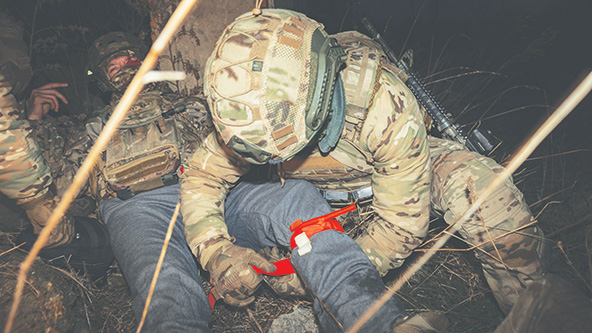
 PULSE conducts tactical medicine training for one of the units of the Special Operations Forces of the Armed Forces of Ukraine, near Kramatorsk, in 2023. (Photo courtesy of Arsen Petrov)
Russia “is bombarding our people with artillery, rockets, drones—anything that kills and maims as many people as possible,” says Fedir Serdiuk, cofounder of both PULSE, an Odesa-based NGO instructing the Ukrainian military in battlefield emergency care, and FAST, a Ukrainian company that teaches basic first-aid techniques to civilians.
In May of 2023, while Russian forces continued to rain missiles on Ukrainian towns and cities, PULSE and FAST conducted the Odesa region’s first Save a Life Day to educate citizens and soldiers on the basics of bleeding control. The two-hour online tutorial was part of the American College of Surgeons’ (ACS) Stop the Bleed program, created in the aftermath of the 2012 Sandy Hook shooting, when 20 children and six adults were shot and killed at Sandy Hook Elementary School in Newtown, Connecticut. Based on the ACS’ booklet on the fundamentals of controlling bleeding, the training had more than 1,000 participants, who learned how to use a military-grade tourniquet provided by the organizers upon registration.
“In the event of critical bleeding, death can occur in three to seven minutes,” Serdiuk explains. “The chances for survival are much greater if bystanders or fellow soldiers give first aid—simple maneuvers aimed at saving the injured person until professional medical assistance is possible.” The event’s success inspired organizers to expand the tutorial nationwide for the 2025 Save a Life Day.
Serdiuk’s interest in first aid originated a decade ago while he pursued a law degree at Odesa National University. That year, in 2014, Russian president Vladimir Putin ordered troops to invade eastern Ukraine to foment unrest and occupy the Ukrainian peninsula of Crimea, territory that is just 200 miles from the Black Sea port city—and Serdiuk’s home—of Odesa. Sensing a protracted war on the horizon, Serdiuk and his friend Igor Korpusov trained with the Ukrainian Red Cross to become certified emergency response team leaders.
After their certification and while training civilian responders as part of the Red Cross, Serdiuk and Korpusov realized that Ukraine’s military was woefully unprepared in emergency-response medical skills. They also found their work stymied by lack of supplies, such as dressings and bandages, tourniquets, stethoscopes, pulse oximeters, and wound disinfectants.
The urgent need for both first-aid skills and supplies inspired their founding of FAST in 2016. The company’s mission is to educate civilians to act quickly and effectively in the event of an emergency. Instruction is also tailored for the private sector, focusing on industrial and workplace safety. FAST trainings vary in length from 8 to 16 hours and cost between $760 and $1,300, depending upon the client’s size and needs. A foundry’s staff, for example, would require a full 12-hour training that encompassed first aid for common injuries that could occur while working with metals, including stopping bleeding, treating broken bones, and cooling burns. Since its founding, FAST’s team of more than two dozen certified first-aid trainers has trained approximately 60,000 civilians in first-aid techniques ranging from cardiopulmonary resuscitation to application of a tourniquet.
When Russia invaded Ukraine in February 2022, FAST’s cofounders partnered with Odesa National Medical University graduate Leonid Kopus to establish PULSE, a nonprofit dedicated to developing the operational medical skills of southern Ukraine’s armed defenders. In just over two years, PULSE has educated 32,000 members of the Ukrainian armed forces, national police, and border patrol in emergency medical methods.
Training a Nation
PULSE offers Ukrainian defense forces three types of Tactical Combat Casualty Care developed by the US Department of Defense: a 7-hour course for all service members, a 40-hour course for nonmedical military personnel involved in combat operations, and a 63-hour course for military medical personnel. PULSE’s training center and its 30 trainers are certified by Europe-based sections of the US National Association of Emergency Medical Technicians. Trainings are free of charge and are conducted by a team of two to four PULSE trainers, several of whom also work for FAST.
PULSE and FAST exemplify the novel bridging of civilian and military spheres—and their significance to the greater war effort.
PULSE has scaled rapidly, logging more than 1,700 trainees a month by the start of 2023. It also addresses obstacles and shortcomings with ingenious fixes illustrative of the lean, flexible, flat hierarchies that the war has engendered in Ukraine. For example, PULSE enlisted battlefield veterans, many of whom had sustained battlefield injuries, as emergency-response trainers. Hiring veterans addressed the economic issue of veteran unemployment and the social issue of veterans’ well-being with their engaging in meaningful work.
The nonprofit is currently working to integrate blood-transfusion technology and skills into its offerings, taking advantage of a recent change in Ukrainian legislation that enables a broader spectrum of medical personnel to conduct the procedures. This particular project is made possible by a patchwork of donors, including a crowdfunding campaign on the website JustGiving and equipment donations from the Ukrainian NGO Slava Ukraini, the Ukrainian NGO Sidus Vitae and their Project Farma, and the Arizona-based Delta Development Team, a manufacturer of refrigeration systems that donated refrigeration units for blood storage. The project is happening in cooperation with the Ukrainian Transplant Coordination Center, in line with guidance from the health ministry. Donations are matched by the Community Initiative of the European Bank for Reconstruction and Development, the European Union’s development bank that provides funding to local charities involved in health care and humanitarian relief.
In addition to financial support from FAST and Ukrainian private companies, PULSE is financed by diaspora organizations including United Help Ukraine, Ukrainian American House, and Razom for Ukraine. About a tenth of the donations come from individuals and groups that heard about PULSE in social media or through diaspora connections. In June 2024, for example, a group of teachers and students from Service High School in Anchorage, Alaska, donated $2,000 to PULSE.
“There are many, many civic organizations that are supporting the military effort in some way,” explains Natalia Klymova, deputy director of the Ukrainian NGO Ednannia, which helps NGOs, including PULSE, to raise money for their activities. “The army is fighting the war, but civil society is doing everything else,” she says, adding that Ednannia also manages food and medical supply donations. Klymova admits that military structures can be tricky partners—in terms of how they prioritize security and the chain of command—but she says the armed forces in Ukraine have no choice but to cooperate given the crucial role that groups like PULSE and Ednannia have assumed in the war effort.
Civic Resistance
In the spirit of Ukraine’s wartime civil-society movement, PULSE and FAST exemplify the novel bridging of civilian and military spheres—and their significance to the greater war effort in a country outgunned and outmanned by a much larger foe. One 2022 study showed that nearly 80 percent of Ukrainians donated their own money to support the military effort.
In addition to offering trainings across the country, PULSE has expanded its reach abroad, including to its northern ally Estonia. In October 2023, a delegation of six PULSE trainers visited Estonia’s Tartu-based military academy to participate in a medical expertise exchange with the Estonian armed forces. “PULSE trainers shared information about on-the-ground tactical medicine in the war that was new to us,” says Estonian Lieutenant Walter Voomets, from the academy’s Center for War and Disaster Medicine. By better understanding the Ukrainian context, he says, Estonia can adjust its training programs and provide more targeted support to Ukraine.
PULSE is also working with some of Ukraine’s most esteemed special forces units, such as the 73rd Naval Special Operations Center, the Ukrainian equivalent of the US Navy SEALs. The Ukrainian military is often fighting behind enemy lines, where “it can take a long time from the moment of injury to the evacuation to the stabilization point during some operations,” said the 73rd’s chief combat medic, who goes by the code name Romaha, in a 2024 interview with the British tabloid Metro. The PULSE training, he added, has been critical to the unit’s survival and relatively low casualty rate, enabling the unit to undertake missions far behind enemy lines that otherwise would be too risky.
“The support of the collective West for Ukraine’s defense of its territory will determine the fate of the country,” Serdiuk observes. Currently, weaponry and ammunition are arriving sporadically, while Russia’s supplies remain abundant. PULSE’s work won’t stop until the war does, which Serdiuk is convinced will happen only one way: with Russia’s full expulsion from Ukraine’s territories.
Read more stories by Paul Hockenos.