


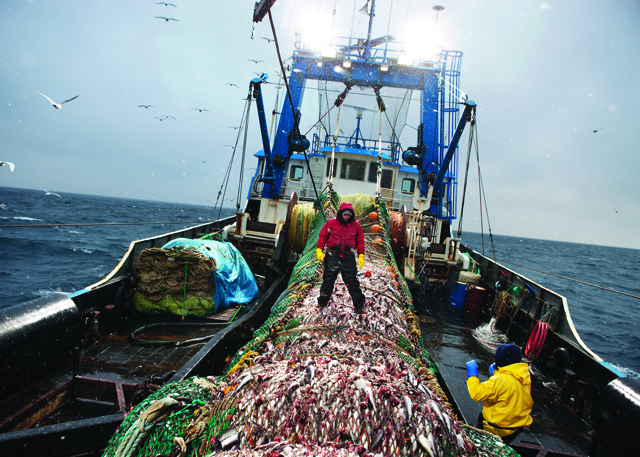
 Fisheries are notoriously difficult to manage ecologically. But some fishermen use conservation practices, such as those aboard the 149-foot pollock trawler Pacific Prince in the Bering Sea off Alaska. (Photo by Corey Arnold)
Nature conservation is fundamentally about making people’s behavior less destructive to the earth’s ecosystems. A purely scientific approach to conservation might carve the world into various zones, preserving ecosystems that are vital to biodiversity conservation and designating others where human activity can most easily be absorbed. But no country, let alone the world, is run by a benevolent biologist-dictator who can unilaterally preserve great swaths of the planet. Conservation goals must be pursued within economic systems where market forces and politics have a great deal of influence over decision-making.
In recent decades, conservationists have made significant strides in finding ways to marry environmental and economic interests. In the United States, for example, they have harnessed the internal revenue code, creating conservation easements that have preserved 22 million acres of land in return for breaks on income and estate taxes.1
As effective as efforts like these have been, conservationists need to be much more strategic about the choices they make and the behaviors they attempt to change. Conservationists have limited time and money. They need to focus on opportunities where they can make the biggest difference for the planet.
The first step in developing a conservation strategy is to identify which ecosystems are most outstanding for their diversity and uniqueness and should be, when feasible, priorities to protect. This has largely been done.2 Norman Myers published his first list of global “Biodiversity Hotspots” in 1988, and since then every major green group has produced a map of conservation targets. More recently, researchers have added maps that go beyond biodiversity to show the importance of places for “ecosystem services,” things like water supply and climate stability.
The next step in developing a conservation strategy is to identify which human behaviors conservationists should try to change, and how best to use economic forces to alter human behavior to preserve endangered ecosystems. This, for the most part, has not been done. Conservationists know which ecosystems should ideally be protected, but they have yet to marry that knowledge with a full understanding of the role of economic and political forces in determining which of those ecosystems can realistically be saved.
Nature is threatened by human pressure that comes in economically diverse forms, including logging, mining, oil and gas extraction, farming, dams, and the networks of wires, tubes, roads, and canals built to enable all these businesses. Trying to conserve nature without understanding this diversity and the economic forces that drive each of them makes protecting ecosystems into more or less a matter of luck and intuition. The industries threatening nature vary in both their profitability and the efficiency of the markets in which they operate. This article examines how conservationists can be more effective in preserving nature by using conservation economics to understand both of these dimensions and use that understanding to shape their strategy.
Understanding Opportunity Costs
Conservation economics uses various branches of economics—such as environmental, agricultural, energy, transportation, and natural resources—to make effective plans and strategies to achieve conservation goals. One of the core concepts of conservation economics is “opportunity cost,” the price (or at least a large fraction of it) of conserving stuff, measured as the potential profits that would have been earned by enterprises that were prevented from operating because they are incompatible with conservation. Individuals, and society as a whole, give up those potential profits when they conserve.
For example, soybeans and oil palm, both highly profitable on certain lands, threaten to sweep away vast areas of forest and grasslands in the Amazon River Basin. The opportunity costs of preserving that land in its natural state are the potential earnings that soybeans and oil palm would generate, minus the value of the other types of economic activity that the region generates in its natural state, such as eco-tourism.
One of our research projects in the Ecuadorean rainforest found that oil palm profits could be as much as ten times those from other crops.3 It turns out that outbidding soybeans or palm is the most costly proposition possible. Foundation and development agency funding for Amazon conservation averaged $206 million a year from 2007 to 2013.4 Brazil’s soybean harvest in the 2012 to 2013 growing season was projected to have a gross value of about $41 billion.5 Profits are, of course, a fraction of that towering figure, but still likely to be a factor of 10 larger than all government conservation spending in the region.6
If going after the most profitable economic activities (i.e., the ones with the highest opportunity cost) doesn’t make sense, what about going after the least profitable causes of pollution and environmental degradation? Intuitively that might make sense, but it raises the risk of spending political and financial capital conserving areas that aren’t subject to any threat. The voluntary payment for an ecosystem service program in Costa Rica, for example, has been criticized precisely for handing out money to people who have no intention of converting land to other uses.7 The Costa Rican scheme pays landowners a fixed sum per acre of forest preserved. According to economists, however, much of the land covered is so steep, remote, or infertile that it has an opportunity cost of zero—it would yield no profits if converted to agriculture.
To generalize, ecosystems whose conservation opportunity costs are moderate—high enough to be threatened, but not so high as to be unaffordable—are good targets for preservation. Unthreatened areas whose opportunity costs are likely to become positive in the near future are also worth conserving now, because conservation can’t be bought piecemeal at the margin on an annual basis at the point when opportunity costs are at some sort of optimal value. Protecting ecosystems is a “forever” proposition. As long as the arrangements through which it’s done match that timeframe, conserving land that will become threatened soon is smart.
Beyond Opportunity Costs
Although opportunity costs are an important factor for conservationists to consider when deciding when and where to intervene, they are not by themselves adequate. That’s because opportunity costs are measured on a single, quantitative scale that treats all threats to the ecosystem as qualitatively equal. They’re not. The economy doesn’t operate as smoothly and efficiently as many economists theorize. In fact, industries are subject to all sorts of inefficiencies—open-access, externalities, policy distortions, and monopoly. Conservationists can exploit these inefficiencies to make better use of their limited resources to preserve habitat and stop pollution.
Where there are inefficiencies there are constituencies for change, because relatively large groups of people are losing more than they’re gaining from those industries. Take, for example, the case of a proposed Brazilian federal highway in the state of Amazonas. The road would have directly benefited only a small number of settlements, but it might have caused widespread deforestation and, because of its high cost, lost more than $100 million. The high financial cost of the road created broad opposition to the project, well beyond the small number of dyed-in-the-wool conservationists, leading to its eventual cancellation.
Three types of inefficiencies in particular can be exploited to further conservation. The first two are market failures, whereas the third stems from government distortion of markets that might otherwise be efficient. The first inefficiency is open access to common resources, known as the tragedy of the commons. It is called a tragedy because groups of people hurt themselves in the long run by overusing something—such as fish or antibiotics—in the short run.
The second type of market inefficiency is externalities. This term refers to effects people have on other people, effects that don’t cost (or benefit) the person who causes them. They can be either positive or negative. Think of second-hand cigarette smoke or keeping bees that pollinate someone else’s crops.
The third type of inefficiency is government failure. The state sometimes interferes in otherwise efficiently functioning markets with subsidies, restrictions on trade, or other policies that cause people to produce more of something than they would otherwise. Sugar subsidies have caused Florida real estate that the free market would have left in the Everglades to be used for cane production.
Greening the Commons
One of the best-known inefficiencies is the tragedy of the commons. Groups of people, acting independently and in their own self-interest, often behave in ways that are destructive to the long-term interests of everyone in the group, including themselves. Take fishermen, for example. In general, fishermen have insufficient incentives to steward fish stocks because they can’t own wild fish. If a fisherman leaves a fish in the water to let it grow and reproduce, someone else is very likely to catch it. So people fish and fish and fish, until fish are so scarce that the cost of catching them dips below the price they’ll fetch. If fishermen notice they’re no longer making money, they will desist. Low stocks, high costs, and zero profits characterize this equilibrium.
There are two well-known alternatives to this effort-maximizing level of fishing. One maximizes fish and the other maximizes profit. The first is known as maximum sustained yield. It corresponds to a medium-sized fish stock that grows at the maximum possible rate. That growth, or annual yield, is what fishermen can harvest year after year. The highest growth occurs when there is a lot of reproducing stock, but not so much that the biological niche the species occupies becomes saturated.
As good as maximum sustained yield sounds, it maximizes neither human nor environmental well-being. If people, as a group, fish less, their cost per fish caught falls because fish are more plentiful and easier to catch. The extra profit more than compensates for the smaller volume harvested until an optimal, profit-maximizing level of effort (maximum economic yield) is reached. At that point, target species, and species vulnerable to by-catch, are more abundant, contributing to ecosystem function and to (sometimes monetizable) services in addition to that of feeding people.
Making fisheries sustainable is a matter of limiting fishing. These limitations take several forms: designating certain areas as no-take reserves; setting overall catch limits, often with rights to shares of the catch distributed to fishermen in tradable quotas; and seasonal closures to enhance reproduction and restrictions on the sort of gear that can be used. What distinguishes the inefficiency of common-pool resources is that correcting it increases benefits to the resource users, not just to the environment-appreciating public at large. Reducing effort from the collapse-inducing level to that of maximum sustained yield or, better, maximum economic yield, makes fishermen richer and the environment healthier. It is a true win-win.
Researchers estimate that $50 billion could be saved annually by avoiding overfishing and related inefficiencies.8 But just because something’s a good idea, one that delivers benefits to the protagonists and to society at large, doesn’t mean it will happen. Fisheries are devilishly hard to reform. Some people lose when fishing is cut. Cheating is especially rewarding when most of the community is laying off the stock. So managing fisheries requires lots of community cohesion and monitoring. And waiting. There’s a lag between when people start to fish less and when they get to catch more. Politicians often cannot sell delayed gratification. In the face of the opportunity for the win-win of fisheries reform, they commonly wrest defeat from the jaws of victory, enacting policies such as subsidies for boats and gear that push fish stocks closer to collapse.
Minimizing Negative Externalities
The second type of inefficiency is externalities, the additional costs (or benefits) of an organization’s economic activity, such as pollution, that are not paid for by the organization that created them. In other words, the costs are passed off to others: “externalized.” One of the primary positive roles that government plays is managing the externalities to the benefit of society and of business.
Overfishing, as we said, has both internal financial inefficiencies and external environmental ones. Fishermen suffer along with the rest of us from their environmentally destructive behavior. But what happens when those destroying the environment do so at little or no cost to themselves? Clearing a forest to generate profits from wood, food, and fuel involves costs, such as lost game, beauty, building materials, and carbon storage, that fall on other people. The logger’s levels of production are inefficiently high from a social perspective, but entirely sensible from his own. In these situations, the logger isn’t a natural member of the constituency for change.
Of course there are some win-win opportunities. Energy efficiency investments, for example, reduce the need for an input that is both financially and environmentally costly. It’s unclear what share of national and global conservation goals can be achieved without any cost, but we venture to say that it’s small. Sooner or later, curbing externalities is a zero-sum game. Miners have to spend real money to reduce air and water pollution. Farmers must forgo profitable planting to set aside biological corridors. In order to make those choices voluntarily, the miner or farmer needs to be convinced that a worse alternative is in store if she doesn’t act: that either the market or the government is going to punish her for generating externalities.
Because the polluter has no economic interest in resolving the problem, she must be either forced or incentivized to make a change. That is the role that the government plays, either by enforcing standards or by creating incentives. Coercion can be affected through a performance, technology, or ambient standard. Using the example of pollution, a performance standard specifies how much of a pollutant can be emitted, a technology standard mandates the gadget by which emissions must be controlled, and an ambient standard dictates the air quality that must prevail in a certain location. In the case of a dam, a performance standard would mandate the minimum flow of water that has to be sustained downstream of the barrier, a technology standard would require a fish ladder, and an ambient standard would specify the minimum fish population to be maintained.
Incentives can take the form of subsidies to companies for accomplishing the standards rather than requiring them outright, or by collecting extra taxes if these conditions aren’t met. Government can also require companies to possess a permit to emit contaminants. Incentives can also be offered by one private party to another, as in many payments for ecosystem service schemes. The advantage of incentives over uniform standards is that they encourage those people to deliver environmental performance who can do it least expensively, so the overall financial pain society endures to keep a clean environment is minimized. The main pitfall is that it’s so inexpensive for some people to conserve habitat that the incentive is actually wasted on them because they had no plans to develop their land or emit pollutants.
As an alternative to regulating externalities, environmental advocates can partner with companies, urging them to do the right thing voluntarily. There are several common reasons firms take on environmental costs voluntarily. One is to dissuade the government from imposing even more costly regulation. A second and related reason is to lead regulation by innovating and showing by example what the new regulation should be. The first business to do this can create a competitive advantage by making its own technology the industry standard. Further, capital-intensive environmental protection measures can create a barrier to entry in the industry, favoring large incumbents.
A third reason that companies partner with environmentalists is that some company owners, not just executives, genuinely want to protect the environment. Public companies sometimes have activist shareholders who campaign for better environmental performance. And among private companies there are ample examples of family-owned firms with an environmental ethic that drives company policy. Private timber companies such as Collins Pine and Lyme Timber, for example, were among the first big US landowners to embrace forest certification, which can impose additional costs associated with growing older, more biodiverse forests.
Voluntary corporate practices can shift industry culture over time so that market access is simply restricted to suppliers whose production is, for example, free of deforestation and child labor, or certified by one of the non-governmental systems such as the Forest Stewardship Council, Marine Stewardship Council, or LEED. Environmental stewardship can be a strategy for differentiating products, few of which are true commodities, and avoiding pure price competition. Absent regulation, however, or the threat of it, “engaged” firms will generally have insufficient market coverage to prevent other companies from destroying the environment in the process of producing soy, beef, palm oil, timber, rice, and other commodities.
Exploiting Market Inefficiencies
Up to this point, we’ve focused mostly on ways to change corporate behavior in relatively competitive markets. But what if markets aren’t competitive? Competition is the bedrock of economic efficiency, but the inefficiency of uncompetitive or monopolistic markets can actually be exploited for conservation. In contrast to the other examples of inefficiency presented in this article, in some instances the conservation opportunity lies in the inefficiency itself, not in stamping it out.
The relevant thing about monopolists, for our purposes, is that they can control overall supply and, therefore, prices. The only checks on monopoly power are anti-trust action, used to prevent unnatural monopolies, and public utilities commissions, which regulate prices in natural ones. Because monopolists control prices, they can take on additional environmental costs without actually paying for them. That may sound bad, but it’s really an opportunity. Yes, consumers pay these added costs, but they get the benefit too, in the form of a cleaner environment, more nature, and preserved biodiversity. Electricity is a good example. Government is the gatekeeper in setting environmental standards and prices, and it can compel society at large to pay the environmental costs caused by our consumption. In fact, government can prescribe how the cost of protecting the environment is divided among power users and utility shareholders. What’s important is that buyers of this service can’t flee the environmental costs, no matter what share is reserved for them.
Sustainability roundtables in the soy and oil palm industries, two crops that are responsible for a large amount of tropical deforestation, may present another such opportunity. Their members include growers, buyers, and social and environmental advocates, and their standards include environmental rules. In economic terms one could say they are a cartel formed to internalize environmental costs and build them into the price of their product.
Careful analysis is needed to determine whether soybeans and palm oil pass through a sufficiently narrow funnel of market concentration that leakage is contained, and are subject to a credible threat of environmental regulation. But let’s say the palm oil market is put on an entirely sustainable footing and that new lands are no longer being deforested to plant the crop. That would be a monumental conservation victory, but a fleeting one unless further steps are taken. Removing the most profitable crop as a competitor for forestland reduces pressure, but it also makes the land less expensive for all other uses, some of which may be profitable and destructive. Absent government regulation or ownership, the land is still at risk in a crop-by-crop approach.
Eliminating Government Inefficiencies
The last inefficiency is the kind created by government. We’re not referring to the daily inefficiencies that ordinary people encounter, such as excessive paperwork. Instead, we’re referring to the inefficiencies that happen when governments get involved in markets, as investors or regulators, and make them work worse, not better.
Governments don’t have to make a profit, which is a good thing. It enables them to pay for education, health care, and national defense, collective and redistributive good works for which it’s hard to get reimbursed. But this healthy freedom from the bottom line can also be put to perverse uses, ones that are socially inefficient and environmentally destructive. To understand this concept, consider these three examples: farm, fish, and infrastructure subsidies.
To feed a larger and more affluent population, world food production will need to increase about 70 percent by 2050. This growth makes agriculture the most acute and chronic threat to terrestrial (and some marine) ecosystems over the next several decades. As problematic as this is, governments make it worse by subsidizing crops that farmers wouldn’t otherwise plant. Cheap credit, price floors, biofuel standards, input subsidies, and crop insurance are all taxpayer-funded measures that reduce the financial risks or increase the net revenues associated with farming. Such policies bring economically marginal, but sometimes biologically phenomenal lands, into agricultural production.9
Not all agricultural supports are bad. Farming is inherently risky, and crop failure is inevitable but unpredictable. Risk pooling is essential to guarantee the food supply, but there is no reason the government should pay for it. In the United States the government pays two-thirds of crop insurance premiums, encouraging farmers to overbuy it for marginal lands where losses are likely. In many countries, the disproportionately loud voices of farming and ranching constituencies divert public funds to what could otherwise be fairly efficient markets. One of the most important policy priorities conservationists should pursue is eliminating farm subsidies that subtract from economic growth and from the stock of natural habitat. Fish subsidies are another example of governments making a difficult problem worse. Researchers estimate that fish subsidies total between $25 billion and $29 billion per year worldwide.10 An estimated 60 percent of the incentives are in the form of fuel subsidies. Part of this misallocation of public money results from domestic competition for handouts and part from a drive to make a country’s fishing fleets more competitive.
The temptation for governments to misspend money on big infrastructure projects can also be overwhelming. By “misspend” we mean spending more on projects than they generate in economic benefits. Some bad projects are built in the sincere but mistaken belief that they will add to national wealth. In other cases construction firms or land speculators will successfully lobby for white elephant projects that benefit them at taxpayer expense. In still other instances local beneficiaries can win approval of government investments, such as roads and bridges, that don’t make economic sense.
A distinction should be drawn here between two of the biggest forms of infrastructure affecting natural habitat: roads and dams. Roads usually conform to the scenario we just outlined: a few local people reap the benefits of projects whose financial and environmental costs, such as biodiversity loss and climate change, are spread widely. Taxpayers may never even be aware of the projects. In contrast to most roads, hydroelectric dams in natural areas concentrate environmental costs on local people, flooding land and putting resources out of reach. Financial costs are paid by the same electricity buyers who get the benefits. This difference in the distribution of costs and benefits matters when conservationists devise strategies to prevent ill-conceived projects.
Targeting Conservation Efforts
To understand how conservation economics and destructive inefficiencies can help guide preservation priorities, consider the following examples from the Amazon region of Peru. The region is home to rich and diverse ecosystems, but like many other parts of the Amazon River Basin, it is threatened by an array of potentially destructive human activities, including dam building, mining, oil production, and farming.
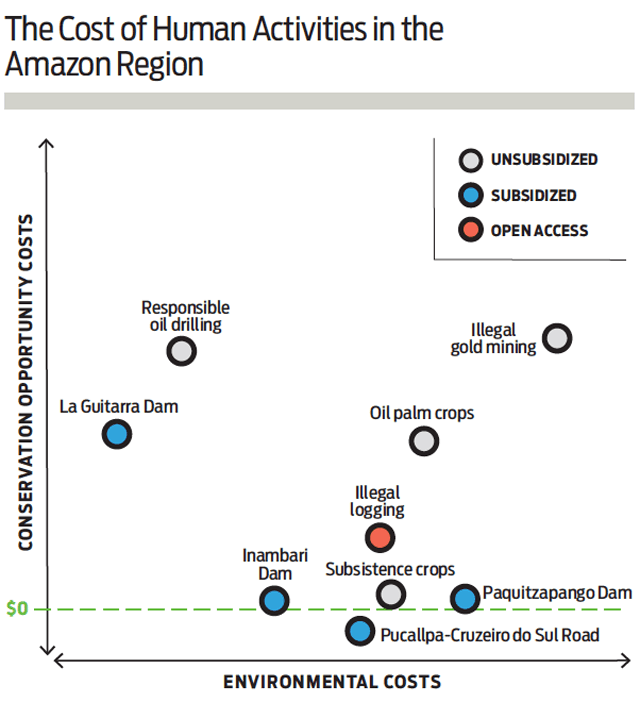
The challenge for conservationists is to figure out where and when to intervene. One way to help is to create a chart that depicts the tradeoffs these threats pose. (See “The Cost of Human Activities in the Amazon Region of Peru.”) The environmental costs of human activities are on the horizontal axis, and the conservation opportunity costs are on the vertical axis. The precise placement of the dots is debatable, but their relative position can yield conservation insights.
At the upper right corner is illegal gold mining in the Madre de Dios region, an activity that generates huge environmental externalities in the form of permanent forest destruction and the poisoning of rivers. Its conservation opportunity cost is also high, because it generates elevated profits without the help of subsidies. Lower in both opportunity and environmental costs is oil palm, which is expanding swiftly in the San Martín and Ucayali regions, displacing forest as it goes. Small-scale cultivation of subsistence crops, such as maize and rice, can be equally destructive, because it destroys forest. Profits, however, are typically low, reducing its opportunity costs.
Three proposed dams in the region show a range of environmental and opportunity costs.11 The Paquitzapango and Inambari dams are both on the very edge of profitability, so forgoing them imposes minimal opportunity costs, but the former would inundate more than twice as much land and displace three times as many people per unit of installed generating capacity. La Guitarra dam is both more profitable and less destructive. Subsidies are not a given for these projects and would not be needed for the most profitable of them, but tax breaks and subsidized credit are common for large infrastructure investments.
Oil production is largely in the planning stages. The dot is placed to the left to reflect a scenario of “responsible” extraction in which the direct footprint of an oil operation is extremely small relative to the scale of the investment and profits. Keeping environmental costs low requires vigilance. Spills must be prevented, pipelines built safely, access roads controlled, and care taken to avoid harming local communities.
We also included the proposed road from the regional capital of Ucayali, Pucallpa, to Cruzeiro do Sul, in the Brazilian state of Acre. Our analysis found the road to be a money-loser just on the basis of its transportation costs and benefits, and to present elevated risks of deforestation and impacts on indigenous people.
The chart reveals several things. First, it shows that there are some low-hanging conservation opportunities—avoiding construction of the road and two of the dams, and providing incentives to contain the spread of subsistence farming. These are projects that conservationists should probably target first. Illegal logging presents a possibility of bringing production within a controlled system of property rights, which exists in Peru, but is bypassed because of inadequate monitoring in the field. In contrast, the high conservation opportunity cost of curbing illegal gold mining explains why the government has used military intervention, and even then had limited success. Despite its impact on the environment, conservation efforts on this issue should be minimal compared to more “winnable” issues, such as stopping roads from opening up new areas to mining. Oil holds the potential to generate profits at a low environmental cost, but government, environmental advocates, and the companies themselves need a lot of hard work to bring this potential to fruition.
Conservation economics has a central role in directing conservationists’ time and energy to their best use in safeguarding the planet’s unique ecosystems. Finding the destructive inefficiencies in the markets driving environmental threats can steer conservationists toward the best opportunities, especially in combination with knowledge of the opportunity costs of conservation. By integrating conservation economics with insights on culture, politics, and, of course, biology, the chances of successfully preserving our planet begin to look pretty good.
Read more stories by Alfonso Malky, John Reid & Aaron Bruner.