


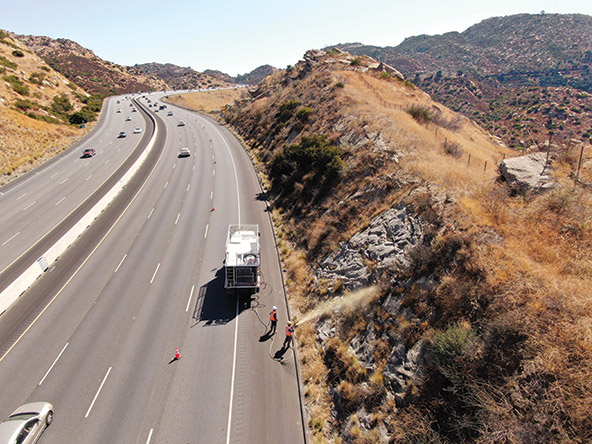
 Two contractors apply Fortify wildfire
gel on dry grass adjacent to a California
roadway that has ignited many times in
recent years. (Photo Courtesy of Jesse Acosta)
Two contractors apply Fortify wildfire
gel on dry grass adjacent to a California
roadway that has ignited many times in
recent years. (Photo Courtesy of Jesse Acosta)
In his day job as assistant professor of materials science and engineering at Stanford University, Eric Appel works on finding solutions for a medical challenge: developing an injectable hydrogel as a carrier for pharmaceuticals—for instance, to help strengthen the immune system of HIV patients.
But when wildfires raged out of control in California two years ago, Appel’s brother-in-law Jesse Acosta, who is a fire researcher at California Polytechnic State University in San Luis Obispo, asked him if it was possible to develop a gel for fire prevention.
Wildfires in the United States burn roughly 10 million acres a year, and fighting them costs more than $2 billion annually. “That’s not even considering the implications for lives lost and property lost,” Appel adds. In 2018, California suffered its worst wildfires in state history, and 86 people died.
Since October 2019, Appel’s fire prevention startup, called LaderaTECH, has produced an opaque, milky-looking gel that can be used to “vaccinate” nature against fires. The gel, which mainly consists of colloidal silica and cellulose polymers, is biodegradable, and Appel says that it does not impair trees and other plants.
Appel and his team outlined their approach last September in the multidisciplinary journal Proceedings of the National Academy of Sciences. “Most people think fires start at random and cannot be predicted,” Appel observes, “but any fire captain can immediately tell you the two or three areas in his district that concern him the most.” After working with the California Department of Forestry and Fire Protection (Cal Fire) and analyzing more than 300,000 fires in California, Acosta found that “84 percent of fires start near roadsides or power transformers.”
Appel’s environmentally benign hydrogel can be mixed with fire retardants and sprayed onto high-risk areas, such as the dried grass near roads that easily ignite from a tossed cigarette. “You don’t have to treat huge areas, just the 25-foot-wide swath along the road that is most at risk,” Acosta says. The gel is supposed to last a whole fire season. “You spray it in the summer, forget about it, and then it still functions as a prevention in the fall when fire season hits,” Appel says. Tests indicate that the gel even withstands an inch of rain, and if it rains more, the moisture decreases the fire danger.
Appel worked on developing the gel for two years through research funding provided by a Realizing Environmental Innovation Program (REIP) grant from the Stanford Woods Institute for the Environment and an Innovation Transfer Grant from the TomKat Center for Sustainable Energy at Stanford University. California firefighters used the gel for the first time in the fall of 2019. Appel emphasizes that he designed it to work with standard equipment, because “we can’t expect fire stations to all get expensive new gear.”
The first test results from four pilots in Ventura County, San Diego County, and San Mateo County are encouraging. “We treated 20 miles of roadside during the red-flag period,” Acosta says about one of the pilots. “We got zero ignitions in the treated area during October.” In November, an area fire smoldering in underbrush was easily extinguished by a fire crew, but, Acosta adds, “according to predictions the fire would have grown to an acre if the area had not been treated.”
There are already fire prevention gels marketed to homeowners as last-minute solutions for approaching wildfires. But they become useless when they dry—usually within hours—and they are also often toxic to plants.
Appel’s hydrogel can be mixed with a fire retardant such as ammonium phosphate that has been approved by the Environmental Protection Agency at both the federal and state levels and used against fires for years. The firefighters who have had the chance to test the new gel see it as a promising possibility. “The gel creates a kind of protective layer around the vegetation that will then not burn,” says Alan Peters, a San Luis Obispo division chief with Cal Fire who has observed the pilots. “We have gathered a lot of data. There is nothing comparable. It has the potential to reduce the number of fires drastically.”
So far, Appel and Acosta have had a hard time persuading fire stations to try out the new product because, Acosta says, “they are used to fighting fires after they started,” rather than preventing them. Appel also points out that emergency fire suppression is the stations’ priority, whereas the funding for prevention efforts is decided by several different agencies.
This May, when LaderaTECH was acquired by fire safety chemical solutions company Perimeter Solutions, the gel took on the official commercial name of Phos-Chek Fortify.
With Australia experiencing the most devastating bush fires in its history, LaderaTECH recently signed an agreement to produce the gel in Australia as well. “The ultimate goal is worldwide adoption of these materials for prevention projects so that we as a broader community can be more proactive at addressing the risks of wildfire,” Appel says. “We hope that this approach allows for more proactive fire management that will be cheaper and more effective than the reactive firefighting we currently do, freeing up resources to improve overall forest management.”
Read more stories by Michaela Haas.