


 (Photo by iStock/IP Galanternik D.U.)
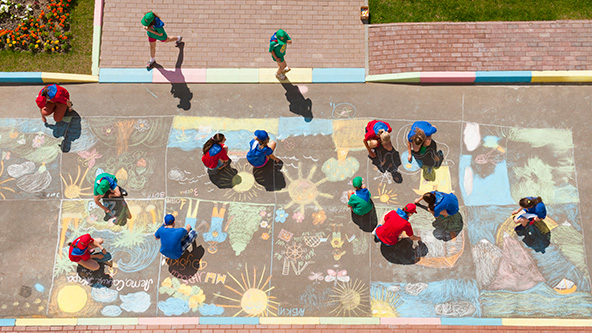
When I was a child, like many children, the street was where I learned how to live in the world. Playing was not just playing. We gathered every evening, first to decide what to play, then making our way through intense debates about how: the rules to follow, the boundary conditions to honor, the alliances that would dictate team formation, and heated discussions over strategies to win. In that one hour, we practiced negotiating, disagreeing, and finding a middle ground. We learned how power shifted, all while retaining our sense of play and wonder. In this shifting social drama, everyone was simultaneously an actor, an audience, a rule-maker, and a student.
When was the last time you saw children playing on the streets? When was the last time this was how you learned?
Today, for children and adults alike, learning can often begin somewhere very different: in search bars, recommendation feeds, and AI-generated summaries. But while conversations about artificial intelligence increasingly revolve around productivity and efficiency, what is lost when the environments that once cultivated social and embodied learning get replaced by systems optimized for speed, convenience, and certainty? Who do we become when our theaters of social learning are outsourced, and when imagination is supplied on demand instead of cultivated through practice? How do these new technological changes reshape the conditions through which people learn, connect, and participate in the world? How do they make meaning of the various social developments happening around them? Are there capacities and skills that must stay stubbornly human even when AI can automate them and do them more efficiently?
Finally: What might this mean for a social sector whose work depends upon precisely these capacities?
For much of human history, what can be called the “developmental commons” were the streets, forests, playgrounds, libraries, and classrooms, shared social spaces where attention was exercised, imagination was stretched, relationships were formed, and, most importantly, knowledge was situated within lived experience. Today, as digital platforms are becoming some of the primary environments in which young people (and many others) learn to relate to themselves and others, we need to explore how the environments in which we spend our time shape the capacities we develop. A growing body of research shows that cognition does not occur solely within the brain, but emerges through interactions with bodies, physical environments, movement, objects, and other people. More than just receiving information, learning is also about the conditions in which knowledge is encountered and made meaningful.
So: What kind of world of learning are we creating?
1. A frictionless world has a cost.
In conservation and environment-related work, restoring the connection between humans and nature is central to a people- and planet-friendly society. Much depends on encountering the living world directly, exploring the wild, and holding its many contradictions and uncertainties. Sometimes this means rigorous scientific observations; other times, using anecdotal insights to bridge the gap between knowledge and practice. In both cases, it means experiencing friction as a feature through real-world engagement.
Can technology deepen connection with nature without becoming a substitute for it, or do we lose our sense of play and wonder when learning becomes frictionless?
Nature is part of the cognitive environment through which learning happens, not outside of it. And this insight has important implications for how we think about technology in the social sector. A community practitioner reviewing an AI-generated summary may gain access to information, but a practitioner spending time in a village, listening to stories and observing relationships, develops contextual judgement and holds local nuance that grounds that information. In many cases, the process through which knowledge is acquired is inseparable from the quality of the knowledge itself.
The challenge, therefore, is how technology can be designed and deployed in ways that strengthen, rather than displace, embodied forms of learning and engagement. Even when technology can create efficiencies and quick wins, sometimes choosing not to use it can help retain productive friction and be the more helpful choice.
For example, the Nature Conservation Foundation programs connecting people to birds have expanded from field-based learning and printed resources to include online courses, digital platforms, and tools that make bird identification more accessible to the public. These efforts have broadened participation significantly, but NCF remains guided by a simple principle: The value of technology lies in its ability to draw people back into a relationship with the natural world. There are innovations that have been able to do this successfully: Tools like Merlin, an AI-powered bird identification app developed by the Cornell Lab of Ornithology, demonstrate a different possibility for technology. But the key is that rather than replacing the experience of being outdoors, Merlin helps people identify birds they see or hear in real time, turning a moment of curiosity into a deeper encounter with the natural world.
2. AI slop is an attention problem before it is an information problem.
We are entering an era where information can be generated faster than it can be verified or meaningfully interpreted. This information abundance obviously magnifies challenges around misinformation, but also around how our attention can be used as a currency. And while the distortion of facts is an important challenge, we also need to look at which facts are being made visible to begin with.
Cognitive neuroscientist Maryanne Wolf argues that the shift toward digitally mediated reading environments may be reshaping cognitive processes associated with what she calls "deep reading," typically associated with the capacity for reflection, for cultivating empathy and critical analysis, and for encouraging inference and imaginative engagement. As information arrives in rapid, broken streams, attention itself becomes fragmented. The consequence is a diminished capacity to stay with complexity long enough for understanding to emerge.
We see the consequences of this shift emerging in different forms. Organizations working on gender equity are dealing with the growing influence of the manosphere, a loose ecosystem of influencers and online communities that rigidly frame masculinity and often promote hostile ideas about it. Generative AI and recommendation systems can accelerate the spread of such narratives, creating feedback loops in which misinformation and polarization travel faster than nuance and dialogue.
A different but equally significant concern is invisibility. Large language models learn from what is documented, digitized, and visible online, focusing on places that receive extensive media coverage, have well-documented institutional histories, and digital footprints. Information on smaller cities, local citizen movements, oral histories, and everyday governance realities often remain underrepresented. This representation inequality makes entire places, communities, and forms of knowledge invisible and absent from the systems through which people learn and make sense of the world.
This is particularly relevant for the social sector. What happens to public trust when attention, not accuracy or representation, becomes the primary currency of the digital age?
3. Social change depends on situational intelligence.
We also need to talk about recovering judgment: Once information is visible, the harder task is deciding what it means, where it belongs, and how it should shape action.
AI's power is its ability to identify patterns across enormous volumes of information. But social change sometimes requires the opposite move. For example, a conservation practitioner deciding how to restore a watershed must understand the particular history of that landscape, the relationships between communities, the local political economy, and forms of ecological knowledge that may never appear in a dataset. Beyond commonalities, it is equally important to stay with the differences.
To this end, Tech4good Community anchors a conservation coalition program that is working with several NGOs to build shared infrastructure for ecological intelligence. They highlight that while interest in AI, analytics, and digital tools is growing rapidly across the social sector, the work they have done with many grassroots conservation organizations demonstrates that organizations today are not just demanding better technology but using that technology in a place-based and locally intelligent manner.
Generalized intelligence needs to be made useful through situational and grounded judgement, with the ability to interpret signals within specific social, ecological, and cultural realities, and to understand when a recommendation should be adapted or ignored. Most importantly, it is important to recognize what is absent from the data as much as what is present.
Learning Capacity to Be Human
This is the paradox of the moment: As intelligence becomes increasingly available on demand, the capacities that may matter are deeply human, not computational. In that sense, the vanishing developmental commons is a story about the environment and experiences we choose to lean into as a society. AI will become more capable. But can we remain intentional about preserving conditions through which people learn to pay attention, make sense of complexity, remain open to wonder, and build coherence between different ways of knowing?
For philanthropy, this may require thinking beyond technology adoption and toward capacity preservation. Supporting institutions, spaces, and practices that cultivate civic trust and value the process as much as the outcome. Perhaps choosing to preserve this inner theater could be one of the most important acts of stewardship we could undertake at this time.
Read more stories by Tanya Kak.