


 (Illustration by Ross MacDonald)
Every morning at 74th Street Elementary School in South Los Angeles, a small figure walks briskly through the front gate. Her name is Linda Ricks; she’s a retired office manager and lifelong community advocate. She carries no special credentials, tablet, or teaching manual. What she brings instead is presence.
Ms. Ricks is one of the volunteers in Generation Xchange (GenX), a program that pairs older adults with elementary school classrooms in neighborhoods where both children and elders often feel unseen. Her role is simple: to listen, to guide, to remind students that they matter.
In one of those classrooms sits Celeste Madal, a fourth grader with bright eyes and quiet determination. “I feel like I know somebody is counting on me,” she says. “And I know that somebody knows I can do it.”
The “somebody” is Ms. Ricks.
Together, they represent what might be the most underappreciated innovation of our time: the power of human relationships to ignite human potential. Over the past decade, GenX classrooms have seen increased reading scores and improved behavioral outcomes in students. GenX also reports in its volunteers increased positive well-being, a sense of purpose, improved physical health, and even weight loss linked to greater physical activity.
As artificial intelligence grabs headlines and investment dollars, Ms. Ricks and Celeste are practicing an intelligence that cannot be automated. It’s the intelligence of attunement, of care, of knowing, and knowing how to know, each other. We might call it relational intelligence (RQ), the deeply human ability to build trust, navigate tension, repair ruptures, and create meaning with others. And it may be quietly rising as the defining skill of our age, the essence of what it means to remain fully human in a world increasingly governed by algorithms and automation.
Across millennia, human intelligence has evolved not simply through logic or invention, but through connection. Our ancestors survived not because they computed faster, but because they cooperated better, learning to communicate and read one another, share stories, resolve conflict, and coordinate care. Now, as machines outperform us in analysis and convincingly simulate empathy, the distinctly human capacity that matters most is coming into sharper relief. RQ is emerging as the next great frontier of human development.
We are entering a pivotal evolutionary moment. The defining challenge of our time is not whether artificial intelligence will advance—it will—but whether we will intentionally cultivate the RQ that makes those advances serve human flourishing, rather than undermine it. In an era marked by loneliness, fragmentation, and the substitution of technology for human presence, RQ is both under threat and newly indispensable. The future of learning, work, health, and democracy will depend less on how smart our machines become and more on how well we design our lives and institutions to strengthen human relationships.
To meet this moment, we must invest not only in new technologies but in relational infrastructure: the intentional design of environments, schools, workplaces, health systems, communities, and digital platforms to make human connection the default, not the exception. It reallocates time from individual output to mutual presence, replaces isolation with connection, and transforms care from a private burden into a public good. At its best, relational infrastructure strengthens learning, resilience, trust, and collective problem-solving. In its absence, loneliness rises, institutions fail, and technology rushes in to simulate what society no longer supports. Building relational infrastructure is not a soft aspiration; it is a hard requirement for human flourishing in the age of AI.
The Evolution of Human Intelligence
To understand our current predicament, let’s review the millennia of development that shaped us into who we are today. The evolution of human intelligence traces a remarkable journey from survival to symbolism to systems of shared meaning. Early hominids developed basic problem-solving and tool-making abilities as their brains expanded to adapt to complex environments. Over time, our ancestors’ growing social groups required cooperation, teaching, and empathy—marking the dawn of social intelligence.
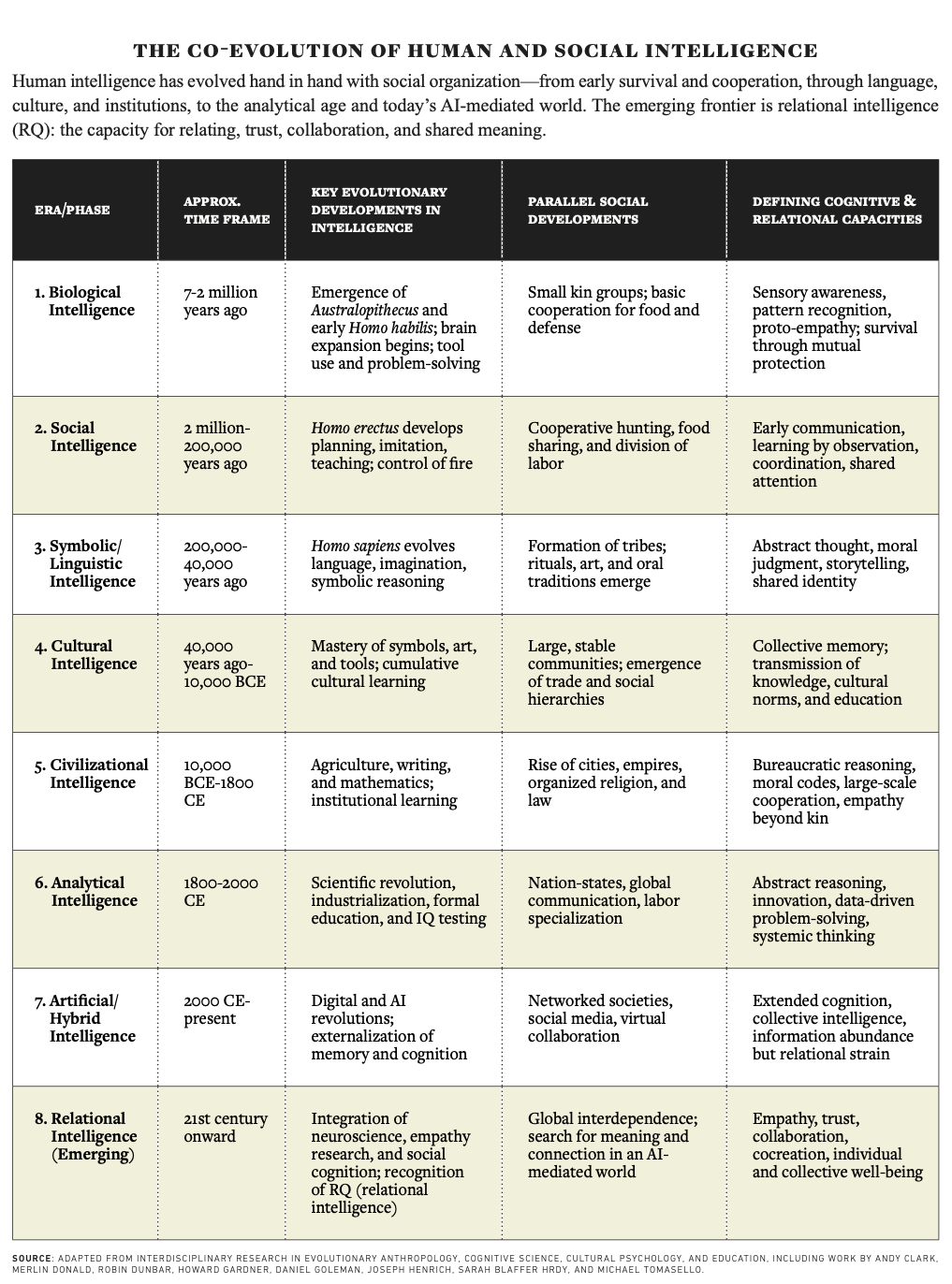
Download a PDF of this table here.
According to anthropologist Robin Dunbar’s social brain hypothesis, our large neocortex evolved not primarily for abstract reasoning or technical invention, but to navigate the complexity of human relationships essential to our survival as a social species. Our human brains are optimized to sustain about 150 meaningful relationships. The number marks the size of a hunter-gatherer band, a Neolithic village, a modern wedding, or active social-media connections. This ability to connect and cooperate became the true driver of evolution.
With the emergence of Homo sapiens, language transformed how humans thought and related, enabling abstract reasoning, imagination, and moral judgment. This cognitive revolution enabled humans to share stories, plan for the future, and build collective identities far larger than kinship or tribe. Storytelling, gossip, and song were not cultural luxuries but evolutionary necessities, tools to cultivate trust and belonging in ever-expanding groups.
As civilization advanced, intelligence became increasingly cultural and collective, encoded in writing, institutions, and technologies that allowed knowledge to accumulate across populations and generations. Humans became cultural evolutionaries, transmitting wisdom through shared norms, rituals, and education. The thread running through every phase of our development is relational.
Social neuroscientist Matthew Lieberman has shown that our brains are fundamentally wired for connection; our need to belong is as basic as our need for food or water. Studies across centuries demonstrate how relational deprivation stunts brain growth and cripples child development. In the 13th century, Holy Roman Emperor Frederick II reportedly ordered a chilling experiment: Infants were fed and bathed but denied speech, touch, and affection, to see what “natural” language might emerge, whether Latin, Greek, or otherwise. Sadly, they didn’t discover an answer—none of the infants survived. Whether fully factual or partly apocryphal, the story has endured because it captures a profound truth we continue to rediscover: Without relationship, humans do not develop and may not live at all.
That same truth reappeared, tragically, in the 20th century in Romania’s state-run orphanages. Under Nicolae Ceaușescu’s regime, hundreds of thousands of children were warehoused in institutions where physical needs were minimally met but relational care was absent. Infants lay in cribs for hours, rotated among caregivers, rarely held or spoken to. The consequences were devastating and well documented: severe cognitive delays, emotional withdrawal, impaired language, and long-term mental-health challenges. Follow-up studies showed that even when children were later placed in families, the early deprivation of stable, responsive relationships altered their brain development.
Today, in rural China, Stanford University economist Scott Rozelle has documented widespread developmental delays among millions of young children left behind as parents migrate to cities for work. While basic physical needs are often met by grandparents or other caregivers, many children experience a profound lack of consistent, responsive adult interaction—talking, playing, reading, and emotional attunement—during the most critical years of brain development. The result is not a failure of care but a large-scale social experiment showing how the absence of nurturing human interaction can quietly undermine cognition, language, and emotional growth. Nearly half of infants and toddlers in rural China are developmentally delayed in cognitive skills. Across centuries and systems, the lesson is clear: Brain development is not forged in isolation; it is built, quite literally, in relationship.
Over millennia, human intelligence evolved from individual survival toward shared intentionality, the uniquely human capacity to coordinate attention, emotion, and purpose with others. In the past century, shaped largely by the demands of industrial and information economies, intelligence has been measured primarily through IQ: the intelligence of logic, analysis, and problem-solving. Over the past three decades, emotional intelligence (EQ), the capacity for empathy, self-awareness, and emotional attunement, popularized by psychologist Daniel Goleman, has gained prominence in schools and workplaces alike.
Yet IQ and EQ may no longer be sufficient markers of human intelligence in an era when machines increasingly outperform us in analysis and convincingly simulate empathy. In one widely cited 2024 study, patients rated ChatGPT as more empathetic than human physicians. The next frontier of human evolution may therefore be RQ, the capacity to build trust, navigate difference, repair ruptures, and create meaning together. In this sense, the next stage in the evolution of intelligence is not artificial—it is profoundly human.
The Relational Recession
Developing a better understanding of RQ is long overdue. Our ways of relating today are not helping us thrive. True, we seem more connected than ever: Our smartphones buzz constantly with texts from others; social media lets us watch our friends’ lives unfold in real time; we can work, date, or attend school without ever leaving our homes. Yet our capacities for relationships are eroding, not expanding.
In 2023, US Surgeon General Dr. Vivek Murthy declared loneliness a public-health epidemic, estimating that its health toll rivals smoking 15 cigarettes a day. Chronic isolation increases the risk of heart disease by 29 percent, stroke by 32 percent, and dementia by 50 percent. Economists estimate the cost to the US economy at $400 billion annually in lost productivity, higher health-care expenses, and premature deaths.
 (Illustration by Ross MacDonald)
The crisis is not limited to the United States. In the United Kingdom, a minister for loneliness was appointed in 2018. Countries like Japan and Canada have launched national efforts to combat social disconnection. In South Korea, the situation has grown so acute that the government now offers stipends to young adults simply to leave their homes, step outside, reenter public life, and reconnect with others. This is a global issue, fueled by major shifts in how we live, work, and interact.
The problem begins early. Research has shown that infants are experiencing fewer conversational turns with their primary caregivers. Data from Stanford’s RAPID-EC survey, which tracks the experiences of families with children under age 5 since the COVID-19 pandemic, reports parents being stressed, less emotionally available, and more reliant on devices to soothe or entertain children. Each time we check our devices—an average of 205 times per day in the United States in 2024—we risk interrupting a moment of relationship. The number of friends a child has is in decline, as well as time spent socializing and playing, while technology is on the rise. Forty percent of American children under age 2 now have their own mobile device. Research shows that toddlers with more than four hours of daily screen time are five times more likely to experience communication delays.
The disconnection continues into adolescence. Studies indicate that American teenagers have experienced a long-term decline in face-to-face peer social interactions. Between 2003 and 2022, one review found, teens’ face-to-face socializing fell by more than 45 percent. In the United Kingdom, one in five children says they feel lonely “often or always.” In Ireland, half of 13-year-olds now report having three or fewer close friends, up from 40 percent 10 years earlier. Isolation has implications on brain development and academic success: Teenagers who feel lonelier are 22 percent more likely to get lower grades.
AI has stormed into our lives, rushing to fill the growing void of human connection. AI companions such as Replika.ai, Character.ai, and China’s Xiaoice now have hundreds of millions of users. Some estimates suggest that more than a billion people use AI companions for friendship, therapy, or even romance. In 2024, Character.ai reported that users spent an average of 93 minutes a day with their bots. Companionship and therapy—once fringe online activities—are now among the top drivers of AI adoption, according to a recent Harvard Business Review report. Young people especially are building relationships with machines that displace human connection. According to Common Sense Media, about one in three teens finds conversations with AI companions to be as satisfying or more satisfying than those with real-life friends.
Why are people turning to AI for relationships? Because we are wired to connect, and AI is stepping into the void left by fading human bonds. Machines are available, attentive, and endlessly affirming. A chatbot never interrupts. An AI girlfriend never rolls her eyes. A synthetic friend always appears to mirror our mood. For the socially anxious, depressed, or isolated, this reliability can provide real comfort. Studies show that AI companions can reduce loneliness in seniors and provide mental-health benefits for some young adults.
But if our most reliable relationships are with machines, our tolerance for the complexity of human intimacy may erode, along with the relational intelligence it builds. Real relationships are full of friction: misunderstandings, silences, needs unmet. They require patience, compromise, humility, savvy, and wisdom. Stanford University researchers have discovered that most young adults who practice conversations with chatbots become confused between machines and humans, and that these tools can introduce biases and failures that could result in dangerous consequences. In Japan, men who form long-term attachments to AI girlfriends report declining interest in real-world dating and family formation, raising broader concerns about social withdrawal and demographic fragility.
These dynamics are beginning earlier in life as well. Children now receive far more frequent affirmation and praise from machines than from humans—by some estimates, 13 times more. Studies have also shown that users of relational AI believe that it is more human and emotionally close than human caregivers. While constant encouragement is essential, human caregiving does something machines cannot: It helps children learn to tolerate frustration, read nuance, navigate disappointment, and repair relationships when expectations are unmet. These moments of rupture and repair are central to healthy social and emotional development.
AI, then, is not merely changing how people interact with technology. It may also be quietly reshaping the relational environment in which human intelligence itself develops, altering whom we turn to, what we expect from each other, and how much effort we are willing to invest in the demanding, irreplaceable work of human connection.
Relational Infrastructure for a Better World
Evidence suggests that our human relational intelligence may be atrophying at a moment when we need it most. To change course, we must determine to build the relational infrastructure that humanity needs to thrive: households, schools, workplaces, and communities intentionally designed to strengthen empathy, trust, and human connection.
Close, supportive teacher-student relationships in early grades predict higher academic achievement years later, even after controlling for socioeconomic status and IQ. Relationships are the bedrock of learning.
Our crisis in relating is driven partly by technology and our inability to be more deliberate about how we use it. Technology will inevitably build or erode relational infrastructure. It is rarely neutral. We must embrace the following principles in managing technology to enhance, rather than destroy, RQ:
Augmentation over automation: Free humans for face-to-face presence. Use technology for efficiency, such as summarizing notes, scheduling, and coordination, so that people can listen, mentor, and care.
Bridges, not buffers: Success should be measured by increases in human-to-human contact (e.g., tutoring tools that prompt more teacher check-ins, not fewer).
Relational safety: Platforms should offer off-ramp mechanisms to connections in real life (“IRL”), transparent data practices, and safeguards against design tricks that isolate and emotionally manipulate users.
To build the relational world we want, we must also design policies, schedules, spaces, and incentives so that connection is not an act of private heroism, but the easiest, most natural path. Since relational infrastructure shapes our entire lives, we must design it to accord with human life stages.
Childhood | Social interaction shapes the brain from birth: The caregiver’s gaze, voice, and touch are the first signals that wire the infant brain for trust. If attachment is the foundation of human flourishing, then policies that support it are not luxuries. They are public goods.
Flexible paid leave and home-visiting programs are the best way to protect the “fourth trimester,” the biologically critical months after birth when caregiver sensitivity shapes stress regulation and executive function in the infant. Attachment-based coaching models such as Circle of Security—Parenting and Attachment and Biobehavioral Catch-up (ABC) have shown, in randomized trials, measurable gains in attachment security. One ABC study found that children in foster care who received the program developed healthier patterns in their cortisol, a biological marker of stress regulation, and made significant gains in executive function, compared with controls.
By the time children arrive at childcare and school, the relational foundation either strengthens or frays. When students feel known and trusted, they take intellectual risks. When they don’t, they retreat. Close, supportive teacher-student relationships in early grades predict higher academic achievement years later, even after controlling for socioeconomic status and IQ. Relationships are the bedrock of learning.
Schools can design for relationships. Small-group advisory systems offer protected spaces where students can pause, reflect, and stay connected—with one another, their teachers, and their families. Community-based projects expand students’ knowledge and appreciation of other adults. Relational schedules—fewer, longer class blocks, with teacher loads small enough that they have time to get to know students—allow for more rewarding and multidimensional human exchanges.
In fact, across the education continuum, intentional relationship-centered models are showing measurable impacts on student engagement and success.
Take San Francisco’s Little School, one of the most coveted private preschools in the Bay Area, which structures its early childhood program around “relationship-based learning” with teachers, peers, and families. Evaluations of such relationship-rich early-learning environments show stronger social-emotional development and school readiness, compared with traditional settings. Similarly, North Carroll Community School in Maryland is designed to promote “Real Life Connections”—cultivating deep relationships, a genuine love of learning, and strong character development. Students not only thrive academically but go on to competitive secondary schools equipped with interpersonal skills and confidence. Their success reflects what decades of research now affirm: When children experience stable, sustained relationships, their brains develop more healthily, their capacity for self-regulation and engagement grows, and academic achievement follows, setting the foundation for lifelong educational, health, and economic well-being.
We see similar results at the secondary-education level. Big Picture Learning, a global network of more than 275 schools, equips every student with a long-term mentor, advisory culture, and extended internships connected to real-world adults. Longitudinal data indicate that Big Picture students persist to graduation at rates that meet or exceed national averages; students from historically marginalized communities show particularly strong gains. In a similar vein, the Consortium on Chicago School Research found that schools strong in “relational trust” were 10 times more likely to improve in reading and math than schools weak in trust. The Search Institute has also elevated a correlation between the number of strong relationships and academic outcomes for high schoolers.
Companies with high levels of trust and social cohesion outperform others in innovation, retention, and profitability. When leaders invest in RQ, they're not being soft. They're being smart.
Workplaces | In adult life, when leaders prioritize authentic, caring workplace relationships, rather than simply focusing on tasks, organizations gain better teamwork, higher retention, and higher morale.
For example, one study showed that workplace relational quality—defined by how much employees felt trusted, supported, and respected by colleagues and supervisors—explained more than 30 percent of variance in employee performance. Google’s Project Aristotle found that psychological safety was the number one predictor of team effectiveness across 180 teams. According to a 2022 report in MIT Sloan Management Review, toxic workplace culture is 10 times more predictive of attrition than compensation is.
Microsoft has been an industry leader in investing in RQ. After CEO Satya Nadella initiated a cultural reset that included manager training in listening, empathy, and coaching, employee surveys showed a 30 percent jump in collaboration scores within two years. Moreover, voluntary attrition at the company fell below industry averages during the tech sector’s Great Resignation, when record numbers of employees quit their jobs in the wake of the COVID-19 pandemic. Analysts widely credit this relational shift with enabling Microsoft’s sixfold market-cap growth since 2014, the year Nadella became CEO.
Microsoft is not alone in netting returns from such an investment. Companies with high levels of trust and social cohesion outperform others in innovation, retention, and profitability. When leaders invest in RQ, they’re not being soft. They’re being smart.
Health care | Few encounters are more intimate, or more consequential, than those between clinician and patient. But doctors are estimated to spend nearly half their day on documentation, which takes away the face-to-face time they have with their patients and can in turn make them less effective at their jobs.
Stanford Medicine’s Presence initiative is exploring how doctor-patient relationships affect healing. The program has already found that when patients feel emotionally connected to their doctors, they’re more likely to adhere to treatments and report better outcomes, even when care is medically identical.
At the Cleveland Clinic, the Communicate with H.E.A.R.T. training program, which in the early 2010s trained clinicians to slow down, acknowledge patient emotions, and close with gratitude, raised patient satisfaction scores by 12 percent in two years and reduced staff burnout by 15 percent. Being present with one another healed both sides of the stethoscope. The program is now integrated into broader communication initiatives and continuing-education offerings by the Cleveland Clinic. In another study, diabetic patients of high-empathy physicians were 40 percent more likely to achieve good blood-sugar control. Other studies show that higher physician empathy correlates with fewer malpractice claims.
In pediatric practices like those promoted by Boston’s Centering Healthcare Institute, group visits bring families together to share experiences, learn together, and form social bonds. The result is not only better child-health outcomes but less parental anxiety and greater community resilience.
Relational infrastructure, sustained across the lifespan, is not only a moral imperative but also a pragmatic foundation for health, learning, work performance and social resilience.
Aging | In later life, relationships are also a powerful determinant of health, dignity, and longevity. Social isolation among older adults is now recognized as a major public-health risk, associated with higher rates of cognitive decline, depression, cardiovascular disease, and premature mortality. One large meta-analysis found that chronic loneliness increases the risk of early death by more than 25 percent—comparable to well-established risks like obesity and physical inactivity.
Longitudinal research from the Harvard Study of Adult Development, one of the longest studies of adult life ever conducted, reveals that strong relationships predict better physical health, psychological well-being, and cognitive function decades into old age. Participants who reported satisfying social relationships in midlife had better memory and executive function in later years, which suggest a protective effect of close, supportive ties.
Social connection also appears to influence neurodegenerative processes. Multiple studies link robust social networks and meaningful engagement with decreased risk of dementia and slower cognitive decline; older adults with richer social lives tend to maintain cognitive functioning longer than peers with limited social ties, even after controlling for other health factors.
Programs that integrate older adults into intergenerational settings and relationship- rich care models show promise. Inter-generational community centers, shared childcare and elder spaces, and consistent caregiver assignments in long-term care are associated with improvements in emotional well-being, reduced behavioral symptoms, and increased quality of life for residents. In relationally enhanced nursing homes, residents exhibit lower rates of agitation, decreased reliance on psychotropic medications, and, in some studies, extended longevity, compared with traditional care models.
Toward a Relational Renaissance
In sum, relational infrastructure, sustained across the lifespan, is not only a moral imperative but also a pragmatic foundation for health, learning, work performance, and social resilience. So how do we start to build this platform for a better life together?
 (Illustration by Ross MacDonald)
We are all familiar with the failures of the current social world: a life of tech engagement and poor relational architecture. Unchecked technology has failed us. So we must begin by acknowledging that we cannot let technology police itself or assume that it has an omniscient understanding of human progress. We must set a technology agenda, just as we set safe speeds for driving, the sequencing rules that govern how aircraft land, or the international laws that make merchant shipping possible. All these systems are regulated to optimize how core technologies serve human flourishing. We must do the same for social media and AI. The renaissance we need is not about inventing smarter machines but about cultivating relationally intelligent humans—capable of trust, care, and collective meaning-making.
Building a better world for relating will not be easy. Our society still undervalues relational skills. Our institutions reward efficiency over connections. Inequality ensures that connection-rich environments are often reserved for the privileged, who are also protected from some of the downsides of isolation. And the lure of machine intimacy, which may assuage the symptoms of loneliness at the expense of RQ, will only grow stronger.
But we can fight back. Education can measure connections and belonging as rigorously as math achievement. Companies can treat trust as a bottom-line asset. Policy makers and philanthropists can fund the infrastructure of good relating in the way they fund highways, by supporting caregiver leave, civic spaces, and community health. Technologists can design AI not as a substitute for intimacy but as a facilitator of it.
Here are 10 recommendations toward creating a relational renaissance:
1. Name RQ as a public outcome. Expand dashboards beyond GDP and test scores to include relational intelligence, belonging, trust, and social capital. Cities can join well-being compacts promoted by the Organisation for Economic Co-operation and Development (OECD), which measure success by human flourishing, connection, and belonging, not just economic growth. Districts can publish school-level relationship and belonging metrics alongside proficiency data.
2. Measure what matters. Adopt validated tools to measure RQ: Relational Coordination Surveys in teams; relational assessments in schools; patient-reported relationship measures in clinics; and early relational-health measures in pediatrics. Then tie funding to improvement, not punishment.
3. Fund time. If relationships take time, budgets must account for it. Pay for fewer students per teacher in education; protect continuity of care in medicine, so patients are seen over time by clinicians who know their history and context; and cap mentoring caseloads in social services so relationships remain meaningful, rather than transactional.
4. Procure for presence. Foundations and government should write requests for proposals that reward technologies that increase human contact—time saved should become time reallocated—and that include relational-safety features, such as clear escalation pathways to human support and strict data minimization practices, to ensure that technology strengthens trust, rather than undermining it.
5. License relational practice. Embed RQ competencies in credentialing. Include residencies in teacher training that prioritize relationship building; emphasize presence in continuing medical education; and include psychological safety in manager certifications.
6. De-risk early love. Scale attachment-based coaching programs—evidence-based interventions that strengthen caregivers’ ability to notice, interpret, and respond to children’s emotional cues—across public systems such as home visiting, child welfare, childcare, and pediatric primary care. These programs could be expanded using braided federal and state funding to reach families during the most developmentally sensitive years.
7. Redesign for connection. This solution will look different across contexts, but the principle is the same: Institutions must be designed around relationships. Schools, in particular, should function as relational hubs, in which teachers serve as relational brain builders. This includes adopting advisory structures: small, stable groups of students who meet regularly with a dedicated adult responsible for knowing them deeply, supporting both academic and emotional growth and maintaining strong connections with families and communities. Schools should also move toward fewer, longer class blocks that give relationships time to form and deepen. In health care, hospitals and clinics can adopt teamlets—small, consistent care teams—and co-visits that bring multiple clinicians together with patients to build trust and continuity. Workplaces can strengthen connection through clear meeting norms (such as no-laptop meetings and intentional turn-taking) and by protecting focus blocks that allow for genuine presence. Communities, too, play a role by investing in relationship-rich public spaces: parks designed for interaction, “third spaces” between home and school where young people belong and cocreate, family rooms in libraries, and intergenerational learning hubs that attract people of all ages.
8. Tame technology and adopt relational rituals. Encourage digital sabbaths and time-bound use of digital technology. Randomized experiments are clear: Even short-term limits can lift well-being and, crucially, reallocate time to in-person socializing. This is not Luddism; it’s training for attention and relating. Families could be further encouraged to hold regular device-free meals—not because it’s quaint, but because shared meals are linked to lower-risk behaviors and stronger child development and learning outcomes. Teams can hold weekly check-ins that include feelings, not just tasks. Neighborhoods can organize block parties, walking buses, and mutual-aid calendars.
9. Steer AI toward RQ. For AI companions, adopt care standards: transparent data practices, handoff prompts to human supports when distress signals appear, and product key performance indicators that reward increased human connection, not just session length. For AI chatbots, require “presence rebates”: document how many minutes per week an assistant saves and how much of that time is reallocated to mentoring, patient touch, or parent outreach.
10. Fund relational infrastructure innovation. Philanthropy can seed a new wave of innovation that builds the connective tissue of society. Investing in relational infrastructure means funding the systems and tools that strengthen human connection—teacher-learner relationships, caregiver networks, and mentoring ecosystems. Just as physical infrastructure expands economies, relational infrastructure expands belonging and collective capacity. Philanthropy must ensure that innovation serves not just efficiency but humanity itself.
By taking these steps, we can start the next revolution in human intelligence. It won’t come from machines that think faster—it will come from people who relate better. From schools that teach love as literacy. From communities that measure progress not by accumulation but by connection. From public officials and foundations that invest in relational infrastructure that serves us.
The Next Intelligence
This plan for enriching our RQ is ambitious, but its vision is simple. We see it at 74th Street Elementary, where Linda Ricks still volunteers several mornings a week. Thanks in part to Linda’s support, Celeste has become one of the top readers in her class. When asked what’s changed, she grins shyly and says, “Ms. Ricks believes in me. That makes me believe in me.”
Linda smiles back. “I just show up,” she says. “And sometimes, that’s enough.”
That, in the end, is what relational intelligence restores—a sense of wholeness, and the recognition that our worth is not in what we produce, but in what we nurture.
We are standing at a crossroads in human history. Artificial intelligence will continue to advance, dazzling and disrupting. But alongside it, quietly, another revolution is possible: a relational renaissance, where the measure of intelligence is not the power to compute, but the capacity to care.
If we choose that path, we might look back a century from now and say:
The 20th century taught us how to build machines that reason. The 21st taught us how to build societies that love.
Read more stories by Isabelle C. Hau.