


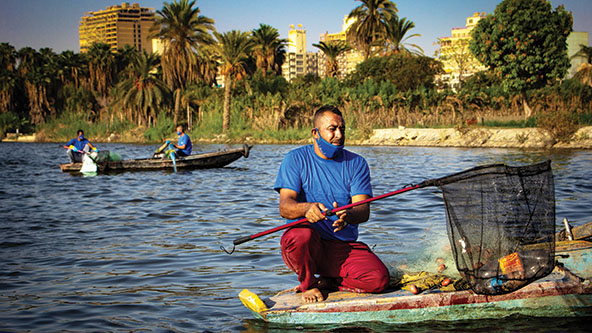
 (Photo courtesy of Yassin Monstasser)
Ninety-six million Egyptians live along the Nile River and depend on it for fresh water, fishing, transportation, and tourism. But the river’s health is increasingly threatened by climate change and pollutants, none more ubiquitous than plastic.
With the dual goal of protecting the vital waterway and supporting communities that depend on it, the Cairo-based, youth-led organization VeryNile is partnering with local fishers and crafters to collect, recycle, and upcycle plastic waste.
Mostafa Habib, one of the organization's founders, was inspired to tackle the plastic problem after talking to his grandmother in Upper Egypt. There, cities like Luxor and Aswan are just as famous for their sparkling blue riverfronts as for their ancient Egyptian temples. The river picks up plastic debris as it travels north through Egypt, a nation that uses an estimated 12 billion unrecyclable plastic bags every year and has limited organized waste collection services. "People treat the river as if it's a place to throw garbage," Habib says. "My grandmother always asks me whether the Nile [in Cairo] will still be dirty the next time she visits."
Habib founded VeryNile with Khadija Hafez in 2018 to address the plastic problem. Its first projects were beach cleanup events. It started working with fishers for on-the-water cleanups in 2019. When gathering for cleanups became less safe with the COVID-19 outbreak, the organization committed more resources to growing its partnership with fishers.
VeryNile also launched its upcycling initiative in 2020. The organization is headquartered in and draws many of its team members from Cairo’s Qursaya Island, located in the Nile, where generations of fishers and farmers have made their homes in informal, semiautonomous neighborhoods.
Working with local fishing communities was a practical choice for VeryNile, and the partnership has helped locals. “They are the most affected by the waste in the water,” Habib says. “They need support because the number of fish they catch has decreased.” On an average day of fishing, a Nile fisherman earns between 50 and 150 Egyptian pounds ($3.18-$9.55). VeryNile pays fishermen 11 Egyptian pounds ($0.70) per kilogram of rubbish they collect, making their incomes less vulnerable to changes in demand for or access to fish.
VeryNile has benefited from the partnership too, as local fishers have intimate knowledge of the river and the skills and tools for efficient cleanup. The organization now works with a team of 45 fishermen, who retrieve about 100 kilograms (220 pounds) of plastic debris from the water every day. The team has collected more than 55 metric tons of garbage since its launch.
Funding for VeryNile’s work comes from like-minded groups, including the Egyptian Ministry of Environment, the Swiss nonprofit Drosos Foundation, and the German environmental organization One Earth One Ocean, which has supported VeryNile since 2019. “We have the same vision,” says Günther Bonin, founder of One Earth One Ocean. “It is easy to work with other NGOs when we have the same goals,” he adds.
Earlier this year, One Earth One Ocean donated a cleaning boat—one of VeryNile’s largest assets and the first such boat deployed in Africa. The cleaning boat can collect as much as 500 kilograms (1,100 pounds) of solid waste per week via a metal basket on its bow.
Once onshore, the collected plastic is sorted and transported to a recycling agency or VeryNile’s headquarters, where its upcycling program is based. Upcycling is the process of turning waste into new products of greater value, and at VeryNile, six craftswomen and two technical experts create products such as baskets, tote bags, and laptop sleeves from rubbish pulled from the river.
VeryNile sells its upcycled products directly to consumers, wholesale, and through collaborations with businesses like Drowzy, a Cairo-based lifestyle brand. VeryNile and Drowzy first collaborated on a collection of home accessories launched for Egypt’s Mother’s Day in March 2021. For Drowzy, partnering with VeryNile was a way to support local communities and reach socially and environmentally conscientious consumers.
According to Alaa Khalil, Drowzy's CEO, VeryNile's crafters were encouraged to steer the design process and showcase their skills throughout the collaboration. “We really believe in empowering every single person in the process,” Khalil says. He believes this collaborative environment is what made the resulting products so unique and successful and inspired a lasting business relationship.
For VeryNile, growing its upcycling program is also part of making the organization more self-sufficient. Its efforts toward sustainability also include ambitious awareness-raising campaigns and community organizing, such as an ongoing effort to ban single-use plastic bags in Zamalek, a wealthy island neighborhood in central Cairo. Going forward, Habib says, the organization will continue to look for new creative ways to address plastic pollution and support local communities while fostering its current relationships.
Perhaps the most promising aspect of VeryNile is the impact of its relatively simple, replicable model. “We are addressing both social and environmental problems,” Habib says, that “can be done anywhere.”
Read more stories by Marianne Dhenin.