


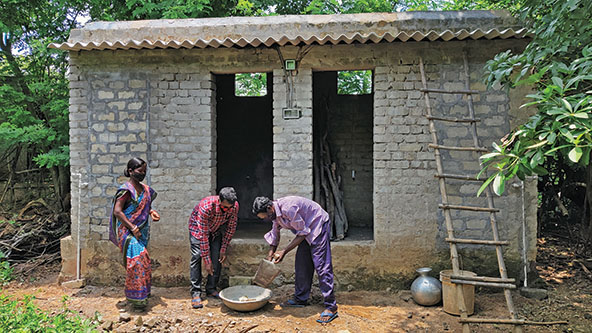
 Santosh Tudu (center) builds a family toilet and bathroom with his brother, Bariyal, and his wife in Hathigadhua, India. (Photo by Puja Changoiwala)
Lakhmi Pradhan was 26 when her younger brother rushed into their home one night screaming in pain, his foot swollen and bleeding, his face turning pale. He said that a snake had bitten him while he was defecating in the nearby forest. Lakhmi was distraught but not surprised. Snakebites were commonplace in the wilderness that the villagers of Samiapalli in the eastern Indian state of Odisha used for toilets. Her concern, however, soon turned into horror when her brother, unable to receive timely medical treatment, succumbed. He was 18.
“A little boy from our village was also bit once, but he lived,” recollects Lakhmi, now 55. “This was in the ’90s when we would walk kilometers to get potable water, defecate in the forest or in the open, and contaminated water sources would cause diseases and deaths. Today, every home in our village has a toilet, a bathing room, and uninterrupted water supply. Had this been the case when I was young, my brother would have lived.”
Lakhmi’s family is one of the more than 80,000 families across 1,435 villages in Odisha who have piped water, household toilets, and bathing rooms, because of Gram Vikas, a nonprofit rural development organization. Founded in 1979, Gram Vikas (Hindi for “village development”) has been working for more than four decades with rural and marginalized communities across Odisha to deliver equitable water and sanitation systems. The NGO takes a sustainable approach by collaborating with rural populations, mobilizing their resources, building their capacities, strengthening community institutions, and promoting social and gender equity.
“There cannot be sustainability unless the entire village is mobilized,” says Gram Vikas’ 72-year-old founder, Joe Madiath, adding that sustainability and equitability were “esoteric” ideas when he first started working in Odisha’s villages. “We have faced resistance in almost every village, as the powerful, the well-off, the upper castes do not want the poor, the women, and the lower castes to be empowered.”
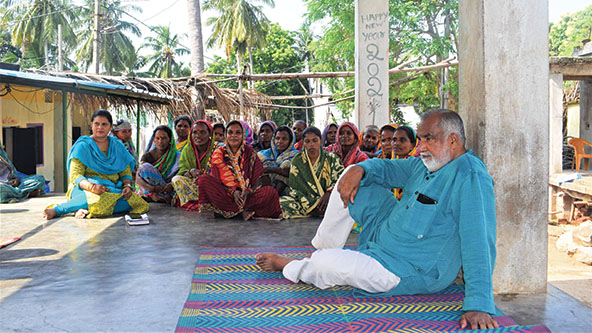 Joe Madiath (right), founder of Gram Vikas, sits with villagers in Tamana, where the MANTRA program has helped farming. (Photo by Puja Changoiwala)
Access to water and sanitation is a fundamental human right. The World Health Organization (WHO) states that a combination of safe drinking water and hygienic sanitation facilities is a “precondition” for health and for success in the fight against poverty, hunger, child mortality, and gender inequality. Yet 91 million people in India still lack access to safe water, according to estimates from Water.org, and 229 million do not have access to improved sanitation—facilities that hygienically separate human excreta from human contact. According to a 2019 report by NITI Aayog, a government think tank, 70 percent of India’s water is contaminated, and the lack of access to safe water claims 200,000 lives each year.
India has made rapid progress in providing water, sanitation, and hygiene (WASH) services to its population in the past few years. For instance, the Narendra Modi-led Indian government, which launched the Swachh Bharat Mission (Clean India Mission) in 2014, declared in October 2019 that the South Asian nation was “open-defecation-free” through the construction of more than 100 million toilets in rural India.
But some villages in India’s hinterlands tell a different story. According to a 2021 report by the WHO and UNICEF, at least 15 percent of the Indian population still defecates in the open. This statistic includes villages like Hathigadhua in Odisha, a tribal settlement located on the outskirts of the capital city of Bhubaneswar. A village of 31 households and 192 people, Hathigadhua has 15 toilets made under the Swachh Bharat Mission, most of which lie unused. A majority of its population continues to defecate in the open.
“We cannot use those toilets because there is no water in the village,” says Laba Murunu, a 26-year-old resident. “The government has made toilets, but they haven’t provided water supply. We informed officials about the crisis in our village. They dug a well, but it stays dry, especially during the summers. What use are the toilets without water?”
Such deficiencies continue to leave room for Gram Vikas and other NGOs that have been filling in for the government over the past four decades. Through its flagship program, MANTRA (Movement and Action Network for Transformation of Rural Areas), Gram Vikas develops community-based water supply and sanitation systems in villages while ensuring safe water sources and elimination of open defecation. Through its focus on long-term sustainability, the program offers inclusive, equitable, and dignified solutions for rural communities, thereby promoting community empowerment, democratic institutions in villages, behavioral transformation, and social and gender equity. From its simple starting point in water and sanitation, Gram Vikas has transformed lives and social relations across Odisha.
The Early Years
In October 1971, a devastating cyclone claimed 10,000 lives in Odisha, the sixth-most cyclone-prone area in the world and one of India’s poorest and least developed states. Madiath, then a student volunteer from the neighboring state of Tamil Nadu, traveled to Odisha with 400 other volunteers to help with relief operations. After the crisis passed, several of these volunteers decided to stay in Odisha to work on rural development and assist villagers with irrigation technology and agriculture. This group formed the core of Gram Vikas, which eventually registered as a nongovernmental organization in January 1979.
Gram Vikas launched to enable poor and marginalized rural communities achieve dignified lives. It initially focused on Adivasi, or tribal minorities in the state, addressing issues such as health care, childcare, illiteracy, land alienation, degradation of natural resources, and restoration of wastelands. Among other solutions, they set up small-scale biogas plants for households. By 1993, Gram Vikas had built biogas plants for 54,000 families, enabling them to access a safe and renewable source of energy for cooking. The organization also addressed the alcoholism and debt of thousands of villagers by ousting liquor merchants and exploitative moneylenders.
In 1992, Gram Vikas conducted a study to understand the link between water, sanitation, and health. It revealed that 80 percent of the morbidity in rural Odisha was due to poor quality of drinking water, largely caused by laxity in human waste disposal. Contamination led to cholera, diarrhea, scabies, typhoid, and dysentery. In 2004, the organization conducted another survey, involving 4,399 households in 49 villages across 9 districts of Odisha, which revealed that less than 1 percent of the people had access to piped water. These discoveries urged a new focus that would become Gram Vikas’ central mission.
“In the early ’90s, public policy on sanitation was very sketchy. The government did not believe that it had the resources or ability to cover rural areas with piped water,” says Liby Johnson, executive director of the organization. “So Gram Vikas, for the first 10 to 12 years, fought a lone battle, even among its NGO peers, as people then did not think that water and sanitation were priority issues. It took us four years to convince the first five villages for our water and sanitation program.”
The pilot project covering water and sanitation for 337 families in five villages was the MANTRA program. The approach involved developing a community-based water supply and sanitation system in villages, where ensuring safe water sources would involve elimination of open defecation through the construction of toilets and bathing rooms with piped water. MANTRA, which focuses on inclusive, equitable, and dignified solutions for rural communities, forms the overarching framework of Gram Vikas’ work in rural development.
It is also the organization’s most impactful social innovation. Over the years, Gram Vikas has won several awards for its water and sanitation program. These include the 2018 India Sanitation Coalition-FICCI Sanitation Award for contributions in the field of sanitation; Stars Foundation Impact Award in 2013 for WASH; the 2009-2010 Water Digest Water Award, supported by UNESCO, in the category of Best Water NGO; the 2007 Skoll Award for Social Entrepreneurship; and the Kyoto World Water Grand Prize in 2006 for addressing critical water needs of communities, among others.
The organization’s road to success, however, was not smooth. Madiath says that when he first devised the program, many, including his colleagues, dismissed the “too idealistic” idea. Government officials found it impractical that the organization wanted to provide running water to villages at a time when even the capital city of Bhubaneswar did not have complete access. “They’d ask me to come off that high pedestal,” Madiath says. “No one believed it was possible.”
The MANTRA Program
Gram Vikas brought the MANTRA program to Hathigadhua in September 2020. It represents the most up-to-date version of its complex and staged intervention. The community-based initiative involves building toilets and bathing rooms for every household. An overhead water tank dispenses safe, piped water to the homes through three outlets, one each in the toilet, bathroom, and kitchen. In promoting these constructions, Gram Vikas is also mobilizing community resources, strengthening village institutions, and addressing the social exclusion of the poor, the lower castes, and women in rural Indian society—all while addressing one of the country’s most important health concerns.
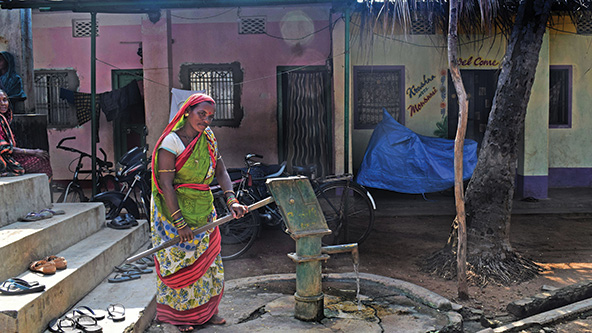
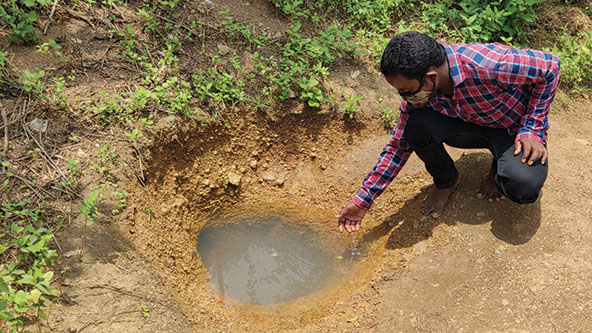 Maina Pingwa of Hathigadhua points at a tiny, dug-out well that villagers use as a drinking water source. (Photo by Puja Changoiwala)
India is home to 18 percent of the world’s population but has only 4 percent of global water resources. It ranks 120th out of 122 countries on the water quality index. In the five years leading to 2017, India registered 69.14 million cases of four waterborne diseases: cholera, diarrhea, typhoid, and viral hepatitis. The World Bank estimates that about 21 percent of the communicable diseases in India are water related.
Waterborne diseases affect nearly 37.5 million Indians annually, and unsafe water leads to stunted development in approximately 20 million children every year, according to a 2017 World Bank report, “Waterlife: Improving Access to Safe Drinking Water in India.” Noting the enormous health burden of poor drinking water in India, the report states, “The single largest cause of ill health and death among children is diarrhea, resulting from the inadequate water quality along with poor sanitation practice and hygiene. Additionally, 66 million Indians are at risk due to excess fluoride and 10 million due to excess arsenic from drinking water.”
The report’s findings ring true in villages like Hathigadhua, where diseases due to contaminated water are rampant. The sources of drinking water are tiny dug-out wells called chuha in local parlance (Hindi for “mouse”)—about a foot deep, dry in summer, offering sandy water in monsoons that villagers strain and boil before consuming. Santosh Tudu, a 36-year-old resident of the village, says that many have fallen prey to waterborne diseases in the hamlet, especially diarrhea. “There are no doctors in the village, and the closest hospital is 5 kilometers away,” Tudu says. “With no means of transport, we usually have four people carrying the ill on a charpoy bed, walking to the nearest facility.”
The MANTRA program employs a three-pronged approach to sustainability: institutional sustainability through the formation of village councils, social sustainability through mechanisms of equity and inclusion, and financial sustainability through the creation of capital and maintenance funds. The intervention begins with a motivation period. As a nonnegotiable condition of the MANTRA program, Gram Vikas requires the unanimous support and participation of all adult members of a village, irrespective of their caste, class, gender, and economic status. The purpose, Madiath says, is to ensure inclusion: The clause requires that the poorest and the socially marginalized participate, contribute, and enjoy the benefits of the program. It also pulls them into decision-making and asset management processes that have historically excluded them.
Since MANTRA insists on diluting long-standing cultural protocols, the program often meets stiff initial resistance from the powerful. Over the past four decades, Madiath has encountered several villages where the upper castes have asked him to forgo the “dirty fellows” of “backward” classes and implement the program only for the rich. The upper castes give in only when they’re made to understand that if the poor did not have toilets, they would continue to defecate in the open, contaminating the water source of the rich. The fear of consuming water soiled with a lower-caste person’s feces creeps in, and some of the rich end up sponsoring the infrastructure for the poor.
“The water source—a common, overhead water tank—is the biggest problem,” Madiath says. “The upper castes do not want to drink the same water that also serves lower-caste homes.”
Although reaching a consensus takes anywhere between a few weeks to years, it eventually empowers the underprivileged. Johnson, the executive director of Gram Vikas, cites the example of Dengapadar, a village in Odisha, where Dalits, or the “untouchables”—members of the lowest social group in the Indian caste system—could not walk the streets with their footwear on. A year after Gram Vikas started implementing MANTRA in the village, Dalits began defying the age-old norm.
“It just empowers them [the lower castes] to say that, hey, what’s the big deal?” Johnson says. “I defecate in a similar place as you. I drink the same water as you. So what’s the difference between you and me?”
While integrating those from socially excluded classes is challenging, Gram Vikas has also encountered villages where huge parts of the population were opposed to the idea of toilets and bathing rooms. “The culture was to defecate outside,” says Lipika Verma, a senior coordinator at Gram Vikas. “People did not want toilets inside their homes because they believe gods dwell inside homes, and toilets make the homes impure. Now, that mentality is changing.”
Building Village Institutions
In the next phase, Gram Vikas sets up a Village Executive Committee (VEC), comprising five men and five women from the village. This step ensures that residents assume responsibility for the processes that affect them. Villagers elect the members, and the VEC has proportionate representation from all caste and class groups in the community. The VEC is registered under the Societies Registration Act, 1860, and this legal status enables villagers to access government offices more effectively and secure public resources for their development needs.
Recruiting and forming a governing body of erstwhile excluded participants can often take a lot of time and energy. Madiath says that villagers are especially opposed to women participating in decision-making processes, arguing that their role is essentially to cook, clean, breed, and take care of the family. At times, women, too, question the sudden cultural shift.
In the village of Khajurisahi, for instance, villagers depended on two wells for water, using the same source to drink, wash, clean, and bathe their cattle. Women would walk for about a kilometer to draw water from the wells, standing in queues for hours, awaiting their turn. Diseases abounded in the village, and despite the ill health and the daily drudgery, women did not want to join the VEC or attend its meetings.
Speaking about her own reluctance, Radhika Sabar, a 45-year-old member of the village’s VEC, listed the reasons for her hesitancy. She feared missing daily wages if the VEC meetings ate into her time. She worried about missing household chores. She also fretted about assuming a leadership role—she had never been in that position before, nor had she seen other women in that capacity. “But since we were so desperate for water, I gave in,” Sabar says. “Now, we make sure that everyone—men and women—attends the meetings. We also impose a fine on those who miss attendance.”
While women are reluctant in some villages, in others they take the lead. For example, in Mohakhand, the men opposed MANTRA, calling the infrastructure a “waste of money,” but the women were keen. In the absence of a forest, they would line up on the sides of a street to defecate and were exasperated about the shame. They tried to convince the men to accept the program, and when they did not listen, the women shut the household kitchens for two days until the men agreed.
Some women feel empowered by the equal representation clause of MANTRA. Pata Pradhan, a former member of the VEC in Samiapalli, says she did not believe that women had the same rights as men until she became a part of her village VEC.
“I realized that it was okay to speak my mind and ask for my rights,” Pradhan says. “Today, women in my village have a voice, a say in issues that affect them. Some others have gone on to win greater victories. For example, a woman, who was part of a VEC in the neighboring village of Charmaria, is now a member of the Parliament.”
Capital and Financing
Gram Vikas insists that the community build capital as well as leadership. The MANTRA program requires a onetime contribution of INR 1,000 ($13.30) per household, which the organization considers the “acid test” of the community’s commitment to WASH. In practice, poorer households contribute less, while better-off households pay more. These fees are pooled and deposited, and the interest accruals are used to provide subsidies to new families in the village, enabling them to construct their own toilets and bathing rooms, thus maintaining 100 percent coverage.
The village of Samiapalli, for instance, now has a corpus fund of INR 183,156 ($2,442). When the MANTRA program started in the village in 1994, 76 families had contributed INR 1,000 each, and a part of the interest accruals was used to build toilets and bathrooms for the five additional families that came to reside in the village over the years. Similarly, the village of Tamana started with a corpus fund of INR 84,000 ($1,120); its value has nearly doubled to INR 158,419 ($2,112).
While most villages use the corpus fund to help new families with their infrastructure, some villages spend the excess amount on other development projects. In Raulibandha, for instance, villagers used INR 40,000 ($533) from the corpus fund to dig a 35-foot-deep well to help with agricultural needs.
Gathering money for the corpus fund, which is managed by the VECs, is a slow process. In the village of Khajurisahi, for instance, it took several months before the VEC managed to pool INR 50,000 ($667) from the village’s 50 families. “Not everyone can afford to pay a thousand rupees,” says Jalinder Sabar, president of the VEC in Khajurisahi. “Some pay in monthly instalments of about 100 to 200 rupees ($1.30 to $2.60) per household.”
At times, the contribution requirement generates resistance to MANTRA. In Samiapalli, for instance, the poorer residents did not want to contribute. Vishwanath Pradhan, former president of the village’s VEC, had to hold several meetings before the villagers agreed. “We also arranged a visit to a nearby village, where Gram Vikas had completed a MANTRA project,” Pradhan says. “When the villagers saw the benefits of the infrastructure, they were convinced.”
Johnson says that although it is difficult for the poor to pay the required amount, the corpus fund is necessary to ensure that people do not compromise on sanitation. “The corpus fund was originally designed as a sanitation corpus, because we knew that for water, people will somehow find ways to repair a broken water supply system because they need water,” Johnson says. “But with sanitation, that was never the case.”
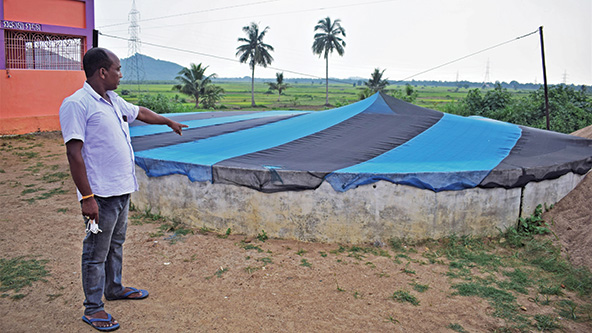 Murali Reddy, president of the Raulibandha VEC, points to the well the village constructed with money from the corpus fund. (Photo by Puja Changoiwala)
Gram Vikas believes that the poor can and will pay for their development. It asks villagers to contribute about 50 percent of the total cost of toilets and bathing rooms (total construction cost is about INR 26,000, or $346, as of early 2022). Villagers also pay about 10 to 15 percent of the total cost of establishing the water supply system. This requirement, the organization believes, builds a sense of ownership and motivates villagers to care for the assets created.
To help villages pay for their development, Gram Vikas offers financial support from its own funds. Gram Vikas receives money from national and international NGOs, multinationals, and donors like the Bill & Melinda Gates Foundation, the United Nations Development Programme, UNICEF, the Skoll Foundation, charity: water, and Karl Kübel Stiftung. It also partners with corporations such as the Aditya Birla Group, NALCO Water, the Steel Authority of India Limited, and the Tata Group, in addition to corporate social responsibility partnerships with companies like HDFC Bank and InterGlobe Foundation.
For infrastructure construction under MANTRA, Gram Vikas offers financial support to villagers through government programs or corporate sponsorships or funding from other donors, while villagers raise the remaining amount in kind—collecting locally available materials (sand, stones, bricks, aggregate) and providing physical labor for the construction. In some cases, they pay cash.
In the village of Raulibandha, for instance, the total cost of construction for toilets and bathing rooms for the village’s 201 households was INR 802,500 ($10,700). Gram Vikas contributed 54 percent of this amount; the government paid 6 percent; and villagers contributed INR 325,800 ($4,344), or 40 percent of the total cost. Jogi Reddy, former secretary of the VEC in Raulibandha, says that many villagers were hesitant because of the cost. “So the VEC decided to give interest-free loans to villagers who could not afford the expense,” Reddy says. “At least 30 percent of the people availed these loans before the construction started in 2002.”
When Gram Vikas first started implementing MANTRA, this cost-sharing aspect raised many eyebrows in the NGO sector, Johnson says. “But our position was … if things have to be sustainable, handing out is not going to work. People have to feel the pinch. Even today, giving a thousand rupees for the corpus fund is not easy. But doing so brings ownership, and not just ownership, dignity … that no one gave this to us, we built this on our own.”
MANTRA also requires villagers to create a maintenance fund to pay for their water consumption and cover operational expenses, including the pump operator’s wages, the electricity bill for pumping the water, and the ongoing maintenance. The VEC in each village fixes the fee, and every household contributes an average of INR 50 ($0.60) per month. Villages have recently started installing water meters, and families pay volumetrically for the amount of water they consume.
 Guruvari Mallick, a resident of Tamana, works as a mason after receiving training through Gram Vikas’ MANTRA program. (Photo by Puja Changoiwala)
In order to generate cash for the maintenance fund, several villages have set up their own common resources like village ponds, which are used for pisciculture, and uncultivated, abandoned lands, which have been turned into orchards. The money generated is used to settle the contribution of all households in the village toward the maintenance fund. A few villages pay a part of their annual harvest toward the fund, while some others have their trained masons and plumbers maintain the infrastructure, reducing the associated costs.
Taking Ownership of Infrastructure
Gram Vikas insists that villages take more than just financial responsibility for the construction and maintenance of their infrastructure. Under MANTRA, every household in a village constructs its own toilet and bathing room. The water is supplied from an overhead water tank constructed to provide 70 liters per capita per day, projected for the population 20 years hence. Solar- or electricity-powered pumps move the water.
Residents of a village, both men and women, are afforded the option of taking a 75-day training in basic masonry skills. Trained villagers can build their own toilets, shower rooms, and the elevated water reservoir of the village. The new masons also assist other residents in building their infrastructure, often at no cost. Many others train to be plumbers and help install taps and the village’s water supply system under the supervision of trained plumbers. Gram Vikas offers guaranteed work opportunities to the trainees for two years after their training.
In the village of Hathigadhua, after MANTRA was initiated in September 2020, about 25 men and women were trained in masonry. One of them was Santosh Tudu, who used to earn INR 250 ($3.30) a day as a construction laborer. “After the training, my daily income has increased to INR 600 ($8),” Tudu says. “I’m also building my own toilet and bathing room.”
The women of Tamana, meanwhile, claim to be the first female masons of Odisha. They were trained by Gram Vikas after MANTRA was initiated in the village in 1995. The women built their own toilets and bathrooms and also transformed their erstwhile kutcha homes into strong, brick-walled dwellings. Guruvari Mallik, a village mason, says she would pick firewood from a nearby jungle for a living before she received her masonry training. Despite toiling throughout the day—collecting wood, sorting, cutting, and stacking—she would earn only INR 30 ($0.40) a day.
“Now, I earn at least 500 rupees ($6.60) per day,” Guruvari says. “There are 14 other women like me in my village.”
Gram Vikas insists that all toilets and bathing rooms in a village be similar. If villagers were allowed to build according to their financial status, the rich would fashion better ones, while the poor would end up with mediocre facilities. “In that case, we’d be perpetuating whatever difference existed in the society between the rich and the poor or the upper castes and the lower castes,” Johnson says.
According to Nimai Nayak, project coordinator for Hathigadhua, building the infrastructure takes a month or two, but since villagers often take time to secure material in stages, the process gets prolonged. “We support them financially, but it isn’t sufficient, so they also contribute, which takes time,” Nayak says. “Villagers don’t usually have to pay for labor, as the trained masons in the village help them with the construction.”
Although Gram Vikas has implemented MANTRA in hundreds of villages, the program does not succeed everywhere. In the village of Jhadakuda, for instance, Gram Vikas completed MANTRA in 2005, constructing 118 sets of toilets and bathrooms and building a water tank. In 2009, however, villagers noticed that the water had turned sandy.
Tarkeshwar Reddy, a 38-year-old resident, says the water was no longer fit for consumption, and the contamination caused blockages in a few water supply pipes and damaged the toilets and shower rooms in some homes. The village has been living without piped water since, relying on a pond to wash and bathe and traveling several kilometers to get potable water. “We approached the government, and they’ve been promising to take this up for years,” Reddy says.
After 2009, Gram Vikas dug a bore well to find an alternative source of water, but that source, too, yielded contaminated water. When probed, Kailash Sahu, former Gram Vikas representative for the village, says that the water gets contaminated at the source because the area is in a salty zone. “We’re thinking of adding a purification unit to refine the water,” he says.
Behavioral Change
Such water contamination is just one of the many complex challenges Gram Vikas faces. The MANTRA approach would collapse if Gram Vikas did not focus on long-term behavioral change in the sanitation practices of rural communities. In order to facilitate this, the organization conducts awareness campaigns in villages to inform people about the importance and benefits of personal hygiene, including washing hands and trimming nails; the need to keep their new facilities clean; and the necessity for all members of the family to use the facilities at all times.
The VEC draws up codes of behavior for its villagers, and it inspects all toilets and bathing rooms regularly to ensure that the facilities are kept clean. Open defecation attracts a fine; so do owners of dirty toilets and bathing rooms. The fines became necessary, says Pradhan of Samiapalli, because even after the infrastructure was built, many villagers did not use the facilities. Behavioral change takes longer than infrastructure development, he says, but the penalties ultimately deterred people from open defecation.
“Anybody who was found defecating in the open had to pay a fine of 10 rupees ($0.10). The practice stopped after we penalized about 10 to 12 people,” Pradhan says. “We also awarded cash prizes of 5 rupees ($0.06) each to every person who reported on open defecators.”
Rukmini Reddy, a health-care worker in the village of Raulibandha, says that although the toilets and bathing rooms were constructed, children in the village continued to defecate in the open, threatening to contaminate the water source. With toddlers, their mothers continued to throw their stools on the street. “Thereafter, Gram Vikas organized a child feces management training in the village, addressing these issues,” Rukmini says. “Now, even the youngest of kids use washrooms.”
Prafulla Gouda, president of Samiapalli’s VEC, attributes the village’s progress to this behavioral change. He says that MANTRA catalyzed fundamental changes in people’s conduct and outlook, leading to holistic progress. Villagers gained greater awareness of their health, vaccinations, education, democratic processes, and financial stability. One good thing leads to another, he says, creating a circle of prosperity.
Citing an example of alcohol abuse in the village, Gouda says that many in the village were caught in a web of debt, as hooch sellers would give alcohol on credit to those who couldn’t afford it and then seize their harvests to waive off the debts. This dynamic would hamper the villagers’ health as well as livelihoods. “MANTRA built a progressive perspective in us,” Gouda says. “We could tell between good and bad, and soon we abolished the alcohol shops. Now, the nearest wine shop is 5 kilometers away. Every child goes to school, and we have a sanitation drive in the village every fortnight.”
In addition to its other initiatives, Gram Vikas runs four residential schools in Odisha, where 1,500 children from MANTRA villages and other marginalized communities obtain free education, room and board, and other necessities. The Gram Vikas High School in Kankia, for instance, has 481 students, studying grades 3 to 10. Opened in 1982, the school has a 3D printer, a computer lab, a gym, and a science lab.
“These kids come from families where education is unaffordable, and hence not a priority,” says Devendra Dash, principal of the school. He cites the example of two brothers—both 15-year-olds—who did not return to school after the government eased COVID-19 lockdown restrictions in 2021. “We learned that the boys’ family had sent them to a fish factory in the state of Andhra Pradesh, where they worked as child laborers,” Dash says. “We went to Andhra Pradesh, rescued the boys, and brought them back to school.”
Pradhan of Samiapalli says that in addition to the WASH facilities, MANTRA has democratized the village. “Earlier, we wouldn’t agree on anything,” he says, “but now, we resolve everything within the village, whether it’s personal disputes or larger issues like infrastructure, development, and health, which concern the entire population.”
In villages like Tamana, meanwhile, there has been a marked drop in migration from the village. The water supply system has enabled irrigation, and agriculture has turned profitable. Kailash Mallik, a resident of the village, exuberantly lists the vegetables he grows: “Tomato, eggplant, cabbage, cauliflower, corn, beans, okra. … In fact, one year, we grew so many tomatoes that the price dropped to 2 rupees ($0.02) a kilogram, the lowest we’ve seen in this century.”
The most important benefit, however, is the sense of community. “We learned that unity is power, and if the entire village came together, we could control our destiny,” Reddy of Raulibandha says. “You cannot make a garland with a single flower. All the flowers have to unite to make one.”
The Way Forward
Gram Vikas’ pioneering attention to India’s water and sanitation challenges has become public policy. The Indian government has introduced many programs in the past few decades, with a focus on WASH for rural communities. Apart from the Swachh Bharat Mission, the Indian Ministry of Rural Development launched Swajaldhara in 2002, a drinking water supply program for rural areas, which involved many cornerstones of the MANTRA approach—cost sharing, community contribution in infrastructural development, and community participation in management of assets. The Jal Jeevan Mission, meanwhile, was launched by Prime Minister Narendra Modi’s government in August 2019. It restructured an ongoing water supply program and aims to “provide safe and adequate drinking water through individual household tap connections by 2024 to all households in rural India.”
In 2019, as the organization entered its fifth decade of operations, Gram Vikas reviewed its past work and set out its priorities for the immediate future. With the government’s active focus on rural water and sanitation programs, Gram Vikas decided to shift its attention gradually from building WASH infrastructure to ensuring water security. The organization would continue to build on existing programs but increase its focus on innovation and solution building in an era of climate change.
“This involves reducing the risks in farming, having water-secure villages, converting local meteorological information into farm and crop advisories, using technology to predict the soil type and ideal crops to be grown in that soil, setting up weather stations that can predict humidity and thus pest attacks, rainfall predictions to enable water-smart irrigation, among others,” Johnson says. “So we are looking at water security in a manner that is comprehensive in terms of quantity, quality, and risk reduction.”
Even though the government has committed itself to MANTRA-style programs, the need for Gram Vikas’ activity in the WASH sphere remain. Subash Chandra Das, an official with Odisha’s Panchayati Raj and Drinking Water Department, says that the state needs more organizations like Gram Vikas. He added that if all such organizations joined hands and helped the government implement its programs and projects, the benefits could reach the poorest and most downtrodden people in the remotest areas of the state.
Gram Vikas insists that MANTRA will continue, albeit on a smaller scale. “Because we focus on some of the more remote, less accessible areas, where population is thinner than average parts of Odisha … there will always be gaps that we will be filling,” Johnson says.
For many, however, MANTRA has already had a substantial positive impact. Anupama Gouda, a 30-year-old woman residing in Samiapalli, says that unlike in the past, women today do not agree on a marriage without ensuring that the groom has a toilet, bathing room, and piped water supply in his home. “We make these inquiries before the marriage is fixed. I, too, asked the same before I agreed to the wedding,” Anupama says. “Health and hygiene are related, we know now.”
In some villages, meanwhile, the staunchest critics of sanitation infrastructure have switched sides. Sudarshan Gouda, a resident of Raulibandha, says that his father was completely opposed to toilets and bathrooms, as he did not want the “dirty, filthy rooms” in the home where his family cooked and prayed. Even after the infrastructure was constructed, he preferred defecating in the open.
“But as he got older, he began to realize that he could no more walk long distances to relieve himself,” Sudarshan says. “The dirty, filthy rooms, then, turned into saviors.”
Read more stories by Puja Changoiwala.