


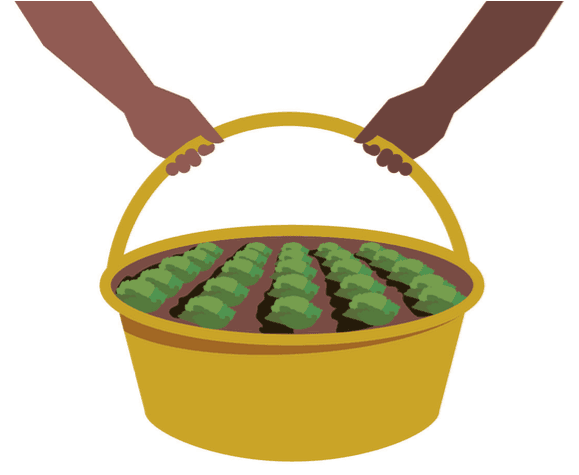
 (Illustration by Ben Wiseman)
It’s well known that strong social networks can lead people to engage in cooperative behavior. But what are the underlying forces that help build and sustain such networks?
Delia Baldassarri, a professor of sociology at New York University, posits four mechanisms that may drive people to work together in a collective endeavor. Two of them, general altruism and group solidarity, are motives that stem from a concern for others’ welfare. And two of them, Baldassarri explains, involve people’s expectations about what others in a network might think or do: “It may be reciprocity: When you interact repeatedly, you learn that others are cooperative—which makes you more willing to cooperate. Or it might be sanctioning: The fact that you are well connected makes it easier for you to check on other people and for them to check on you.”
To evaluate the relative significance of these mechanisms, Baldassarri conducted a study of producer organizations in Uganda. By joining one of these groups, farmers can pool their crops and sell the crops at higher prices than they would receive otherwise. But the success of producer organizations depends on maintaining a high level of voluntary cooperation. Such cooperation is necessary to coordinate crop pooling, to recruit enough members to make pooling worthwhile, and to limit “free riding” (in which nonmembers benefit from members’ cooperative activity).
Farmer cooperatives in the developed world serve a similar function and face a similar challenge. Consider Organic Valley, a cooperative based in La Farge, Wis., that serves organic dairy farmers. George Siemon, founding member and CEO, says that he helped start that organization in the late 1980s out of frustration with market price fluctuations. “Instead of just [taking] what the market will give us, we came at it from a different perspective: What does a farmer need to make a living?” Today Organic Valley—one of the largest organic farmer-owned cooperatives in the world—helps keep the prices for organic dairy products relatively high. But farmers benefit from the higher pricing level even if they don’t join the co-op.
Baldassarri, in the initial phase of her study, collected data on the social networks of nearly 1,500 members of 50 Ugandan producer organizations. She examined those data to determine whether network involvement correlates with high levels of cooperation, as measured by the likelihood that farmers will sell their crops through a producer organization and that they will participate in organizational activities (such as meetings). She found that farmers who had many connections, who had connections with other well-connected farmers, and who connected other farmers with each other were more likely than their peers to score high on those measures of cooperative behavior.
In a later phase of her work, Baldassarri randomly assigned farmers to play one of two behavioral games that would test for specific mechanisms of cooperation. In the “dictator game,” for example, farmers were given a sum of money and told that they could choose to share a portion of it with a stranger, a villager, or a member of their cooperative. Through players’ conduct in variations of this game, Baldassarri was able to examine the effects of altruism and group solidarity. Using variations of the “public goods game,” meanwhile, she examined the effects of reciprocity and the threat of sanctioning. Ultimately, she found that reciprocity—in the form of sustained communication and the use of verbal commitments—was the mechanism that most strongly predicted a high level of cooperation.
Siemon, in explaining what allows a cooperative like Organic Valley to succeed, cites another factor—one that aligns closely with reciprocity. “One of our members said, ‘You want the coop to be someone that anybody would trust with their wallet,’” Siemon says. “Trust is huge.”
Delia Baldassarri, “Cooperative Net works: Altruism, Group Solidarity, Reciprocity, and Sanctioning in Ugandan Producer Organizations,” American Journal of Sociology, 121, 2015.
Read more stories by Rachel Wright.