


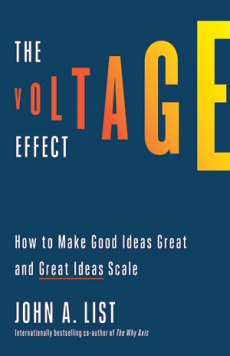
The Voltage Effect: How to Make Good Ideas Great and Great Ideas Scale
John A. List
288 pages, Currency, 2022
I’m sure that John List did not intend for his new book, The Voltage Effect: How to Make Good Ideas Great and Great Ideas Scale, to raise foundational questions about American capitalism. A University of Chicago economist who served on former US president George W. Bush’s Council of Economic Advisers and as the chief economist for both Uber and Lyft, List has built an impressive career in behavioral economics. Drawing on that experience, he offers The Voltage Effect as a manual to achieve “voltage”—the power to take an idea from small to large scale. “The path from early promise to widespread impact requires one thing and one thing only: scalability—the capacity to grow and expand in a robust and sustainable way,” List contends. “You can only change the world at scale.”
Yet The Voltage Effect can’t quite escape the gravitational pull of politics. Scale is freshly problematic nowadays, with lawmakers on both sides of the aisle increasingly agitated by unregulated Big Tech companies having too much market power. List, however, isn’t seeking to flatter tech billionaires. His rebuke of the “great man” theory of economic growth—the idea that enterprises succeed on the genius of singular founders like Elon Musk and Jeff Bezos—emerges in his book. List suggests instead that success at scale is a collective social achievement—a product of institutional design and how it coordinates large numbers of employees to work together effectively.
List devotes the first half of the book to the most common pitfalls in scaling up and how to avoid them: Watch out for false positives; don’t mistake your initial audience for who your audience will be at scale; know whether your success rests on the “ingredients” or the “chef”; watch out for spillover effects; and avoid diseconomies of scale—instances where per-unit costs either increase or remain unchanged as an enterprise scales. The book’s second half presents four best practices to achieve what he calls “high voltage scaling”: incentivizing employees to spot pitfalls like false positives early on; focusing on the productivity of the next marginal dollar; knowing when to quit an idea that isn’t working; and building an institutional culture that will succeed at scale.
The Voltage Effect is a useful primer on economic concepts like “marginal utility” and “diminishing marginal returns” for general readers. However, the book’s accessible style results in chapters that feel too breezy. While List ably illustrates economic concepts with anecdotes from history and his own experience, he doesn’t offer many concrete suggestions for how to implement his advice. Ironically, the hows in this how-to manual are thin, and his concept of voltage reads as a half-baked marketing framework holding the book together.
List asserts that his lessons apply not only to entrepreneurs but also to lay readers and to people like me who are interested in broader policy concerns. The book is about scale in a “broad and inclusive sense,” List writes, “toggling between the worlds of business, policy, and everything in between.” I’d say he’s right, though often in more radical ways than he intended.
Take his chapter on determining whether a start-up succeeds because of its “chef” or its “ingredients.” List uses the example of a curriculum designed to help students from marginalized communities close the academic achievement gap. If the curriculum can only be taught by the best teachers (the “chefs”), it won’t scale. Rather, the curriculum (the “ingredients”) must be broadly accessible to a teacher with an everyday skill level, and not just the best-of-the-best.List’s lesson that “easy-to-use technology scales” is a point that US policy makers could afford to learn, since social welfare benefits are often delivered in complicated and targeted forms such as tax credits, and beneficiaries often must navigate byzantine and even contradictory bureaucratic hurdles.
Throughout The Voltage Effect, List emphasizes the need for repeated randomized controlled trials, beta testing, and data gathering, so that entrepreneurs can avoid false positives, understand an enterprise’s customers, and “actively generate the alternatives” to pursue if a current project fails. While excellent advice, this tack also requires time, energy, and—most important—money, in ways that seem duplicative and inefficient.
That’s not just a problem for private enterprise, which is under competitive market pressure to make every dollar count. It’s also a problem for government spending, which is often hamstrung by fear of big budgets and exploding deficits and of pouring money into the next Solyndra—the solar-panel maker that infamously went bust in 2011 after receiving hundreds of millions in clean-energy loans from the US government. Yet failure is an inevitable by-product of successful experimentation. Applied to the public sphere, List’s argument demands an attitude toward spending that is abundant, prodigious, and even carefree—all in the name of gathering enough data and conducting enough experiments to substantiate the research.
If companies are the plants and the government is the gardener, we’re already awash in advice for how the plants can be the best plant they can be.
We can take List’s ideas in still more radical directions. Consider his examination of “lock in,” a Big Tech phenomenon whereby the more people use a platform, the more valuable it is for everyone else to be on it, and the less valuable using another platform is. All of which implies that a Big Tech platform like Facebook is the internet’s equivalent of a natural monopoly. And even textbook economics will tell you that natural monopolies should be either owned and operated by the government or at least stiffly regulated as public utilities, because they don’t face the competition that usually disciplines companies into providing the best value for customers.
In another chapter dealing with scalable institutional cultures, List explores different companies’ experiments with “coopetition”—a blend of competitive and cooperative structures between various teams within a company. “Coopetition” could just as easily be applied to the entire economy to determine if cooperation or competition is the best way to organize a particular economic activity. Why, for instance, is it legal for a hierarchical firm like Uber to coordinate prices between its drivers but illegal for drivers to coordinate prices among themselves as a kind of democratic cooperative?
You could even point out that had our government properly applied antitrust law and fair market rules, Uber would never have been allowed to scale to its current size. A quality software platform for hailing rides is not easy to build, but it’s not unique to Uber. The company’s real innovation was realizing that peer-to-peer platforms would allow it to claim it wasn’t technically an employer and thus duck the legal obligations—and attendant costs—that companies owe their employees. If you don’t have to follow the same rules as your competitors, you will be quite successful and “scale” nicely. Uber’s entire business model is effectively a form of regulatory arbitrage, and one that delivers better values for customers by undercutting workers—never mind that many of the people whose welfare the economy is meant to serve are both.
Arguably, this example isn’t a direct criticism of The Voltage Effect. After all, List offers his book to individual companies and enterprises. The role of government is to shape the overall economy in which firms and organizations operate. He’s simply tackling a different category of problems.
The problem I have in mind is that the United States has a deeply entrenched and very well-financed ideological apparatus aimed at obscuring this distinction for policy makers, convincing them that what is pleasant for an individual firm (fewer taxes and fewer regulations) is also good for the whole economy. Too often they elide the difference between an idea that scales and an idea that scales within the ever-expanding boundaries of one single firm. A fundamental purpose of market competition is to spread innovations—to take an idea adopted by one firm and force all its competitors to adopt it as well, so they can remain competitive and the costs of the innovation can be as low as possible, thus delivering a benefit for consumers. A set of economic policies that encourages scalable ideas is different from a set of policies that encourages companies to scale. But I can easily see plenty of people reading List’s book and thinking the job of the government should be to get out of the way of businesses.
Markets are ultimately a government creation. They do not spring up ex nihilo; they are put together by society’s enforcement of certain rules and norms. Innovation is, on its own, an entirely amoral process; its breakthroughs can be pro-social or anti-social. (See, again, Uber.) Government has not only the right but the obligation to make sure its rules encourage pro-social innovations and discourage anti-social ones. The purpose of a business is to produce goods and services, while the purpose of a government is to produce a just and functional society. Demanding “efficiency” from the public sphere is often a categorical error. And once you admit, as List does, that some efforts are so worthwhile, they “transcend monetization and conventional measurements,” you’ve dynamited economists’ entire conceptual framework for assigning value. All that remains is the simple question of what kind of society do we the people, via our elected officials, want to build—profits and cost-benefit analysis be damned.
None of this is to say that I think List has written a bad book or a pernicious one. Rather, my point is more that it needs a companion piece it can be read in dialogue with—one with a more holistic view that addresses broader questions: How should we distinguish between scaling an idea and scaling a firm? What sorts of market rules encourage the innovations we want? What approach, for both public regulation and public investment, would make following List’s advice as feasible as possible for as many firms as possible?
Admittedly, I’m not sure what that companion piece is, because I’m not sure it’s been written yet. If companies are the individual plants, and the government is the gardener, we’re already awash in popular advice for how the plants can be the best plant they can be. But while few of us run large enterprises, we all live in the world they shape—and we elect the policy makers who must in turn shape them. So what we need as much, if not more, is a popular understanding of the framework that should guide the proverbial gardener: when, how, and to what purpose they should break out the pruning shears.