


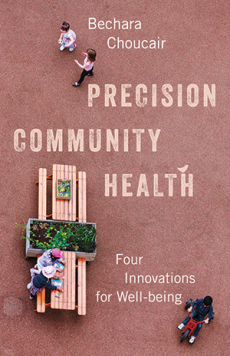
Precision Community Health: Four Innovations for Well-being
Bechara Choucair
224 pages, Island Press, 2020
This year’s public health crises—the coronavirus pandemic and endemic police violence—have shone a harsh light on historical inequities in the United States, prompting calls for new ways to guarantee the health, safety, and well-being of all Americans.
Historically, attention to public health has waxed and waned as crises strike and then abate. The result has been a patchwork of inadequate public health infrastructure, the weaknesses of which are evident in the United States’ uneven response to COVID-19. Written just before the current crises, Bechara Choucair’s Precision Community Health: Four Innovations for Well-being offers one potential path forward for public health in an increasingly uncertain future.
The modern field of public health has undergone two revolutions and is currently in the throes of a third. Choucair, the former commissioner of the Chicago Department of Public Health (CDPH), explains that the first revolution made dramatic reductions in communicable disease transmission through infrastructural improvements in the 19th century, such as sewers and housing in rapidly growing industrial cities. Beginning in the 20th century, the second revolution addressed chronic diseases—such as cancer, asthma, and diabetes—that are characteristic of advanced industrial society and are driven by a consumerist lifestyle and the industrial processes undergirding it.
Today’s third revolution focuses on health equity. While the work of addressing communicable and chronic disease is far from over, much of the field’s energy is now focused on deep racial and economic inequities in health outcomes. This time, Choucair claims, the revolution is powered by the understanding that good health can no longer be defined simply as the absence of illness. This endeavor requires thinking beyond the world of medicine to address education, housing, environmental policy, and social welfare. In Precision Community Health, Choucair presents a framework for how to work toward a more holistic vision of community health.
“Precision community health,” as Choucair defines it, “involves taking advantage of new tools, including cutting-edge data and communication technologies, and using traditional methods, such as coalition building, in new ways to target public health interventions in the most effective way possible.” His vision is inspired by “precision medicine,” which targets treatments to individuals’ genetic makeup, and “precision public health,” which applies similar techniques at the population level to understand which demographics are most at risk for specific illnesses.
Choucair contends that his approach is unique because it treats the community environment as the locus of intervention to improve public health. To achieve health equity, he argues, public health interventions should be targeted to those communities that will benefit most from innovations in the field. Communities suffering from the United States’ profound health disparities have different needs and require different treatments.
In the first two chapters, Choucair outlines the modern evolution of public health and describes how his experience as CDPH commissioner from 2009 to 2014 informed his precision community health approach. Now the senior vice president and chief community health officer for Kaiser Foundation Health Plan, Inc. and Hospitals, Choucair grew up in Beirut, Lebanon, and attended medical school there before moving to the United States for further training.
During his tenure at CDPH, Choucair realized how many of the city’s public health challenges resulted from the cumulative effects of decades of racist policies, environmental injustices, and economic inequality. The department’s goal, he believed, should be to create healthy environments in those disadvantaged communities. He shifted CDPH’s efforts toward the creation and implementation of the city’s first comprehensive agenda for public health. It included citywide targets for health outcomes and policies, programs, and services to reach those targets. Choucair says that the core tenets of the precision community health approach crystallized through designing and implementing the Healthy Chicago plan.
Choucair proposes that precision community health must serve three functions to be successful: anticipating crises, preventing them, and effectively combating crises when they do arise. These functions are performed through the four strategic pillars of coalition building, big data, media, and policy.
Coalition building, Choucair argues, is necessary to understand health challenges and generate interventions that coordinate a community’s social, economic, and physical assets in the service of better health. He describes how the CDPH partnered with preexisting coalitions tackling breast cancer and childhood obesity to improve access to mammograms for Black women and to introduce healthier foods to convenience stores. These efforts increased his department’s “system capital,” the ability to collaborate across different organizations and institutions to solve complex challenges that public health departments are not equipped to tackle alone.
The second pillar is “tapping the power of big data” in order to identify and address health problems before they become epidemics. In recent decades, our ability to gather, store, and analyze data has grown enormously, and Choucair rightly argues that these developments present an opportunity for public health. To ensure the broadest impact possible, he says, big data must be “liberated” and made accessible to all.
Surprisingly, Choucair’s arguments about coalition building and big data do not directly address questions of power. This is despite the fact that the health inequities that his approach purports to alleviate are rooted in the uneven distribution of power in society. For public health interventions to achieve health equity, they must build community power. His reflections on coalition building, for example, do not consider how members with different degrees of power were brought into coalitions, nor how decision-making power was shared between large, wealthy organizations, like hospitals and foundations, and community-level actors, like residents and grassroots organizations. If coalitions are to be a pillar of how this precision community health approach achieves health equity, Choucair must explain how they can transform, rather than uphold, current power structures.
Similarly, Choucair fails to examine how leveraging big data might uphold or upend the unequal distribution of power that undergirds the health inequities he seeks to address. Crucial questions to consider include what data is selected to understand community health challenges, how it is analyzed, how it is interpreted and communicated, and who has the power over these decisions. Communities must be equipped with the tools to guide these decisions if big data interventions are to meet their needs and advance their vision for collective well-being. Additionally, while Choucair acknowledges that big data comes with considerable privacy concerns and potential for misuse, he does not consider the myriad ways that racial biases run through the algorithms used to amass data and the ways this can make the use of data for policymaking complicit in the reproduction of racial inequities.
The innovative use of media to raise awareness and influence behavior is the third pillar of the precision community health approach. Choucair argues that while the scale of access to information online poses the risk of key messages being drowned out or distorted, new opportunities are emerging for public health officials to control narratives and reach new audiences. Examining the historical pattern of the information battles waged between public health officials and Big Tobacco, he traces how the latter targeted marketing to specific groups like young people and Black Americans. Chicago, he explains, intervened with provocative ads about the dangers of smoking with content and placement aimed at specific populations and neighborhood areas.
The final pillar of precision community health is targeted policy innovation. Choucair focuses again on smoking, this time on curbing young people’s access to flavored tobacco products like mentholated cigarettes and vaporizer cartridges. He explains that CDPH used a series of town hall meetings in neighborhoods with large Black, Latinx, and/or LGBT populations to develop recommendations, such as targeting retail outlets, rather than possession and use—which the community had made clear should not be criminalized. CDPH formulated targeted policy interventions from this process, including restricting retail sales of flavored tobacco in stores near schools and raising taxes on cigarette packs.
The epidemiological evidence indicates that the greatest barriers to health equity are systemic: racism, environmental injustice, and economic inequality.
Choucair’s discussion of targeted media and policy interventions is hampered by an absence of clearly articulated, generalizable lessons that other practitioners could use to guide their work. This is the second shortcoming of his book. Choucair favors anecdotes over analysis and does not distill the examples he uses to illustrate his approach into a coherent theory of how the four pillars of precision community health can be combined to bring about health equity. Choucair’s argument would be stronger and his approach more widely applicable if he identified the essential components of these cases that represent what is novel and innovative about precision community health, and then specified how these components promise to overcome existing barriers to health equity.
The weight of epidemiological evidence clearly indicates that the greatest barriers to health equity are systemic: racism, environmental injustice, economic inequality, state violence, and patriarchy. While Choucair acknowledges that social and economic forces are at the root of the geographic disparities in health outcomes, the examples that he uses to illustrate the precision community health approach instead focus on the level of individual choice and behavior as the locus of change.
Consequently, Choucair undermines his argument that precision community health can bring about health equity, which will result only from broad systemic changes in our government, economy, and built environment. It is here that public health interventions must concentrate their efforts, rather than on individual choice or behavior. Choucair is correct that coalition building, crafting powerful media messages and programming, leveraging big data, and implementing more precise policy are major tools of this work. However, to improve the health of the collective, these tools must be directed at the systems that shape us and not at the choices we make.
Targeting new policies toward disadvantaged communities is not the same as dismantling the structures and systems that have produced deadly disparities in the first place. Without addressing these underlying conditions, new policies are more likely than not to reproduce historical legacies of harm. For precision community health to truly revolutionize public health, it must be able to provide insights into how and why the uneven distribution of power in our society reproduces health inequity, and it must offer tools that facilitate the redistribution of power to those most harmed by society’s present arrangements.