


The Upswing: How America Came Together a Century Ago and How We Can Do It Again
Robert D. Putnam with Shaylyn Romney Garrett
480 pages, Simon & Schuster, 2020
After the noble aspirations of post-Civil War Reconstruction to build a unified nation faded into the squalid Gilded Age of corruption and exploitation at the dawn of the 20th century, the United States found itself riven by economic inequality and politically paralyzed by partisan polarization. Early 20th-century America was a land of astounding technological progress and great wealth, but the majority of the population suffered in bleak conditions. Politics, rather than redressing the economic and social inequities of the system, was marred by massive corruption and disrupted by sporadic violence.
A century later, Americans living in the 21st century seem to face many of the same woes. And the problems, interlocking and interconnected as they are, seem intractable. Today’s politics are too hateful and divided to generate meaningful reform. And, absent this reform, society is too corrupt and unequal to generate constructive policy.
In The Upswing: How America Came Together a Century Ago and How We Can Do It Again, coauthors Robert Putnam, the Malkin Research Professor of Public Policy at Harvard University and celebrated author of Bowling Alone, and Shaylyn Romney Garrett, writer and social entrepreneur, say they have learned important lessons from the Progressive Era reversal of entrenched inequality. “By the time we arrived at the middle of the 20th century, the Gilded Age was a distant memory,” they observe. “America had been transformed into a more egalitarian, cooperative, cohesive, and altruistic nation.” Yet, the trend, they show through their overview of 125 years of American political history and social science data, is that “between the mid-1960s and today … we have been experiencing declining economic equality, the deterioration of compromise in the public square, a fraying social fabric, and a descent into cultural narcissism.”
Putnam and Garrett argue that the “long arc of increasing solidarity” that devolved into “increasing individualism” since the 1960s has resulted in today’s “tribal view of society, and, eventually, to Trumpism.” Through their analysis of these trends, they aim—although not very convincingly—to convince readers that the past offers a workable set of solutions for the future. That a nation of “I’s” can once again become a nation of “we’s.”
Most of The Upswing consists of a social history that summarizes literatures on economic inequality and political polarization to show how the United States went from being highly unequal and highly polarized in the late 19th century to less polarized and more equal by the 1960s, and then returned to massive inequity and polarization in the 21st century. The authors supplement this descriptive history with the literature that Putnam himself has anchored, most notably in Bowling Alone, showing that the more equal and less polarized America also had more involvement in community institutions ranging from churches to Rotary Clubs to bowling leagues.
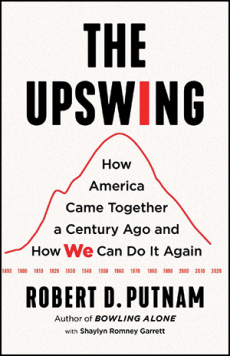
The authors then propose that a similar inverted-U curve exists for individualism. They quantify this with metrics accessed through such means as Google Ngram Viewer, an online tool that charts the frequency of any word, which demonstrates a rising-then-falling ratio of the occurrence of the pronoun “we” relative to the pronoun “I” in American culture. They concede that the causal relationships between all these variables are difficult to disentangle. But after applying statistical smoothing to the data points, they say that the four curves—economic equality, bipartisanship in politics, lack of cultural narcissism, and social capital—essentially overlap. All rise beginning around 1920 and peak in the mid-1960s. These trends, Putnam and Garrett claim, “are braided together by reciprocal causality.” They use this causal interpretation to define the social cycle from individualism to communitarianism and back again as the “I-we-I curve” and identify this curve as the master variable driving all change.
Thus, Putnam and Garrett observe, “as we look to an uncertain future, we must keep in mind what is perhaps the greatest lesson of America’s I-we-I century: As Theodore Roosevelt put it, ‘the fundamental rule of our national life—the rule which underlies all others—is that, on the whole, and in the long run, we shall go up or down together.’”
As the authors acknowledge, the mere fact that different series move in the same direction at the same time still leaves open the possibility that it is inequality that causes narcissistic self-centeredness, rather than vice versa. But worse, it is far from clear that the I-we-I curve is a meaningful, or entirely accurate, phenomenon. The Ngram evidence on “I” versus “we” is interesting but hardly an exhaustive exploration of how language has changed over time. For example, “you” has surged recently along with “I,” and the Ngram for “community” peaked not in the mid-1960s but in 2000. The linguistic evidence is simply too ambiguous to bear the weight of strong conclusions. To consider another pronoun, “they” peaked in 1811 before steadily declining until the late 1980s. It then started an ascent that we are still living through, likely due to the growing popularity of the singular “they” as a nongendered pronoun. But why did this pronoun decline for 175 years before rebounding? Putnam and Garrett are not linguists, and their analysis is quite literal-minded: that use of pronouns reflects changes in the level of self-centeredness in society.
A further, related problem they are acutely cognizant of has to do with race. The authors claim that the real “Greatest Generation” occurred during the Progressive Era, the 1890s through the 1910s, when “facilitated by the muckrakers’ revelations about a society, economy, and government run amok—and urged on by the Social Gospelers’ denunciation of social Darwinism and laissez-faire economics—Americans from all walks of life began to repudiate the self-centered, hyper-individualistic creed of the Gilded Age.” These days, though, one cannot write about this period without conceding that “the Progressive Era coincided with the rise of Jim Crow; Woodrow Wilson was one of the most openly racist presidents ever to occupy the White House”; and, more broadly for African Americans, it seems odd to posit that the good old days ended in the mid-1960s. This facet additionally undermines the integrity of the “we” in their pattern—for who has the “we” represented, historically?
Perhaps due to the challenges that can arise from co-authorship, the book cannot quite seem to decide what it wants to say about the poor racial equity record of the Progressive movement. On the one hand, there is a sort of old-fashioned liberal argument running through the book that while the “we”-ness of America has declined over the past 50 years, the “we” has become more capacious, so now we can try to return to solidarity, but without the exclusion. On the other hand, Putnam and Garrett offer the provocative argument that in terms of “material well-being” there was “substantial progress toward racial equality over the half century before 1970,” but stagnation since then.
The Putnam/Garrett I-we-I curve could be a case of hunting around in the vast haystack of Google data until you happen to find a pattern that fits the thesis.
To read the 1920-1970 era as the heyday of racial progress is a somewhat tortured interpretation of the data. But even if you accept it, on other topics the authors’ argument is that we’ve actually moved backward since 1970, and the switch to an argument about a slowing pace of improvement is jarring. Fundamentally, you can’t get around the fact that racial equality does not fit their pattern of rise and decline. But while this argument doesn’t quite work, it does at least offer an interesting view of the longer trajectory of racial equality.
By contrast, while Putnam and Garrett usefully complicate the pat notion of a sudden women’s liberation moment with statistics showing that “the picture of progress toward economic equality between men and women over the course of the twentieth century is mixed,” progress on this front doesn’t neatly fit their inverted-U pattern, either.
Indeed, one interpretation of the Putnam/Garrett curve would be to read the book as suggesting that life was better when we didn’t have high expectations for women’s careers, strong aspirations to racial equality, or many immigrants, and that we should seek to return to those traditional social hierarchies in order to “Make America Great Again” (MAGA). But the authors reject this conclusion without quite being able to explain why.
A better rejoinder to MAGA nostalgia is to simply say it’s not true that we’ve been in national decline for the past 50 years. Statistics have shown that opportunities for women and Black Americans have clearly improved—perhaps most visibly evident in the steady upswing in the diversity of America’s political officeholders. And Americans as a whole are richer, are better educated, and live longer than our midcentury predecessors. Politics is more polarized because we don’t have apartheid rule in the one-party South. The economic inequality story is similar across many countries and thus unlikely to be driven by US-specific changes. (The Stanford University historian Walter Scheidel, working with the same data on inequality from French economist Thomas Piketty that The Upswing cites, argues that the worldwide trend toward equality is best explained by the world wars.) Arguably, the I-we-I curve could be a case of hunting around in the vast haystack of Google data until you happen to find a pattern that fits the thesis.
The revival of interest in the Progressive Era reforms is welcome, however. And the fact that the politicians of this era were able to smash through intense political polarization and gridlock and deliver major reforms remains remarkable. However, once we lose the belief in the magical power of changing pronoun frequency in books, we are left with the question that’s puzzled me for years: How did they do it? Is there a big lesson about political organizing to be learned that today’s organizers don’t know? Or is it all just happenstance that an assassin’s bullet brought Teddy Roosevelt into the White House despite the bosses’ intentions? Was there anything other than sheer laziness stopping Trump from becoming a Teddy Roosevelt-like figure who achieved massive popularity by casting aside partisan orthodoxy to enact moderate reforms?
The question of how deserves more research. It’s clearly true that America has somehow broken out of the doldrums. But the answers probably lie more in detailed political history than in The Upswing’s broad speculation about abstract macrotrends.