


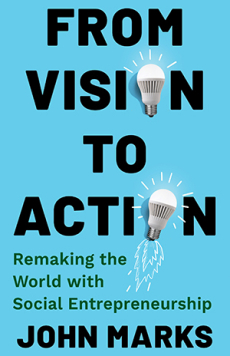
From Vision to Action: Remaking the World Through Social Entrepreneurship
John Marks
208 pages, Columbia University Press, 2024
Social entrepreneurs are people who launch ventures aimed at promoting positive change in their community and the world. I am such a person. In 1982, I founded a nonprofit organization, Search for Common Ground (known as “Search”). My bottom line was not financial gain but making the world a better place.
My credentials as a social entrepreneur grew out of hands-on involvement in building Search from zero into the world’s largest nonprofit organization involved in peacebuilding. My partner and closest collaborator was my wife, Susan Collin Marks. By the time we stepped down from Search’s leadership in 2014, we had a deeply committed staff of 600 employees working out of offices in 35 countries. In 2018, Search was nominated for the Nobel Peace Prize.
There are two kinds of social entrepreneurs: those, like us, who work in the nonprofit sector, and those who start social enterprises whose goal is both to promote the public good and to make a modest profit.
As a social entrepreneur, I was self-taught, neither a theoretician nor a scholar. Over the years, I developed a set of 11 working principles that became my modus operandi and that provide the basic framework for my new book, From Vision to Action: Remaking the World Through Social Entrepreneurship, from which the following article is adapted. While I used these principles in nonprofit work, they are also applicable to social enterprises, and to life, for that matter.—John Marks
* * *
PRINCIPLE #1: START FROM VISION. Social entrepreneurs need to have a clear vision, and everything they do should be consistent with that vision—or at least not inconsistent with it. A vision may appear in a flash or evolve over many years. My vision was to shift how the world deals with conflict—away from adversarial, win-lose approaches toward non-adversarial, win-win problem-solving.
During the Cold War, my vision included ending the adversarial relationship between the United States and the Soviet Union. Like so many people, I was terrified by the prospect of nuclear war. If something profound were not done, I feared the superpowers would blow up the planet. Preventing nuclear war—in essence, saving the world —provided me with huge motivation. It still does.
I believed the best way to reduce the threat was to move the superpowers from confrontation to cooperation. Consequently, my colleagues and I played a key role in getting the U.S. and the Soviet Union to work together in countering terrorism. To that end, we even facilitated cooperation between the CIA and the KGB.
PRINCIPLE #2: BE AN APPLIED VISIONARY. Social entrepreneurs should not be pure visionaries unless they intend to start a new religion or write a philosophy textbook. Rather, they need to be applied visionaries who produce concrete results. Although they may have lofty intentions, they have no choice but to move ahead one step at a time and be incrementally transformational. If they go for overwhelming, unified solutions, they are likely to fail. However, if some part of their overall goal is reachable, they should probably start there. A small victory is almost always more useful than a large failure. And their timing needs to be right. If they move too quickly or are too far ahead of the curve, they will be viewed as hopeless dreamers. However, if they are too slow in reacting, there may be little reason for them to proceed. I have found that being six months to a year ahead of conventional wisdom is a good place to be.
While the chief argument against taking decisive action is often that the time is not right, social entrepreneurs must be prepared to jump in. For example, in 1993-1994, before official peace talks had begun between Jordan and Israel, we at Search sponsored back-channel meetings between former generals from the two countries. Together they worked out unofficial understandings on key issues. After each session, the results were quickly sent to the prime minister of Israel and the king of Jordan. Our unofficial talks demonstrated that agreements could serve the interests of both countries, and many of the formulations became part of the eventual Israeli-Jordanian peace treaty
PRINCIPLE #3: “ON S’ENGAGE ET PUIS ON VOIT.” This is a quote from Napoleon Bonaparte. A non-literal translation is “one becomes engaged in an activity, and then one sees new possibilities.” Napoleon was a soldier, and he believed that the best way to understand enemy defenses was to attack and then observe the reaction. As a peace-loving civilian, I only apply this Napoleonic logic metaphorically. I don’t go around beating up opponents to see how they defend themselves. But the lesson here for social entrepreneurs is that once engaged in an activity they will detect opportunities they otherwise would not have seen.
I found that excessive planning was often a barrier to moving forward. As boxing champion Mike Tyson once said, “Everyone has a plan until they’ve been punched in the mouth.” The Soviets learned this the hard way with their five-year plans.
Allen Grossman, my oldest friend and a former chair of Search’s board, topped off a successful career in both the nonprofit and for-profit sectors with twenty years as a professor at Harvard Business School. According to Allen, there are two principal management styles. The first is management by rule. It requires employees of an organization to follow well-defined procedures. The second is adaptive management. It calls for problem-solving and decision-making in response to exceptions, new information, and changed circumstances.
All organizations must have rules, but social entrepreneurs are usually much more interested in being adaptive than in following regulations. The path forward most often emerges, not from long-term, deliberative processes, but from unfolding events.
PRINCIPLE #4: KEEP SHOWING UP. It has been said that 80 percent of success is showing up. For social entrepreneurs this means continuing to stay engaged without dabbling or parachuting. Like a child’s toy windup truck that moves forward until it hits an obstacle and then backs off and finds another way forward, social entrepreneurs should be persistent – and adept at finding work-arounds. They must be willing to commit for the long-term. I found this was particularly important in working with Iranians who tend to look at the world in terms of centuries and millennia. Even after Search became a multilayered organization with hundreds of employees, I personally stayed engaged in the details of our Iran work. I knew that management experts would advise me, as head of a relatively large organization, to delegate. Regardless, direct involvement helped me avoid being crushed by administrative demands. I absolutely loved being able to shut my office door; put aside questions of finance and logistics; and game-plan how to improve US-Iran relations. Indeed, I would advise all social entrepreneurs to retain some hands-on functions.
PRINCIPLE #5: ENROLL CREDIBLE SUPPORTERS. Social entrepreneurs, by definition, operate outside the proverbial box, so they are often seen to be fringe players. Thus, they should try to project credibility. To that end, having prominent backers, while not indispensable, can be helpful. Credibility is best gained by developing a reputation for doing good work. However, social entrepreneurs can increase the odds in their favor by borrowing credibility from prestigious people. At the same time, social entrepreneurs should be cautious about bringing in outsiders who are not aligned with their vision. Particularly perilous are strong-minded individuals with time on their hands. As the head of another nonprofit warned me about prospective board members, “Be sure to stay away from people who don’t have enough to do.”
PRINCIPLE #6: EXPECT THE UNEXPECTED. Social entrepreneurs must be prepared to deal with high levels of uncertainty. If they find it distressing not to know what the outcome will be and if they cannot deal well with the unexpected, they should probably make a different career choice.
Social entrepreneurs regularly intervene in complex situations and systems, and they often face unanticipated problems. Even when they do thorough research and ask all the questions they think are relevant, issues are likely to emerge that should have been considered but were not – because they didn’t know that they didn’t know. The only defense is to realize, in the words of former Secretary of Defense Donald Rumsfeld, that there are going to be “unknown unknowns.” Social entrepreneurs need to be agile enough to minimize damage when these inevitably appear.
For example, just as we at Search and our partners at Children’s Television Network (makers of Sesame Street) were about to start production in Macedonia of a children’s TV series to encourage inter-ethnic cooperation, unanticipated armed violence broke out in neighboring Kosovo. As a result, Macedonian state TV reneged on its agreement to provide us with production facilities and broadcast our series. Obviously, an unforeseen event like the war in Kosovo could have been a disaster for us, but we did not give up. We were sufficiently nimble to build a soundstage in an empty warehouse and to cobble together a network of independent TV stations. Nevertheless, things certainly would have been easier if we had had in place a Plan B. But we didn’t know that we didn’t know.
PRINCIPLE #7: MAKE YESABLE PROPOSITIONS. As Roger Fisher and William Ury wrote in their seminal book, Getting to Yes, it is desirable to make proposals to which others say “yes” and which are both in their interest and in the interest of the other party. The concept of a yesable proposition is so simple that many people brush it off as childish. Nevertheless, when someone—child or adult—internalizes the idea, the results can be life-changing.
PRINCIPLE #8: PRACTICE AIKIDO. I am impatient, and I yearn for rapid solutions to problems that are tearing apart the planet. When I worked in the Middle East and the Democratic Republic of Congo, I witnessed widespread violence. Still, I understood that, even though Search was a comparatively large organization, it lacked the power to reverse events, and it was usually futile to take a confrontational stance. Literally and figuratively, screaming “STOP NOW!” only made matters worse.
Instead, I adopted an approach rooted in the Japanese martial art of aikido: Namely, when someone is attacked, he or she does not try to reverse the assailant’s energy flow by 180 degrees. That is the aim in boxing where the goal is to knock the attacker backward. In aikido, the person under attack accepts the attacker’s energy, blends with it, and diverts it by ten or twenty degrees to make both people safe. For social entrepreneurs, this means accepting a conflict or a problem as it is and blending with it, while transforming it one step at a time. Indeed, aikido makes a virtue out of necessity because almost no one has the power to win with adversarial tactics.
PRINCIPLE #9: DEVELOP EFFECTIVE METAPHORS. For social entrepreneurs, communicating compelling ideas is crucial to being able to reframe reality. Extended metaphors in the form of captivating stories can play a key role in breaking up – and replacing – deeply held beliefs. Metaphors—short or lengthy—can provide a picture of what might lie ahead and why it is desirable. Social entrepreneurs should be adept at what advertising executives call content marketing.
I had a grand vision of global transformation, but to have an impact at that level I had to find ways to move beyond workshops and trainings that reached small numbers of people – not the masses. I was inspired by a statement made by A. J. Liebling, the New Yorker’s longtime press critic, who said, “Freedom of the press is guaranteed only to those who own one.” With that in mind, I started Common Ground Productions whose core premise was that popular culture could cause enormous changes in attitudes and behaviors. So, my colleagues and I became TV producers who made dramatic TV series, reality shows, and documentaries that promoted peaceful conflict resolution across the Global South.
Our best known series was The Team, and we produced versions in eighteen countries—altogether 356 episodes. Everywhere, the plot centered on a fictional soccer or cricket team whose members reflected ethnic, religious, and/or gender diversity. The core message was if players did not overcome differences and cooperate, they would lose. In each place, we located an experienced production house to be our co-producer, and we found a TV network to air the series in primetime. Our yesable proposition to prospective broadcasters was to offer a high-quality dramatic series at no cost.
Not every social entrepreneur needs to start a media production company, but all would be wise to develop ways to effectively communicate their core messages.
PRINCIPLE #10: DISPLAY CHUTZPAH. Social entrepreneurship is definitely not a good fit for those who are timid. Launching new initiatives and overcoming seemingly insoluble problems often requires chutzpah (a Yiddish word meaning extreme self-confidence—or nerve or gall). When bold solutions are called for, social entrepreneurs need to dial up their inner chutzpah.
Still, chutzpah should not be seen as a boundless quality that social entrepreneurs regularly unleash. No matter how worthy the cause, the ends do not justify the means, and it is not OK to be rude or obnoxious in the name of making the world a better place. Chutzpah needs to be tempered with discretion and wisdom. It should be a calculated response— and not one that is triggered by anger. I believe both good and bad chutzpah exist. The most familiar example of the bad was described by author Leo Rosten: “Chutzpah is that quality enshrined in a man who, having killed his mother and father, throws himself on the mercy of the court as an orphan.” In contrast, good chutzpah is what the prophet Abraham demonstrated when he opposed God’s plan to destroy Sodom and Gomorrah. By standing up to God, Abraham took a grave risk in order to save lives – even if the people spared were evil and corrupt.
PRINCIPLE #11: CULTIVATE FINGERSPITZENGEFÜHL. Fingerspitzengefühl is a German word that means having an intuitive sense of knowing at the tip of one’s fingers. This is what one-time basketball star and later U.S. Senator Bill Bradley was referring to—albeit in a sporting context—when he said:
When you have played basketball for a while, you don’t need to look at the basket. ... You develop a sense of where you are.
However, like chutzpah, fingerspitzengefühl is not a quality that should be relied upon in all circumstances. Instead, when social entrepreneurs make decisions, they should factor in—but not be overwhelmed by—what feels right. The trick in social entrepreneurship is to develop an appropriate mix of instinct and intellect.