


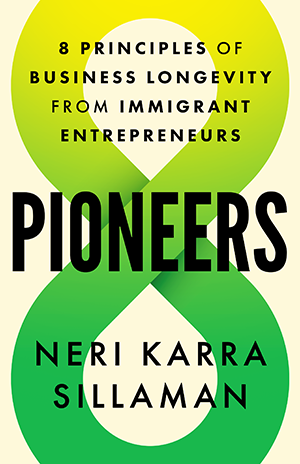
Pioneers: 8 Principles of Business Longevity from Immigrant Entrepreneurs
Neri Karra Sillaman
256 pages, Wiley, 2025
Immigration is a perennially hot topic politically, perhaps never more so than right now. But amid the divisive language from both sides of the debate, are we missing a fundamental opportunity to learn from immigrants? Consider these stats: Immigrants and their children make up around 28 percent of the United States population, but 80 percent of billion-dollar startups have founders or senior executives who are first- or second-generation immigrants. Immigrants also founded 46 percent of the companies on the Fortune 500 list, and in 2023, those companies generated over $8.6 trillion in revenue, exceeding the GDP of every country except the United States and China.
As a former refugee, three-time immigrant, and international fashion label founder, I find such statistics inspiring. But as an academic and entrepreneurship expert at Oxford University specializing in business longevity, I find them a professional challenge: How can we explain why immigrants, who often begin their entrepreneurial journeys with very limited resources, enjoy such success? And what can we all learn from them about building businesses that last?
In my new book, Pioneers: 8 Principles of Business Longevity from Immigrant Entrepreneurs, I set out to explore those questions by engaging with the stories of some of the world’s most successful people. The answers surprised me. Immigrant entrepreneurs don’t follow the rules when it comes to building businesses; but they enjoy remarkable success by acting as cross-cultural bridges, forging connections based on shared values, acting with kindness, prioritizing sustainability, and focusing on building legacies that transcend profit. In this edited excerpt from Chapter 8, I introduce one of the eight principles—build community—by telling the story of Hamdi Ulukaya, who came from a poor family of nomadic shepherds in northeastern Turkey but found new community in a neglected upstate New York hamlet and worked with it to create a multibillion-dollar success story named Chobani.—Dr. Neri Karra Sillaman
* * *
İliç, Northeastern Turkey, 1970s
Hamdi Ulukaya grew up in the heart of a nomadic community of shepherds whose way of life had scarcely changed since the time of the Bible. “We are nomads,” he says, still using the present tense despite, or perhaps because of, the fact that he's now settled in upstate New York, “a Kurdish nomadic family of hundreds of hundreds of years caring for herds and shepherds and the fires and the stars.”
In the mountains of northeastern Turkey, Hamdi's life followed a deeper rhythm than that dictated by clocks and calendars; to the extent that his family didn't even know the exact date of his birth, only that it was sometime in the autumn of 1972, at that time when the changing of the season would drive the community out of the high mountain pastures to the lowlands to escape the winter chill. There, the children went to school and were forced to follow a little the rhythm set by bells and teachers' watches. But when the spring broke through again, as it always did, it was time to return to the high mountain pastures where the children would learn the ways of the herds and the time-honored skills of making the feta cheese and yogurt that would sustain their community throughout the whole rest of the year.
Hamdi might be a billionaire now, but the values that he holds at his core still come from that other world where he grew up. “Money,” he says, “meant nothing up there. You couldn't buy anything with it. What mattered more was your social reputation, the trust you earned. Whether you had a thousand sheep or a hundred, everyone ate the same—yogurt, cheese, and bread. There was no difference.” Trust and respect come from treating the community with honor, and even though Hamdi now lives 6,000 miles from his original home, its values remain an essential part of him, as we shall see when looking at the crucial role that community has played in his incredible success with Chobani.
Hamdi came to the United States in 1994 to study English. Initially, he struggled with both the language and the quality of the food, which didn’t match up to the simple, natural flavors of the yogurts he had taken for granted back home. However, his life was transformed by an assignment he wrote for his English course about making cheese, which led to him starting work on his teacher’s farm in upstate New York and, ultimately, launching his own business importing feta cheese from Turkey. Stifled by the complexities and costs of international trade, Hamdi was struggling to break even when he spotted in his trash can an advert for a defunct yogurt factory that was up for sale after being abandoned by Kraft Foods.
When Hamdi visited the factory in South Edmeston, NY it was not just the potential of the plant that impressed him but also that of the community. The closure had cut at the heart of the little hamlet and its population of 150 people, but Hamdi was straight away struck by their individual and communal strength.
They were just heads-up and doing their best to close this factory. And there was no screaming, there was no deep cursing or anything. They were just sad and quiet and supporting each other.
Fresh from the relative failure of his feta cheese business, Hamdi had little cash to invest, and he was originally only able to employ five members of the 55-strong workforce that Kraft had laid off. But as the saying goes, “From little things big things grow;” especially when they have the required soil, nutrients, and water, which in this case meant the determination and talent of the community that Hamdi, the Kurdish shepherd boy, suddenly found himself at the heart of.
Focusing on yogurt, Hamdi and the team perfected a recipe that was based on those he had grown up with, which provided a refreshing alternative to the typically sugar-heavy options that filled fridges in American stores. Sales started in the shops that served the community, and it wasn't long before Hamdi received a call from the owner of a local store owner telling him that his yogurt was flying off the shelf. It was the moment, Hamdi recalls, when he realized that he'd be spending the next few years in his factory, cultivating his business.
Chobani's rise to the stars had begun, but Hamdi reaffirmed his commitment to the local community by continuing to hire from it, strengthening the bonds within the team. At the same time, he led from the front, using as a CEO in America the skills he'd learned as a child in Turkey to work alongside his staff. He never asked anyone to do anything without doing it himself first; a policy that saw him packing products, driving forklifts, and fitting trucks, deeply integrating himself with the plant's workflow and fostering a deep sense of unity and co-ownership.
As Chobani's success escalated, Hamdi looked to extend his community-focused approach to nearby Utica, a city home to a significant number of refugees struggling to find employment and integrate. Seeing parallels with his own experiences as an immigrant, he was determined to make a difference and moved to act. Hamdi initiated programs to help these new community members overcome barriers, including organizing transportation, providing language training, and opening up job opportunities at Chobani. But throughout he always called it not refugee work but community work, emphasizing the inclusive nature of his efforts.
This philosophy not only elevated the spirit of the town but also propelled Chobani to achieve massive scales of production and revenue growth without outside capital: going from $25 million to a billion. The tendency in Western culture, when we hear such dramatic success stories, is to attribute them to the heroic leadership of an individual and to look to them to see what lessons we can learn from their personal qualities. But Hamdi Ulukaya, like many of the immigrant entrepreneurs featured in this book, comes from a culture that celebrates communal effort over individualism, which explains why he, accurately, attributes his success not to himself but to the people around him:
No one can do this alone … [I] created my community within the company. I really didn't have much of a network. When I settled in upstate New York, I didn't know many other people who have done this. I didn't know people who wrote books about this or studies … I did not have a board. I did not have people who have done this before. So, my support system was in that community in upstate New York, and the people that I work with. And I would ask them to warn me if they see me going in the wrong direction.
Of course, it's common for CEOs to talk about the importance of their staff and the community in which they are based. What is rare is to see them putting their money where their mouths are. But Hamdi has done just that, by not only creating jobs for the community but also sharing the results of the labor with it: in 2016, he gave 10% of the shares in Chobani, a company valued at billions, to his employees. Hamdi's model of community integration and co-ownership not only reshaped a hamlet in upstate New York but also set a new standard for how businesses around the world can profoundly impact and uplift the communities they inhabit.
Hamdi's journey from a small-scale yogurt plant to a global business exemplifies the impact of integrating community values into business practices. His efforts in South Edmeston (and subsequently in Twin Falls, Idaho) show how businesses can serve as catalysts for community revitalization, proving that the right approach to business can indeed lead to what Hamdi describes as “miracles” in local development and social cohesion. His story is a powerful example of how a community can be rebuilt, integrated, and expanded (by including local refugees within its definition) by a business that can enjoy astounding success powered by that same community.
Hamdi's story is far from the only example of how an immigrant entrepreneur, almost by definition an outsider, has tapped into the power of community to achieve long-term success and impact. But why is it that immigrant entrepreneurs are so adept at creating communities and connecting them with their companies? To answer that question, it makes sense to start with understanding the roots of community itself.
The Essence of Community: From Breaking Bread to Sharing Roots
When thinking about the importance of community for companies, it's instructive to consider where the words come from. The word “company” derives ultimately from the Latin companio, a term used to describe someone you would share bread (panis) with. By medieval times, the word compagnie was being used in Old French to describe a society or a group of friends, and from there the word ended up in Middle English meaning “a number of persons united to perform or carry out anything jointly.” Eventually, the word ended up developing the sense of a business association, but we can see how the roots, etymologically speaking, of the businesses we call companies extend deep into the soils of collaboration and friendship. And, just as the word company shares roots with community, so should any company actually be rooted in its community if it wishes to survive and thrive.
But where do immigrant entrepreneurs fit into that picture? After all, much of the literature on immigrant entrepreneurship focuses only on how they draw strength from and serve what is perceived to be their own community, i.e., the people with whom they share an ethnic/cultural heritage. Of course, immigrant entrepreneurs do draw on such homophilic ties as sources of strength. But they do not limit such ties to people from the same ethnic/cultural backgrounds, using value homophily to forge strong connections with people who share the same worldviews and follow the same moral compasses.
In the modern business world, community is often spoken about in the context of online communities or the creation of networks to sell more products. But the sort of community that I am talking about here goes much deeper and extends far beyond that. When trying to understand the real nature of community, I find, once again, that an example drawn from the natural world is instructive because it shows us how we are all much more deeply intertwined than we ever realize. And it's an example that I only learned about thanks to a question from my young son.
In the garden of our family home just outside Paris, we are blessed to have four mighty trees—two chestnut and two sycamore—each more than 150 years old. I like to sit in their cool shade with my son, chatting and playing together. For me, the trees were the silent and solitary sentinels of the garden. But then one lazy afternoon as I was explaining to my son, who was four at the time, how the trees took their food from the sun above and the soil beneath, he turned to me and asked whether the trees' roots “touch each other underground.”
As is often the case with children's questions, his words sent me off on a journey to learn about something I'd never really considered before. And that journey led me to Rachel Sussman's beautiful book The Oldest Living Things in the World, which brings to life the incredible interconnections of the forests that sustain ancient trees. Her description of the sprawling Pando in Utah shows us how what appears to be a forest made up of around 47,000 separate trees is, in fact, a one-tree forest interconnected through an intricate web of roots covering an area the size of 86 football fields.
In its scale, Pando is exceptional, but in another way, it is illustrative of the interconnections that all forests depend upon for their survival. Suzanne Simard's astounding PhD research on the “wood wide web” showed how trees use the fungal networks that connect their roots to trade and share food, supporting each other through tough times. As Simard puts it:
Plants are attuned to one another's strengths and weaknesses, elegantly giving and taking to attain exquisite balance. There is grace in complexity, in actions cohering, in sum totals.
All of which sounds like a perfect description of the complex power of community. These revelations about Pando and the wood wide web reshape our understanding of individualism. Each tree, despite appearing solitary, is actually part of a vast network of communication and support. Drawing on that natural metaphor, we can see the profound significance of community for entrepreneurship. But what my research has shown is that immigrant entrepreneurs, who have been uprooted and lost many connections, are particularly likely to make community a vital part of their existence and their success.