


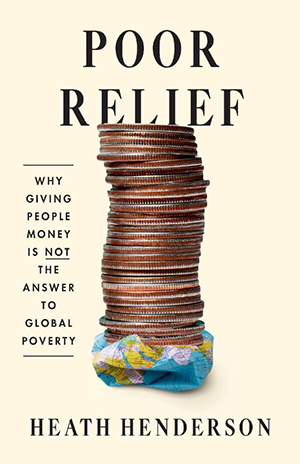
Poor Relief: Why Giving People Money Is Not the Answer to Global Poverty
Heath Henderson
256 pages, Harvard University Press Publication, 2025
Over 800 million people worldwide still live in extreme poverty, according to the World Bank. While there has been remarkable progress alleviating extreme poverty over the last several decades—most notably in countries like China and India—victory in the fight against poverty remains elusive.
The global development community has increasingly endorsed a single strategy for fighting global poverty: giving people money. Such “cash transfers” have been supported by international organizations (the World Bank), country governments (the United States), as well as nonprofits (GiveDirectly). Some have even viewed cash transfers as a kind of magical elixir for poverty alleviation. Nancy Birdsall, co-founder of the Center for Global Development, once said cash transfers “are as close as you can come to a magic bullet in development.”
In my new book, Poor Relief: Why Giving People Money Is Not the Answer to Global Poverty, I argue that cash transfers are a flawed way to address extreme poverty.
Cash programs do not combat the deep, structural issues that serve to keep people poor, such as racism or sexism, lack of access to quality education or health care, and even political exclusion. In addition, money can’t buy everything a person needs to escape poverty, like a stable climate, clean water, or access to markets. Furthermore, some people can be left behind or outright harmed by cash programs, particularly women and children.
Given the limitations of cash transfers, it is no surprise that people living in poverty often prefer other forms of support. I ultimately argue that impactful and respectful poverty alleviation requires being more responsive to the voices of people in poverty, rather than assuming markets know best. Stated differently, eradicating extreme poverty requires looking beyond one-size-fits-all solutions and toward a truly bottom-up, democratic alternative.—Heath Henderson
* * *
Cash transfer programs—also known as guaranteed or basic income programs—have become increasingly popular tools for fighting poverty over the past few decades. Growth in the sheer number of such programs around the globe has been accompanied by similar expansions of academic research, public discourse, and media coverage emphasizing the benefits of assisting the needy with direct grants of cash. Leading international organizations like the World Bank and United Nations have increasingly funded cash transfer programs, and charities like GiveDirectly have been established for the sole purpose of soliciting donations and relaying funds to poor households. GiveDirectly alone, across the decade from 2014 to 2024, saw its cash transfers increase from $3 million to $543 million.
Various influential people have expressed support for cash transfers. British politician Rory Stewart (who served a year as president of GiveDirectly) has asserted that cash programs reliably produce "extraordinary positive impact" and that a well-funded US program could “lift millions from extreme poverty.” Nancy Birdsall, cofounder of the Washington-based Center for Global Development, provocatively claimed the approach was “as close as you can come to a magic bullet in development.” In 2020, entrepreneur Andrew Yang famously centered his bid for the US Democratic Party's presidential nomination on the promise of a "Freedom Dividend"—a $1,000 monthly check sent to every American citizen aged eighteen or older. Many other entrepreneurs—including Bill Gates, Elon Musk, and Mark Zuckerberg—have similarly advocated for a universal basic income. In short, there's a growing consensus that a straightforward distribution of cash is the best solution to the poverty problem.
A closer look nevertheless reveals that cash transfer programs have some unsettling limitations. A useful starting point for understanding these limitations is in the experience of the Indian state of Jharkhand. In February of 2018, over a thousand people there amassed to protest the Direct Benefit Transfer for Food Subsidy (DBT), a trial program that did away with their ability to buy a quantity of rice each month at a dramatically discounted price, and instead gave them a financially equivalent benefit in the form of cash deposited to their bank accounts. The protesters gathered at a junction near the town of Nagri and marched eight kilometers to the governor's residence in the capital city of Ranchi. Upon arrival, they submitted a memorandum to the governor that read: “We demand the immediate withdrawal of the DBT pilot in Nagri in favor of the one rupee per kilogram rice at the ration shop. All households who were unable to purchase rice due to this pilot ... should be compensated as per the provisions of the National Food Security Act.”
The context behind the DBT experiment was that the National Food Security Act of 2013 had mandated that central and state governments provide low-income households across all of India with adequate amounts of quality foodgrains at affordable prices. To accomplish this, the act expanded on an existing food aid system in Nagri, whereby eligible beneficiaries were able to purchase a certain quantity of rice from specific local shops for just one rupee per kilogram. It was in October of 2017 that the Jharkhand government began its experiment of instead transferring money into people's bank accounts. Again, importantly, DBT didn't change the value of the subsidy to anyone simply using the cash to make the same grain purchases. Paid for at the market rate, but with transferred cash, a kilogram of rice still cost them one rupee. In the eyes of many, this shift: to direct cash payments could only leave people better off, as the option to spend on items other than rice gave them greater control over their household budgets. Yet, many residents of Nagri were clearly upset by the change. Part of the problem was the payment system, which created confusion about where and when the funds would be sent. Some people found themselves making multiple trips to the bank each month to see if the money had arrived. In one case, a woman named Jamna Sanga paid 32 rupees each for four rides to the town of Nagri, where she twice paid 20 rupees to a "banking correspondent" middleman to check the balance in her account. In the process, she missed five days of work at a hotel that paid her 150 rupees per day, and her daughter had to take time away from school to collect water in her absence.
The issues with cash programs like DBT go well beyond the payment systems. In April of 2018, Jharkhand's state government conducted an audit in which they surveyed over eight thousand beneficiaries about their experiences with DBT. The audit confirmed that collecting benefits was onerous and showed that many people failed to withdraw their money. Specifically, of the six installments to which recipients were entitled since the program began, the average beneficiary had claimed only 3.6. Making the situation even worse was that, according to economist Jean Dreze, "the elderly, the disabled, the ailing and the most vulnerable" were the least likely to claim their benefits. The people most in need of assistance were thus the most likely to be left behind.
Cash programs like DBT underserve such vulnerable populations in other ways, too. To the extent that people in these groups do manage to claim their benefits, they tend to take less advantage of them. In a detailed survey of people's views on cash transfers across nine Indian states including Jharkhand, a team led by economist Reetika Khera conducted interviews in roughly twelve hundred poor, rural households. Over two-thirds preferred in-kind transfers to cash. One prominent concern was with the constrained mobility of the elderly, the disabled, and many women, which made it difficult to "convert" cash into goods in markets that were ofi:en farther away than ration shops. In the words of one respondent, a sixty-year-old tribal widow named Aetwaribhai, "It is very difficult to get rice in the market. I am too old to go and search for rice.”
Other studies of cash transfers in India have raised different concerns. Most notably, a government's decision to disburse cash to individuals may mean that investments in certain public goods, such as schools, clinics, and infrastructure, are displaced. In this case, the cash transfers can undercut investments that the poor themselves believe are more critical for poverty alleviation. A 2018 poll conducted inBihar, India, asked people about their social spending priorities and found strong preferences for investments in public goods over cash transfers. Out of approximately thirty-eight hundred respondents, 86 percent preferred investments in public health over receiving cash transfers, and 65 percent preferred investments in improved roads over cash.
A further shortcoming of cash programs is that they don't address the systemic or structural barriers to poverty alleviation. Sometimes, in fact, they reinforce them. One program in India, because of the conditions it attached to cash transfers, actually increased the number of first pregnancies subjected to sex-selective abortions by somewhere between 1.0 and 2.3 percent. Introduced in 2002, the Devi Rupak program had intended the opposite: to combat persistent gender discrimination in household family planning by creating a financial incentive to have daughters. But because the program's designers also wanted to rein in population growth, they specified that cash would be distributed only to households with just one child-or two, if both were girls. Many families, however, maintained a strong preference to have at least one son, so to get benefits they took measures to make sure that their first (and only) child was a boy. Devi Rupak not only failed to address gender discrimination, but actually made the problem worse.
Problems with cash transfers aren't unique to India and there aren't any easy solutions. Banking apps on handheld devices can be used to make benefits more accessible, but this requires a level of mobile technology penetration which in India was far from complete when DBT was implemented. A 2015 report found that only about 36 percent of India's 1.3 billion people owned mobile phones, with devices in the hands of just 28 percent of women, versus 43 percent of men. Bypassing banks to transfer the cash would in any case be only a partial solution, as many people would still struggle with limited market access, inadequate public goods, and structural barriers to overcoming their poverty. As we'll see, there are other problems with cash transfers that similarly resist simple fixes.
Nearly 97 percent ofNagri residents opposed DBT and the government eventually responded to the pressure by returning to the old system in August of 2018. Unfortunately, this was by no means a satisfying resolution, in part because the old system had a history of severe corruption. It is an ofi:en-cited statistic from an audit of 2004-2005 distributions that 85 percent of food grains were siphoned off by corrupt middlemen. While the system has improved in recent years, important issues remain. Many households report that some members aren't listed on their rationcards, ration dealers routinely give people less than their entitlement, and the biometric authentication system is ofi:en out of order. The case of Nagri is hardly a ringing endorsement of in-kind benefits.
The concept is simple and seductive: give people cash, lift them out of poverty. Simplicity can be misleading, however, and when it comes to fighting extreme poverty, cash transfers have important limitations–which show up in all different types of cash programs across all country settings. The goal of this book is not only to document these limitations but ultimately to propose an alternative that is more responsive to the needs of people living in poverty. Rather than a one-size-fits-all approach to poverty alleviation, the fight against economic injustice requires a more radical, democratic form of intervention. Making the case for this alternative begins with this chapter, which takes stock of the different types of cash programs, outlines a brief history of cash transfers, and discusses how the argument will unfold across the remaining chapters.