


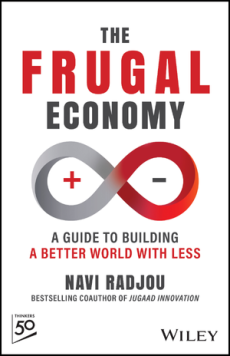
The Frugal Economy: Building a Better World With Less
Navi Radjou
256 pages, Wiley, 2024
In March 2022, I was living in Paris. The French presidential election was imminent. All leading candidates touted a national ecological plan to fight climate change, a top priority for French voters.
Around that time, my eyesight was getting poorer. I learned I had cataracts. I had written two books on frugal innovation that praised the Aravind Eye Care System in India for its frugal ability to deliver high-quality care at low cost. I decided to “see” for myself if that’s true. I flew to India and had an affordable cataract surgery at one of the Aravind Eye Hospitals.
After surgery, I could see clearly. Bye, bye glasses. When I returned to Paris, my newly gained visual clarity led me to a major insight: A single national ecological plan implemented in a top-down manner to fight climate change will be ineffective. Instead, we need a multitude of local plans developed and implemented in a bottom-up fashion that heed and leverage the vast diversity of resources, constraints, needs, and aspirations that exist across the French “territoires” (the equivalent of counties in France).
I decided to put my hypothesis to the test. For 10 months, I undertook a Tour de France to see the reality on the ground. I met hundreds of visionary public, private, and nonprofit actors in midsize and small cities, as well as left-behind places like Loos-en-Gohelle described below, who are boldly reframing the climate crisis as a climate opportunity.
These grassroots climate innovators are not focusing their energy (no pun intended) narrowly on driving just an energy transition. Rather, they are leading a systemic transition to co-build a frugal economy, a virtuous socio-ecological system that maximizes the well-being of all citizens within planetary limits using only local resources.
In mid-2023, I learned I had a secondary cataract. Rather than undergo another surgery, I decided to write a book to help business leaders and policy makers see clearly as I do that climate change is, in fact, a generational opportunity to change our deleteriously capitalist economy and build a better one.
In my book The Frugal Economy: A Guide to Building a Better World with Less, the last section is titled Frugal America. It is an ode to the 3,143 counties across the United States that are frugally leading a systemic transition today to reverse climate change just like Loos-en-Gohelle did.—Navi Radjou
* * *
The situation was dire when, in 2001, Jean-François Caron was elected mayor of Loos-en-Gohelle, a small town of 7,000 residents situated in a mining basin in Northern France. The last coal mine was shut down in 1986, leaving this historic mining town severely hurt by deindustrialization in the 1970s and 1980s. The soil was contaminated, unemployment was at an all-time high, and morale was at an all-time low.
Caron, who saw this crisis as a once-in-a-lifetime opportunity, embarked his city on a systemic transition that integrates five complementary dimensions: social, cultural, economic, ecological, and democratic. The social and cultural aspects of this transition are just as significant as the environmental aspects, making these five dimensions work in concert. In fact, one of Caron’s very first initiatives as mayor was to persuade UNESCO to officially recognize, in 2012, the mining basin where Loos-en-Gohelle was situated as a UNESCO World Heritage Site. By getting the slag heaps in his town (the tallest in Europe) the same recognition and status given to the pyramids in Egypt, Caron wanted the people in this town to feel proud of their cultural past, no matter how traumatic it was. Caron believes that any city must “own” its entire past to confidently build its future.
Then, Caron set out to regenerate the wounded spirit of his fatalistic voters. To restore the self-confidence of his voters, Caron decided to involve them as committed actors in the reinvention of their own town. By rebuilding their shattered town from the bottom up, the citizens also rebuild their own (broken) selves.
For instance, the town started a “Citizen Solar Plan” to produce locally all the renewable energy to address 100% of its electricity needs (Loos-en-Gohelle aims to be powered 100% by renewable energies by 2050). This plan incentivizes residents to drive the installation of solar panels throughout the town by acting as both investors and advocates. Furthermore, the municipality established France’s first green business incubator, which creates innovative solutions to fight climate change. The incubator is located on the site of a former mining pit, a symbolic nod to the city's industrial heritage.
During the 22 years (2001–2023) that he served as its mayor, Caron’s journey had its ups and downs, but its citizens have remained steadfastly committed to the systemic transition in their town. France is a country (infamously) known for top-down, centralized political governance. In Loos-en-Gohelle, however, participative democracy rules: all local redevelopment projects are coled with, by, and for the people. For instance, under the “50-50 program” initiated by Caron, citizen groups and community organizations can submit a plan for economic, social, cultural, or ecological development and the municipality will finance 50% of the project while its proposers finance the other 50%.
In the past 15 years, dozens of 50-50 projects have been successfully implemented, like installing solar panels on the rooftop of the local church (Let there be solar light!), schools, and municipal and commercial buildings; renovating and improving the energy efficiency of homes that were poorly insulated and heated with coal; and engaging local farmers and their equipment to fix rural roads (which saves the municipality 70% in maintenance costs). The 50-50 program has elevated citizens’ self-awareness: rather than view themselves as powerless victims, they gained trust in their capacity to initiate and lead change in their town. By improving their town, these citizens also boosted their “agency” (the power to make conscious choices) and expanded their “capability” to lead a good life. Today, the French environmental agency ADEME acknowledges Loos-en-Gohelle as an exemplar model for undertaking sustainable and regenerative development at a city level with active participation of local citizens. In November 2018, French President Emmanuel Macron visited Loos-en-Gohelle and discussed with Caron, as they climbed together a steep slag heap, how to replicate the success of the local regenerative development model in other ailing towns across France struggling to reinvent themselves.
I interviewed Caron for this book in Loos-en-Gohelle in early 2023, a few weeks before he left his office. According to Caron, there is no one-size-fits-all formula; instead, each territoire (county or city) must develop and implement its own regenerative development model with creative input from all relevant local stakeholders. However, Caron listed five key ingredients that are crucial for the success of any regenerative development journey:
1. All stakeholders in the city must first accept that the world of yesterday is truly “dead and buried.” We must counter any nostalgic impulse to re-create a “glorious past” or make the count(r)y “great again.” If you regenerate a dead body, you will end up with a zombie! It is said that the Hindu god Shiva performs his regenerative (cosmic) dance in cremation grounds, implying that the old (systems and worldviews) must die so the new can arise. If the terms death and dying frighten you, here is a reassuring metaphor: a jeweler melts a golden jewelry and uses the molten gold to craft a more beautiful piece of jewelry. Here, the gold didn’t “die”; it just lost its old “form” and gained a better one. When a place—or a person—is regenerated, their unique “essence” is preserved; they find a new, better way to “express” authentically that essence and share it with others.
In physics, the first law of thermodynamics, also known as the law of conservation of energy, states that energy is neither created nor destroyed. Rather, energy changes from one form to another. In the same vein, a city’s genius loci, or life energy, can never be destroyed, but its embodiment can evolve from one form to another form. Sadly, when that life energy gets “stuck” in a system (like in the aftermath of a trauma in a human body or even an entire society), the system “freezes” and loses its capacity to change form and evolve. Jean-Francois Caron was trained as a kinésitherapeute, French for chiropractor. Kiné means movement. Without movement, life atrophies. When a chiropractor releases your stuck joints, your innate life energy flows freely through your body, and you experience greater vitality and your mobility improves. Caron wanted to liberate that frozen life energy trapped in the collective subconsciousness of his traumatized city so it can regain its freedom of movement and willingly transition to a better form.
2. Today the word transition is very popular (even in the US, which long resisted the term), but it is still interpreted too narrowly through an exclusively environmental lens. Most people think of “energy transition,” that is shifting our energy system from fossil fuels to renewable energy sources to reduce emissions. To have a broad and deep impact at a local level, however, a transition can’t be just ecological. Rather, it must be systemic and integrate five interrelated dimensions: social, cultural, economic, ecological, and democratic. This final component is essential because, as Caron is fond of saying, “there is no ecological transition possible without a democratic transition.” The success of the 50-50 program mentioned previously, which marries citizen empowerment with ecological transition, is proof of that.
Caron also believes that economy and ecology can be harmonized in a systemic transition that contributes to “fair growth,” a middle ground between inequitable exponential growth (defended by die-hard capitalists) and degrowth (advocated by hard-core environmentalists). Caron explains, “I am an elected environmentalist, but I don’t just defend the environment. In a mining town with a record unemployment rate and a total loss of self-confidence, I must also reinvent the local economy and restore the dignity of all citizens. We must help financially challenged citizens reconcile ‘end of the world’ and ‘end of the month.’ The systemic transition that I am leading aims to simultaneously regenerate the human psyche, the social foundation, the cultural roots, and the natural ecosystem.”
3. Making the collective decision to leave the old world is a positive step, but we still need to choose the destination (“Where to land?” as the social scientist Bruno Latour put it) in thick fog. Instead of relying on cold logic, we must invite local stakeholders to use their imagination and intuition to codesign a fictional world that will enable them to project themselves into the future.
4. Next, we have to craft an inspiring narrative that (1) depicts vividly the course of a city’s systemic transition to a bright future while honoring and “appropriating” its past, no matter how painful it was (as Loos-en-Gohelle did), and (2) offers a compelling vision of a conscious society that awaits local citizens at the final destination: this the North Star that confers meaning to the regenerative transition.
Then, and then only, we must codevelop a transition road map with citizens and other stakeholders in the city.
5. Finally, for bottom-up change to be facilitated with courage and humility at the local level, enlightened political leadership is required. We need servant leaders who can subordinate and sublimate their ego for the greater good.
Excerpted with permission from the publisher, Wiley, from The Frugal Economy: A Guide to Building a Better World With Less by Navi Radjou. Copyright © 2024 by John Wiley & Sons, Inc. All rights reserved. This book is available wherever books and eBooks are sold.