


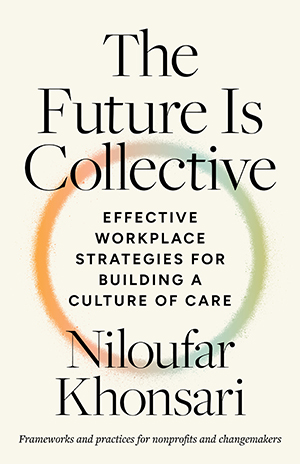
The Future Is Collective: Effective Workplace Strategies for Building a Culture of Care
Niloufar Khonsari
248 pages, North Atlantic Books, 2025
What if setting boundaries at work wasn’t seen as selfish—but as an act of solidarity, mutual respect, and movement sustainability? What if modeling boundaries could catalyze cultural change inside our organizations?
That’s one of the questions I explore in The Future Is Collective: Effective Workplace Strategies for Building a Culture of Care. As a movement lawyer, co-founder of a prominent immigrant justice organization, and someone raised in both Iranian cultural traditions of generosity and the gendered expectations placed on girls and women, I’ve wrestled with what it means to be endlessly giving—and what it takes to break that pattern.
For years, I overextended myself in the name of purpose. I felt an unspoken pressure to keep going no matter the cost, to hold everything together because the stakes felt so high. And like so many in our sector—especially women, gender nonconforming folks, immigrants, and BIPOC leaders—I believed I had to do everything to be enough. Setting boundaries was a personal turning point, but it was only possible with intentional collective support. And it’s still a work in progress. I’m not writing from the mountaintop—I’m sharing from the deep practice of transformation, with hard-won lessons and an ongoing commitment to the path.
This excerpt from Chapter 4 shares how even small shifts—naming my needs, requesting advanced notice, saying no without apology—created ripple effects. I began to feel more whole. My team began to value me and my work more deeply. And as I modeled the boundaries I hoped to see, we continued designing systems that made those boundaries real—not just for me, but for all of us.
This chapter includes practical tips for leaders and organizations who want to embed care into the fabric of how we work—not just in crisis, but in daily practice. Because boundaries aren’t barriers. They’re invitations—to dignity, to reciprocity, and to building a future where care and sustainability aren’t afterthoughts, but foundations.—Niloufar Khonsari
* * *
A few years before I transitioned out of Pangea, I started to set firmer boundaries around my time and energy. I went from doing the work of multiple full-time staff members to reducing my responsibilities to that of just one full-time staff member. Making myself unavailable on weekends, requesting advance notice when colleagues needed me to review documents, and prioritizing more vacation time became essential practices.
Surprisingly, instead of facing resistance, a noticeable shift occurred. My colleagues began treating me differently. For the first time, I felt truly valued and appreciated. Even though I was doing less than I had before, I received more praise and recognition. As I started valuing my time and setting boundaries, I noticed that my colleagues began to mirror this respect back to me. They no longer assumed I would always be available. When I was flexible and made time for something on short notice despite my stated boundary, there was a genuine sense of respect and gratitude—something I hadn’t experienced when I was always accessible. One colleague even told me, "I admire how you advocate for yourself, Nilou." These were some of the unexpected but powerful outcomes of setting boundaries.
I also felt the impact at home. I was more present, more at peace, and more connected with my family. Setting boundaries didn’t make me rigid or distant. Instead, it helped me show up as my full self both at work and in my personal life. This experience taught me that drawing boundaries isn’t just about self-preservation; it’s about creating space for mutual respect and deeper connection with others, both in the workplace and beyond.
The development of my boundaries required three key elements. First, I needed a strong will to set boundaries—a resolve that naturally strengthened after becoming a parent and that I further nurtured through therapy and coaching. Second, Pangea’s collective efforts, including a substantial fellowship award, provided us the resources to hire additional staff, such as a coordinator who could take on responsibilities I had previously managed. Finally, the collective structure we established, with intentional task redistribution meetings every six months, allowed me to gradually delegate my workload. While the delegation of my workload to other staff members wasn’t a perfect science, it served as an important structural support.
This raises an important question: How can we truly prioritize boundaries without adequate resourcing? We need to recognize that our system is inherently flawed; nonprofits often do public-sector work funded by government contracts at rates far lower than government-level compensation. While we often don’t have the resources to hire the staffing we need, we can begin with a strong sense of will and determination. By establishing long-term goals and co-creating values that uphold our commitment to balance, we can lay the foundation for the boundaries we aspire to so we can implement them when resources become available.
In collectively led organizations, we often work together with an entrepreneurial spirit, driven by our shared passions and goals. This enthusiasm can sometimes lead us to feel like we need to be available all the time, pushing our limits and compromising our well-being. It’s important to remember that we have the autonomy to set our own boundaries.
Below are some strategies for establishing and maintaining workplace boundaries.
Be explicit and affirming. Clearly state your boundaries and invite others to state theirs. Acknowledge the diversity in needs early on, and find ways to affirm boundaries. For example, openly share when you need uninterrupted focus time, or set expectations for response times on emails.
Lead by example. Adhere to your own boundaries. For instance, avoid sending emails after hours. Rek Kwawer of NASCO shared, “One of the boundaries we established was to use separate phones for work and personal calls, or to create a dedicated Google Voice number for work. This encouraged everyone to turn off their work devices when they were off the clock.”
Reassess regularly. Boundaries evolve with life circumstances. After I became a parent in 2018, my boundaries and priorities shifted. In 2022, with coaching from Sheena Wadhawan, I prioritized attending my daughter’s day care gathering at 4 p.m., even when it conflicted with a recurring work meeting. I asked three colleagues who would be impacted by moving this meeting to change the time. Previously, I would have shown up late or missed my child’s event. With a new perspective, and Pangea’s written Points of Unity supporting our wellness as individuals, I learned to create boundaries that aligned with my reality.
Acknowledge achievements. At Pangea, each staff member shared their vacation plans via email, checking our responsibilities and coordinating with colleagues to delegate tasks. Once these steps were completed, we didn’t need to seek approval. Instead, we announced our time off in an all-team email and tracked it in a shared chart, allowing everyone to take vacation when they wanted while maintaining trust and accountability. When others received these vacation-plan emails, we celebrated their time away and sent notes of encouragement.
Boundaries in the Office
Set clear working hours. Define the hours when you are available and avoid working outside of them unless necessary.
Take lunch breaks. Avoid eating at your desk; take time to enjoy your meal without distractions.
Minimize distractions. Limit personal calls and texts during work hours so as to not distract others.
Communicate about your workload. Inform your colleagues if your workload becomes unmanageable.
Don’t work if you’re sick. Take time off to heal.
Stick to focused time. Protect blocks of time on your calendar for focused work (e.g., no meetings or emails on Thursdays from ten a.m. to one p.m.).
Boundaries Away from the Office
Use your vacation days. Over 40 percent of US workers don’t take all their paid time off.8 Make it a priority!
Limit after-hours communication. Avoid checking work emails or going into the office during your time off.
Limit stress talk. To avoid reactivating anxiety and overwhelm, be mindful of talking about work-related stress. Reserve these conversations for designated supportive spaces.
Set automatic out-of-office responses. Set automatic email and voicemail replies directing inquiries to a colleague during your absence.
Delegate tasks. Identify tasks that others can handle to reduce your workload.
Boundaries are essential for protecting both our individual and collective integrity, especially in organizations with shared leadership; but they don’t have to be rigid. Flexibility within those boundaries allows us to maintain balance while still showing up for ourselves and each other. When we create space for our limits and honor the diverse needs of our peers, we cultivate an environment where we can thrive collectively. According to Prentis Hemphill, co-founder of the Embodiment Institute, “Boundaries are the distance at which I can love you and me simultaneously.” Hemphill’s words indicate that boundaries are about more than self-protection; they are about creating the space where mutual care and respect can flourish. By supporting one another in setting boundaries, we embrace our own evolution while also contributing to the creation of a more liberated and joyful community.