


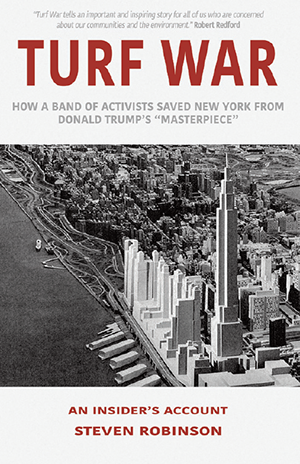
Turf War: How a Band of Activists Saved New York from Donald Trump’s “Masterpiece”
Steven Robinson
326 pages, Archway Publishing, 2024
My curiosity to see Donald Trump’s design for his West Side property led me to a crowded New York auditorium on November 18, 1985. Neighbors filled the seats and were standing in the aisles. We watched Trump unveil his self-proclaimed “masterpiece,” Television City. It would occupy the largest piece of privately owned vacant land in Manhattan—the abandoned 62-acre Penn Central Railyard along the Hudson River. He anticipated building the biggest project in the city’s history: 18.5 million square feet, featuring the World’s Tallest Building flanked by six massive luxury residential towers, the largest shopping mall east of the Mississippi River, a nine-thousand-car garage, and a television studio complex.
In the following excerpt from Turf War: How a Band of Activists Saved New York from Donald Trump’s “Masterpiece,” I describe how, as a young architect living and working nearby, I was outraged at the sight of this gargantuan plan that would overwhelm our community. I stole time from my office to help civic activists create a nonprofit, Westpride, to stop Television City. These neighbors became my mentors. They were lawyers, journalists, artists, and preservationists. During the next five years, they taught me about community organizing, real estate development, city politics, and fundraising. I found myself in neighbors’ living rooms, government offices, public hearings, protest events, drafting rooms, and courtrooms.
When Television City became recognized as a citywide danger, Westpride formed a coalition with several venerable New York civic organizations. We stopped Trump’s proposal, designed the Civic Alternative—a radically different community-oriented vision, established a joint master planning entity with the developer, and monitored the construction for 10 years.
I kept daily notes, saved documents, and collected press clippings, as well as photographs and drawings. I believe that this was an important and inspiring story for those concerned about our communities and the environment. As local activists, we banded together to overcome a powerful real estate company and compliant elected officials. This was a turf war—a prolonged conflict between the landowner pursuing excessive development and residents insisting upon participation in land-use decisions.
In cities and towns across America, people are facing similar assaults on the character of their turf. There are lessons to be learned here.—Steven Robinson
* * *
We are often drawn to specific places by the character of their buildings, streets, or open spaces. We have become familiar with the important dialogue about that “sense of place.” This story is different. It is about the continuing attachment we feel toward the places we claim as our “turf.”
Appreciating a sense of place may be temporary. Knowing our own turf is not. We are enriched by place, but we possess turf. That is why we are willing to fight for it.
Turf is our claimed place. It is claimed by children, adults, families, neighbors, tribes, governments, nations, and corporations. Turf may be claimed through war, seniority, purchase, occupancy, or gift. The claimed area may have well-defined boundaries or flexible limits. Its boundaries may be safe or under challenge; they may shift over time in response to internal or external dynamics. Turf may be claimed for days or millennia.
Turf is a hard-wired connection; it is our home ground, personal territory, sphere of influence; it may be the familiar city street, neighborhood, favorite park bench, ancestral sacred ground, religious site, a place of political or financial importance, or one of communal memory; its emotional value is determined by its qualities to sustain life, confer status, or provide security. In times of conflict, its value is determined by those who strive to control it.
Turf wars are not about whether places change; they are about how places change.
Organizing the Opposition
I began to meet with a small band of neighbors. We were angry about the abuse of power enabled by Trump’s wealth and political influence; angry about the greed that seemed to drive his vision; angry that our community’s character would be transformed by this stranger who did not care about what residents valued; angry that this deal would be made behind closed doors; and resentful at being overpowered, ignored, and disrespected. We were motivated by personal knowledge and love of our neighborhood, our need to insist on healthy community growth, and a desire for transparency in the public arena. These emotional reactions became the durable core of our opposition. We felt an obligation to act, to fight for our turf.
As our conversations continued, we were fueled by the belief that we just might be able to change the way large-scale real estate development decisions got made. There was a chance that we could prevail, and redefine “Highest and Best Use” to include social, cultural, historic, and environmental values.
We also knew the need to be well organized. We would build a war chest for our new nonprofit in order to hire land-use attorneys and environmental engineers, to inform and organize the community, and to craft and execute strategies to stop the impending juggernaut. We would be disciplined as well as flexible in order to become powerful adversaries. We would demand our right to be involved. This opposition could be fueled by thousands of concerned citizens. We would reach out to our natural allies. Families, friends, and neighbors talking in our homes, on the street, and in the shops might create a movement.
We would carefully chart our course, playing to the advantages we might exploit. We would force our shoulders into the door to get a legitimate seat at the table. That inside table was the source of current, accurate information; outside of that room, all was rumor and conjecture. Throwing rocks from the outside rarely penetrated the established development review process. But strategically throwing well-crafted monkey wrenches might succeed in slowing it down or stopping it. We would become committed and formidable foes.
Each previous struggle against excessive development had its own set of circumstances – the particular piece of land, the economic and political climate, and the cast of characters. Each struggle was waged in uncharted territory, never knowing what lay ahead. In this war, there were many intertwined layers of participants, including Trump and his staff, his architects, his attorneys, as well as city staff, politicians and the media. The forces arrayed against us would be formidable, experienced, well connected, and determined to have their way with our community.
We knew this war would be a risk. We would be the underdogs. The seminal question was whether there was enough political and financial will in the community to join us. If not, the city’s review process would proceed and the governing authorities would likely approve some slightly reduced version of Television City to be inflicted upon us.
Years of Progress and Collaboration
By 1990, Trump (Television) City appeared to be in trouble. Its application for Certification was four and a half years behind schedule; NBC had withdrawn as the anchor tenant; the mayor had stated his opposition to its density; Community Board 7 had expressed its opposition; Trump’s financial weakness had been publicly reported; the Manhattan borough president had called for city acquisition of the Penn Yards property, and declared her support for the Civic Alternative; the Coliseum lawsuit had shown the power of community activism; our civic organizations had filed lawsuits against the city’s Amendments to the Zoning Resolution and against the state’s highway rehabilitation; the press was opposed to Trump City; and the Civic Alternative had been well-received.
This was the moment for the civic organizations to create a new coalition – to build a formal partnership among natural allies – the Municipal Art Society, The Parks Council, the Regional Plan Association, Natural Resources Defense Council, Riverside Park Fund, and Westpride. Each organization had its own silo – its own agenda, history, reputation, leadership, funding sources, and constituency. This was an opportunity to join in common purpose – a citywide fight to advocate for a development based upon the Civic Alternative. Compared with the distinguished, well-established advocacy organizations, Westpride, even with our gains, was new on the scene. All six organizations gained the approval of their boards of directors, and the coalition became collectively known as the “Civics.” Seven city and state local elected officials signed on as supporters. Certification for Trump City was now predicted in February. The Civics began to communicate daily on strategies for ULURP, the city’s public review process.
Victory through Intervention
Throughout this turf war, New York activists made a series of interventions in order to defeat the Television City proposal and to design and monitor the development known as Riverside South, based on our Civic Alternative:
The pre-Certification negotiations between the developer and the city were normally closed to the public. We intervened to get that critical information through Freedom of Information requests, and, without precedent, we gained the right to be at the decision-making table.
Trump wanted to control the substance and timing of information being released to the public. We intervened to disseminate the real information about the proposed development to the community.
Trump paid his consultants to prepare the Environmental Impact Statement. We intervened by paying for and providing technical critiques to the Community Board and to the city review authorities which revealed their omissions, errors, and biased analyses of the potential negative impacts on the city.
As in the normal course of events, Trump designed his plan for property he owned. We intervened by designing the Civic Alternative, illustrating and publicizing what a community-oriented development could look like on the Penn Yards.
The city government wrote and approved Amendments to the Zoning Resolution which diminished the environmental standards to which Trump City would have been held. We intervened with a successful lawsuit against the City Planning Commission and the Board of Estimate, thus stopping the city’s review of Trump City.
With his masterpiece defeated by our intervention, Trump capitulated, agreed to build the Civic Alternative plan, signed the Penn Yards Agreement, and withdrew his Trump City plan.
Expecting that he would try to modify the Penn Yards Agreement to suit his intentions, we intervened by creating RSPC, the Riverside South Planning Corporation, a jointly controlled nonprofit entity, which gave the Civics an equal role in designing the master plan.
The developer normally navigates ULURP, the city’s public review process with a team of consultants. Because of the Civics’ successful role in designing the master plan, we intervened to participate in that process.
During the design and construction of the first seven buildings, the RSPC collaboration allowed us to intervene by enforcing Design Guidelines and Sustainability Guidelines.
New York State, New York City, and the federal government had been determined to repair the elevated West Side Highway, instead of relocating it underneath the new riverfront park. Our intervention efforts, including lobbying and litigation, failed to stop the state’s highway repair. This crucial defeat was decided by political shifts and personal animosities.
It may be said that the Civics got snookered by Trump. After all, he got the Penn Yards rezoned, establishing a substantial financial asset, and the Civics did not get a world-class park. However, he did not achieve his masterpiece of Television City or Trump City. The Civics got a rational neighborhood development with an expansive, although compromised, public park along the Hudson River. My reply is that we got more of what we wanted than Trump did.
Were we able to change the way land-use decisions get made in New York? In this instance we did. But recently, there has been a lack of public discourse about overdevelopment in New York. The press has largely ignored the issue; therefore, the politicians are not obligated to take a stand and few civic-minded organizations are willing to intervene. New Yorkers have witnessed the proliferation of enormous skyscrapers, the gargantuan Hudson Yards buildings, and “super-tall” residential towers near Central Park, as well as neighborhood-altering high-rise buildings in Brooklyn and Long Island City. It is clear that absent strong public opposition, such overwhelming developments, encouraged by compliant politicians, will get built.
Given this void of healthy opposition, development rushes in without regard to the social or environmental consequences to the character of communities.
Our American systems of federal, state, and local governance are, because of the advocacy of diverse interests, malleable by intent. These systems function with flexibility, are adaptive to change, and are designed to provide stability and balance in society. Yet, they are also vulnerable to powerful individuals pursuing personal advantage at the expense of the public welfare. When citizens recognize that our malleable system is being molded in a self-serving way, as Trump attempted on the West Side, intervention by residents becomes necessary to stop it and to prevent social and environmental injustice on their own turf.