


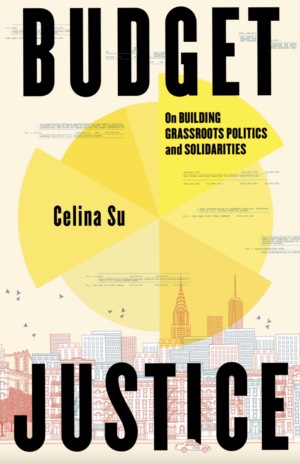
Budget Justice: On Building Grassroots Politics and Solidarities
Celina Su
296 pages, Princeton University Press, 2025
As trust in public institutions declines, Celina Su’s Budget Justice: On Building Grassroots Politics and Solidarities calls us to imagine how government budgets can reengage citizens in the decisions that shape their lives. People across the country are hungry for new models of governance, and affording them the opportunity to determine public budgets is an excellent way to address their concerns. While budgets are often viewed as dry accounting tools, they are actually deeply moral and political documents, values embedded in reams of paper. Budgets reflect a society’s values and priorities: When a city allocates minimal funds to early-childhood education, for example, while providing more resources to other areas, it is declaring who and what matters.
If budgets are crucial documents for understanding a society’s values, why are they so often inaccessible to the average person, or even to policy experts? Why are they so often unresponsive to the needs of marginalized communities and traditionally underserved communities? While philanthropy tries to fill gaps, alleviate suffering, and innovate where government has fallen short, Su urges us to look upstream: How are public priorities set in the first place? And what would it take to ensure that the communities most affected by budget decisions are actively shaping them?
To provide answers, Su breaks down the architecture of municipal budgeting, exploring how funds are allocated, why certain line items persist year after year, and how language and presentation are used to obscure, rather than clarify. Budget opacity is not simply a bug, as she emphasizes, but a strategic feature aimed at limiting public engagement in decision-making processes. In one vivid example, she recounts how difficult it can be to trace where school funding goes or to compare agency budgets over time, even for experienced advocates: “I felt overwhelmed when I tried to read about budget cuts, and I’m a public policy scholar. The public budgets I looked at felt like dismaying, overly technical documents.”
Questions about who controls the budget are intertwined with questions about power, democracy, and political economy, as ways that anyone who advocates for change only to be met with data inconsistencies, bureaucratic jargon, or shifting goalposts understands. Genuine civic participation, Su argues, depends on radically increasing transparency and accountability, not only in making budget data available, but in making them intelligible and actionable for all residents. Bringing people closer to the budgeting process is an important part of hands-on civic learning and strengthening local level democracy.
At the heart of Budget Justice is a nuanced exploration of participatory budgeting, a democratic process that first began in Porto Alegre, Brazil, in 1989, in which ordinary people decide how to allocate portions of public funds. Su documents how participatory budgeting can empower people who are often excluded from formal politics: immigrants, youth, formerly incarcerated individuals, and low-income families. Participatory budgeting brings people together in their neighborhoods, school cafeterias, and community centers to deliberate and vote on how funds should be spent. Projects have ranged from installing bathroom stalls in public schools to increased funding in low-income communities to improving street safety in high-traffic areas. New York’s Participatory Budgeting process included a range of creative projects, among them a study of endangered bats, fitness equipment for senior citizens, and freeze-resistant water fountains.
Having personally witnessed scores of these meetings across the country, I can attest to their democratizing power: Participants leave transformed with an intense appreciation of the genuine trade-offs required for policymaking, as well as new relationships with their neighbors and members of government. But Su also shares moving anecdotes of residents who changed their minds mid-process, such as a parent who arrived to advocate for a school amenity and left supporting public housing improvements after listening to their neighbors. These moments, she suggests, represent the kind of civic transformation that democracy needs, precisely because people are learning throughout the process to weigh trade-offs and deepening their understanding of what it takes to make the city run.
Su is candid about participatory budgeting’s limitations. It often involves only a small sliver of public funds, can be exhausting for volunteers, and, when poorly designed, risks reproducing existing inequalities, being co-opted, or not enabling power shifts. Participatory budgeting is not a silver bullet, and she does not romanticize it. But it is a meaningful starting point for shifting power and fostering civic learning. As such, it can help build what she calls “an ecosystem of participation,” drawing from scholars of deliberative democracy like Jane Mansbridge and John Parkinson.
Instead of seeing civic engagement as a series of isolated events—voting, attending a meeting, or responding to a survey—Su describes an interconnected, ongoing ecosystem of participation, from democratic innovations like participatory budgeting to informal networks of mutual aid, advocacy, and cultural expression. Mutual aid flourished during the COVID-19 pandemic, as she powerfully recalls: “My neighbors quickly mobilized to help one another. Flyers on every block announced phone numbers to call or text if someone needed groceries. Few questioned whether those who requested help ‘deserved’ it.”
Decentralized, care-driven efforts are presented as models for relational forms of civic life that challenge bureaucratic inertia. Especially in under-resourced communities, informal care systems outside the bounds of official government programs are not apolitical acts of charity, but democratic expressions of solidarity and shared responsibility.
“Radical ideas are of little use if they do not manage to be shared by a social majority and get translated into public policies that, in turn, transform social reality.” For all its power, mutual aid is fragile, especially under resource strain.
For those in the social sector, thinking this way helps reframe the question of how to work with government while also pushing it to be better. Rather than choosing between state and civil society, Budget Justice envisions an interplay, where community-led initiatives can inform public priorities and vice versa.
Though filled with policy analysis and institutional critique, Su’s book also shares her own journey as an immigrant—moving to the United States from Brazil in the 1980s—and argues that how we show up in civic life is tied to our sense of self and our own personal narrative. In case studies and interviews from Mississippi, Porto Alegre, and Barcelona, Su illustrates how participatory budgeting and similar models have played out in diverse political contexts. Porto Alegre, for example, serves as an inspiration but also a cautionary tale. Initially, participatory budgeting “redistributed millions in public spending toward underserved neighborhoods,” she writes. But as political winds shifted, the process became depoliticized and less impactful; as explained by Tarson Núñez, former head of the Porto Alegre Planning Office, who oversaw participatory budgeting in the city and helped launch it on the state level, “The most important problem is that we don’t have a transformational paradigm, and we don’t elaborate on how we can build power to people outside traditional political and economic institutions. We need to rethink politics as a whole.”
One of the most detailed sections of the book focuses on participatory budgeting in New York City, a process in which residents decide how to allocate a portion of public funds, by far the largest such program in the United States. (Since 2012, it has allocated more than $250 million to nearly 1,000 community projects.) By engaging communities often left out of traditional decision-making, the approach creates space for young people, noncitizens, and other disenfranchised groups to participate meaningfully: “Nearly one-quarter of people who voted in New York City’s participatory budgeting process were not eligible to do so in typical elections.”
Barcelona’s experiment, especially under Mayor Ada Colau, has been more ambitious, embedding feminist and digital principles into participatory governance. But here too, Su emphasizes that participation is not self-justifying and must be linked to redistribution and structural accountability. “Radical ideas are of little use if they do not manage to be shared by a social majority and get translated into public policies that, in turn, transform social reality,” as she quotes Marc Serra Solé, a former Barcelona City Council member and secretary general of the International Observatory on Participatory Democracy; “This applies both to the institutional policies of political parties and those forwarded by social movement.”
Su is clear that formal processes like participatory budgeting, while valuable, are insufficient. “There are no shortcuts or algorithms for democracy,” she writes. Sometimes winning projects are expenditures that city agencies would have implemented anyway—“consolation prizes in a game of permanent, punishing austerity,” as she puts it. Many projects are basic infrastructure fixes, not transformative investments, and she warns against conflating small wins with structural change. Moreover, technical expertise can often override lived experience, as when “city bureaucrats sideline local knowledge in favor of technical knowledge.” Even well-intentioned participatory mechanisms can reproduce inequality without critical design and facilitation.
None of this is really an argument against it. There are reasons to think that participatory budgeting does transform social reality. Districts with participatory budgeting showed distinct funding patterns, as she notes (“Schools and public housing, for instance, received more funding, while parks and housing preservation received less”), as well as increased political engagement across the board (“Participants were 8.4 percent more likely to vote than those who had not participated in the process”). There is a spillover effect to other aspects of democratic life, in other words; as Su eloquently puts it, “Perhaps they will elicit ripple effects like a pebble in water.”
And yet … how can such ecosystems scale, sustain themselves, or interact with less-open state systems? Her argument is thought-provoking, and yet it is undeveloped in this way. For all its power, mutual aid is fragile, especially under resource strain. Leaving implementation questions to the reader is a gap in an otherwise comprehensive book. But by reimagining how budgets are built, who builds them, and what values they reflect, Su suggests that we might also rebuild our democracy, one line item, one conversation, and one community at a time.