


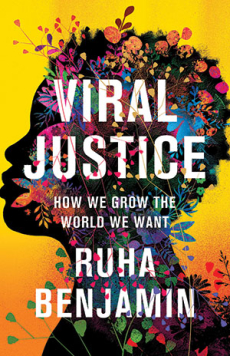
Viral Justice: How We Grow the World We Want
Ruha Benjamin
392 pages, Princeton University Press, 2022
It is a bold move to use the metaphor of a virus to represent a new framework for social change. But this is precisely what Ruha Benjamin does in her compelling new book, Viral Justice: How We Grow the World We Want.
“Viruses are not our ultimate foe,” contends Benjamin, who is a professor of African American studies at Princeton University and founding director of the Ida B. Wells Just Data Lab. In Viral Justice, Benjamin focuses the concept of the virus not as a deadly, communicable illness but as a model for collective world building—what she refers to as “reworlding,” or the reordering of our values and priorities.
Virality is the organizing principle of her theory of social change—the viral spread of which begins within an individual and expands outward through engagements with other people, positively influencing their choices and actions. Ultimately, Benjamin’s vision “requires each of us to individually confront how we participate in unjust systems even when in theory we stand for justice.” In doing so, the virus is not something that happens to us but is something we have some power over. “This is a call to action for individuals to reclaim power over how our thoughts, habits, and actions shape—as much as they are shaped by—the larger environment,” she says.
Combining autobiography and sociological studies, Benjamin analyzes the layers of discrimination within the United States’ health care, education, and incarceration systems to demonstrate how systemic harms use “multiple paths to get under our skin.” She begins with her personal story to illuminate the constant fear of violence that Black Americans experience. “I spent most of my childhood sleeping defensively,” she observes. “Imaginary bullets interrupted my dreams night after night. That is why Breonna’s death at the hands of the police in the middle of the night hit me so hard.” Breonna Taylor was asleep in her bed when she was fatally shot by police who, claiming to be searching for drug dealers, unloaded 20 rounds of gunfire into her home in Louisville, Kentucky, in March 2020. The argument and examples that follow in the book are a continuation of this theme of endangerment—not just the reality of violence and the intergenerational compounding effects of violence, but the unceasing fear ingrained on a cellular level.
These cumulative effects are known as “weathering,” a term coined by behavioral health professor Arline Geronimus that Benjamin uses to describe “how we embody stressors and oppressors in the broader environment and how this process causes preventable illness and premature death.” She elaborates that these stressors and oppressors, which produce various types of inequity, originate in human systems. “Hostile environments are made and remade daily through machinations of institutions and individuals alike,” she says.
“Weathering,” like the concept of the virus, has both a positive and a negative valence: Weathering deteriorates a body, but the term is also applied to describe persistence—such as “to weather the storm.”
The racism embedded in the health-care system, for example, is camouflaged under the oft-repeated and inaccurate pretexts of preexisting illnesses attributed to genetics, alleged vaccine and medical treatment hesitancy, and Black “thick skin” that “doesn’t crack”—to suggest that Black people do not feel pain the same way as white people. This scapegoating underscores the importance of how weathering can serve both as a “public health idea and a framework for understanding and challenging how everyone’s lives and futures are affected by anti-Black racism,” Benjamin says.
Weathering is also a product of centuries of enslavement, incarceration, and lifelong policing and surveillance. This state violence is institutionalized brutality that, Benjamin notes, causes heightened blood pressure, accelerated aging, and mental health issues. So, she reiterates, racial health disparities are not biological but socially produced over time.
While structural change, steeped in bureaucracy and political processes, is inherently slow, Viral Justice does not succumb to despair. Instead, Benjamin believes self-awareness and accountability are the starting points to eradicating these systemic harms. “Starting in our own backyards,” she asserts, “let’s identify our plots, get to the root cause of what’s ailing us, accept our interconnectedness, and finally grow the fuck up.”
So, Benjamin proposes a kind of DIY practice, cultivated over time, to offset the institutional ineffectiveness. “It turns out, transforming the weather doesn’t require magical powers. It just requires that we begin to plot—emboldening one another, reimagining our relationships,” she says. “Watering the alternatives we want to grow and always shouting love in all we do.”
Benjamin points out that “the threat was never the man in the street or across the border. It was always the man in the mirror.” Therefore, the way forward, she proposes, “requires cultivating new habits internally, seeding restorative ways of being together interpersonally, uprooting practices of inequality institutionally, and planting alternative possibilities structurally.”
Of course, this strategy hinges on a personal willingness to change oneself—to work on oneself—to improve the health and well-being of the nation. In light of the increasing violence against marginalized communities and the heightened political division, this optimism may at times feel too lofty to the reader.
But virality, Benjamin emphasizes, is the pathway forward that can help us to envision our individual agency in making systemic and social change a reality. The concept of virality represents the power of relationships and interpersonal connections. The internal work begins by asking ourselves questions, interrogating our beliefs and the language we use. Micro-change can happen through intentional use of justice-oriented language, or phrasing that calls out explicit systemic injustice. “As a small-business owner,” Benjamin proffers, “perhaps you’ll start by hanging a neon sign that reads, ‘White supremacy won’t die until white people see it as a white issue they need to solve rather than a Black issue they need to empathize with,’ as did Glory Hole [Doughnuts] on Gerrard Street in Toronto.”
Benjamin’s proposed solutions to systemic injustices and weathering aspire to abolition. For example, to end state violence and the weathering effects of racist policing and surveillance, she argues, “justice in this context is not about police reform. It refers to the gradual abolition of an institution born of slave patrols and kept alive on the myths of virtuosity and necessity.” She reiterates the importance of the defunding and eventual abolition of “policing and punishment [and] carceral system,” adding that “a core element of viral justice empathy goes hand in hand with abolitionist experiments in creating a world without police.”
In lieu of policing, Benjamin suggests greater government and foundational investments in social services. In Seattle, for example, the Seattle Solidarity Budget, a coalition of more than 200 organizations that formed during the 2020 protests against police violence, is, Benjamin observes, not handing “more money to police for surveillance” but investing in public-interest technology, “in which digital stewards work with community members.” Guided by the belief that budgets are “moral documents” that reflect a city’s, state’s, or nation’s values, the Solidarity Budget “hosted public education meetings, rallied at City Hall, [and] delivered testimony at city council meetings.” The coalition’s collective effort with local communities and local government resulted in “successfully [shrinking] the police budget two years in a row while winning investments that center the city’s most marginalized residents,” including the creation of a Guaranteed Basic Income Pilot program.
However, given that annual federal budgets for policing and prisons have increased by billions of dollars since the 1970s, and very few politicians have expressed any abolition-related sentiments about the police, such solutions might seem nothing short of pipe dreams. At the same time, public trust in the police is at an all-time low, according to a 2020 Gallup poll. So, changing public opinion might foreshadow policy and funding changes in policing in years to come.
Reading Benjamin’s chronicle of America’s enslavement of Black people as a writer living in Pakistan, I was reminded of the ghost of the British Empire’s global colonization and the weathering effects of the oppressive policies that still simmer just beneath the surface in many countries, including on the Indian subcontinent—India, Pakistan, and Bangladesh. Britain’s history of imperial excesses remains largely excluded from its school textbooks, suggesting Britain’s lack of remorse and national introspection. As such, the idea of reparations seems farfetched when many people are, at most, willing to cosmetically acknowledge wrongs but unwilling to support reparations.
The final pages of Benjamin’s Viral Justice are a testament to human resilience, to finding meaning in little acts, and growing a garden from a seed.
A reworlding of the United States or Britain or any other imperialist country, then, I agree with Benjamin, is impossible until its institutions address and repair what she calls “the foundational lies—such as the myth of meritocracy—on which our societies have been erected.” Instead, she argues, we need transformative learning environments that “lay a different foundation, brick by brick, in the hearts and minds of young people whose trust we can only earn by telling the truth.”
Benjamin’s recommendations for such a reworlding of education include reimagining schools “as laboratories for growing empathy and solidarity”; investing in “mediation and restorative justice processes” in schools; prioritizing the “recruitment and retention of teachers of color”; and integrating “Black history and ethnic studies in curriculum.” The last guidance, of course, is currently a point of critical contention across the United States, as parents and teachers—misconstruing the teaching of history under the banner of “critical race theory”—decry educating children about the innumerable histories that have been suppressed in America.
The final pages of Benjamin’s Viral Justice are a testament to human resilience, to finding meaning in little acts, imbuing beauty in the mundane, and growing a garden from a seed. When one individual is there for another, a neighborhood turns into a community, a community into a city, a city into a country, a country into a continent, and a continent into the world.
Interpersonal acts of kindness multiply into collective empathy, setting into motion Benjamin’s process of reworlding, whereby no act of support and assistance is irrelevant. “Viral justice,” she says, “is not about dystopia, or utopia, but ustopia.”
At a time when the coronavirus has unfolded a new reality in which social distancing and masks have become the new normal, and when we as a society have not yet grieved all who were lost to the virus—many without getting to say goodbye, without a last hug, and without last social or religious rites—we need to remember the “us” in what seem to be our increasingly siloed worlds. Benjamin’s Viral Justice is that “stubborn beauty, a joy that refuses to kneel in defeat” in a pandemic-afflicted world, and in an America tainted with racism and colorism.