


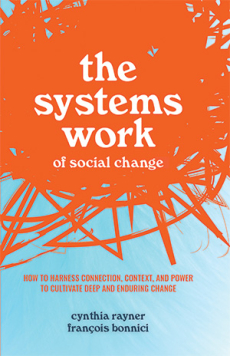
The Systems Work of Social Change: How to Harness Connection, Context, and Power to Cultivate Deep and Enduring Chang
Cynthia Rayner and François Bonnici
304 pages, Oxford University Press, 2021
Current debates about social progress question the effectiveness of piecemeal reform measures in addressing today’s greatest societal challenges. Some leading thinkers, including psychologist Steven Pinker and entrepreneur Peter Diamandis, claim that sustained social progress is achieved by incremental changes to systems that we already have.
Others, such as activist Edgar Villanueva and journalist Anand Giridharadas, argue that our worsening societal crises—from increasing wealth inequality to climate change—prove that reform measures are ineffective because the systems in place are broken. These advocates believe that stepwise change is unlikely to slow, let alone reverse, these mounting crises.
In The Systems Work of Social Change: How to Harness Connection, Context, and Power to Cultivate Deep and Enduring Change, Cynthia Rayner and François Bonnici argue that there is no easy way to generate systems change. They delve into the deeper work of social change through a series of eight case studies of civil society organizations worldwide to propose a pragmatic pathway for systems change. These organizations share a commitment to centering people in their work—and reject the traditional, top-down approaches to social change that often overlook the communities they serve. “The day-to-day work in the long arc of social change is messy and nonlinear,” the authors write. “Effects can rarely be traced to single root causes, and outputs are rarely proportional to inputs.”
Rayner and Bonnici’s definition of “systems change” emphasizes the gradual, often underrecognized, work by nonprofits. “Rather than just promote successful outcomes, these organizations are focusing on the process of change, creating new systems that are more responsive to a rapidly changing world, and more representative of a diverse and growing global populace,” they explain. “The values and approaches with which these organizations are operating are not new, but have generally been happening beneath the surface. … We have come to call these principles and practices systems work.” Their definition differs from an understanding of systems change that reduces societal problems to discrete technical issues that are then analyzed in isolation and solved through “scaling what works” while diligently measuring performance indicators until the job is done.
Emphasizing process and practice, The Systems Work of Social Change is methodical. The first section surveys 200 years of social change efforts to derive three principles of systems work: fostering connections by building collective identities that allow for learning, growth, and change; embracing context by equipping primary actors to respond to day-to-day challenges; and reconfiguring power hierarchies by putting decision-making and resources in the hands of primary actors, in order to ensure that those social systems represent the people who live them.
The second section puts these principles in action. Rayner and Bonnici divide this section into four chapters, each of which presents the four practices that organizations have adopted in their work. These practices are people-centered, highlighting the importance of the individuals doing the work and the people who the nonprofits serve. Rayner and Bonnici focus on cultivating collectives and human connection, especially through social media; equipping problem solvers with resources to have the time, ability, and support to do the work; promoting platforms that connect problem solvers to learn from one another and collaborate to challenge static organizational structures; and disrupting policies and patterns that perpetuate discrimination and inequitable results.
The final section assesses the support networks—from internal actors such as professional managers and advisors to external actors such as funders—that social purpose organizations need to thrive. It is in this finale that the authors recommend a reevaluation of how to resource and measure the work of social change. This work requires rethinking the values underlying measurement—what value is being measured for? And what, the authors ask, are the “invisible values,” such as strength of relationships and human interactions, that are being overlooked and/or are difficult to quantify?
Rayner and Bonnici’s provocative idea that process matters as much as or even “far more” than quantifiable outcomes is bound to rankle those invested in a managerial, top-down approach to social change. They argue for building local institutions that are adaptive, enduring, decentralized, and yet networked with similar organizations so that they can be “unified” without needing to be “uniform.”
In their view, enthusiasm for simplistic efforts to scale up solutions to complex problems has become a secular religion and an “illusion” resulting from philanthropic elites’ inability to see the interconnected and ever-shifting nature of society’s problems. Far better, they contend, to put “primary actors”—“the people most immersed in the context of a social issue, often with lived experience of the issue itself”—at the center of responding to the web of social problems and relegate funders and experts to supporting roles.
Rayner and Bonnici criticize the current obsession with measuring short-term outcomes that values numbers over people. “Social change metrics,” they contend, “often have more to do with their ease of quantification rather than their value to those” pursuing or hopefully benefiting from social change efforts. Reliance on those outcome indicators also presupposes that we know what we should be measuring and that the benefits of doing so outweigh the costs, including the opportunity costs—dubious assumptions at best. The authors remind us that outcome metrics are effectively value judgments.
Further, they point out that evaluation efforts tend to focus on trying to prove whether a certain technique works better over a short time horizon (usually related to a project’s budget cycle) rather than on seeking to improve how organizations perform. As a result, they charge, “vital learning” is sacrificed at the “altar of accountability” by the priestly elites. They propose a new paradigm focused on measuring for learning, where “organizations are able to ask different questions, recognizing the primary aim is to determine ‘what is happening’ rather than ‘what worked.’”
Rayner and Bonnici marshal these points as part of their larger challenge to the linear thinking of social change. They note that when “we treat social change efforts with defined starts and ends, we nearly always feel frustrated, since our understanding of what needs to change is necessarily a moving target.” Instead, they recommend that we focus on “the process of change—asking critical questions such as who deserves? who designs? and who decides?—[so that] we can move forward into the future with a great capacity to adapt.” Elevating social change processes above outcomes, they argue, would result in faster progress on vexing social and environmental issues.
At times, the book struggles to stay grounded in the realities, paradoxes, ambiguities, and compromises of the messy work of social change.
The book has a few noteworthy limitations. The authors fail to grapple with the consequences of sidelining experts and expertise—as evident in the nativist, anti-science, and anti-intellectual populism in the United States and elsewhere that has stymied efforts to control the COVID-19 pandemic. At times, the authors are uncritical of the organizations featured in their case studies, and, as a result, the book struggles to stay grounded in the realities, paradoxes, ambiguities, and compromises of the messy work of social change.
For example, the global NGO Child and Youth Finance International made some impressive headway on increasing the financial literacy of children before folding after a brief nine years. The organization’s surprising assertion that they had achieved their goals and were no longer needed is unquestioningly accepted by the authors without examination. In another case study, government-mandated decentralization—an approach praised elsewhere in the book—reverses much of the astounding progress achieved by education nonprofit Fundación Escuela Nueva in Colombia. Rather than investigating whether they could have anticipated this change or adapted to it better, the authors claim without evidence that the many aspects of their student-centered approach somehow live on.
To take another example, their case study of international nonprofit mothers2mothers, which is dedicated to eradicating HIV transmission from birthing parent to child, slightly exaggerates its effectiveness at slowing the transmission rate (rounding up their rate from 1 in 52 to 1 in 60), while the authors relegate helpful context (the benchmark rate of transmission) to the appendix. More often, they refer to these organizations’ achievements with vague or imprecise information. These omissions and other gaps in analytical rigor detract from the power of the case studies and seed doubt about whether emphasizing often intangible process over more quantifiable outcomes is a wise bet after all.
Nor do the authors grapple with the practical issues, for example, of convening primary actors when those actors don’t share a common language, or the confounding but common issue of the most marginalized people being excluded when self-selected peer groups of slightly wealthier people are formed. If the impressive organizations that they feature have figured out how to solve or at least manage such problems, this book would have been richer and provided more guidance to social change leaders if it offered more explanation. Perhaps a sequel more oriented toward practitioners of systems change could fill in the blanks.
Likewise, Rayner and Bonnici don’t acknowledge that many successful efforts do not conform to their principles. They could have provided better explanations of the trade-offs that are so common in the complex, real world of social change and in building “people’s institutions”—an out-of-vogue term that I was pleased that they revived.
Yet, far from being a fleeting effort to ride the latest philanthropic fad, Rayner and Bonnici demonstrate the power of building institutions capable of integrated analysis and adaptive learning, as well as challenge us to confront old ways of thinking that may have served us in an earlier era but clearly no longer do so.