

In one of those coincidences that reveal the spirit of the moment, two books appeared last year within weeks of each other celebrating public libraries. Sociologist Eric Klinenberg expanded on the idea of public libraries as an instance of “social infrastructure”—“a powerful way to promote civic engagement and social interaction”—while New Yorker writer Susan Orlean used the story of a 1986 fire that destroyed the Los Angeles Public Library to riff on the history of libraries and heroic librarians. Together, the books marked a rediscovery of a public resource with a long history.
Where Klinenberg and Orlean delved into a particular model of public institution, legal scholars Ganesh Sitaraman and Anne Alstott take a wider lens in their new book, The Public Option. They treat libraries as just one model of a public institution that can thrive alongside market-based options (like bookstores) and provide desirable benefits to society more broadly and equitably than the private sector can do alone.
“Public options are everywhere, and they are some of the most beloved, celebrated, important, and effective parts of our society,” the authors write. After describing the theory behind public options as “a very American institution [that] leverages public resources without preempting private provision,” they survey examples in existing programs and suggest areas such as childcare where a public option might work.
Because politics since 1980 has set up such a sharp contrast between the zones of free enterprise and government, we often neglect the public gems that coexist happily in an ecosystem that includes private and nonprofit options for similar goods. Like libraries and public schools, these are not “public-private partnerships,” in which the private sector’s profit motive is supposedly harnessed to a public good. Nor are they “coupon programs,” to borrow a phrase from Mike Konczal, a fellow at the Roosevelt Institute, in which government gives citizens some form of voucher or tax benefit to purchase goods in the private sector. These are clearly defined, publicly funded entities, available for the most part to all without the means testing that typically limits eligibility for direct-spending programs, nor the regressive effects and complexity of benefits delivered in the form of tax deductions or credits.
No one refers to the library as a “public option,” though. The term has been associated for the last decade with health reform, and specifically the idea of a publicly administered plan that would offer basic benefits comparable to Medicare or better. In this context, the public option is often regarded as either an incremental step toward a fully public, single-payer health system, or a dubious compromise. In the early years, of the Obama Administration many hoped that a public option would be so appealing that it would draw people away from private insurance, leading to a single-payer system. But the public option didn’t have enough support to make it into the final version of the Affordable Care Act.
Today, though, critics on the left who favor Medicare for all see the public option as an overly cautious middle ground, supported by those unwilling to go all the way to the ideal. In neither case has it been treated as a desirable end in itself.
Sitaraman and Alstott leave the intimidatingly complex issue of health care aside until a brief section at the end, where they speculate about whether regulating health insurance as a monopolistic utility might be a good alternative to a public option. But for those who can see the health-care public option only as a step toward, or away from, something bigger, Sitaraman and Alstott make a vital contribution by showing how all kinds of public options have played a key role in complex systems with private, nonprofit, and public elements, and that those configurations have been stable, popular, and successful over the course of decades.
Some provide a cheap, basic option: The postal service, for example, sits alongside UPS and other private carriers that offer more customized services, just as postal banking would not replace private banks. In higher education, public options do include some elite institutions, but the base is composed of reasonably affordable two- and four-year institutions, where more than 80 percent of students are enrolled.
In other cases, the public option provides a kind of framework for private activity, as the authors would do—and the Obama administration attempted to do—for retirement, simply setting up the structure of a simple, cost-free account for saving. (The Trump administration moved quickly to eliminate that public option.) In other cases, a public option can provide a benchmark, using efficiencies of scale and lower costs to ensure competition where it wouldn’t otherwise exist. In certain markets, this will be a more effective means of ensuring competition than regulatory enforcement.
But these public options operate in very different ways that matter. For example, as Princeton University sociologist Paul Starr, an expert on health reform, has noted, a public option could have many different effects depending on design: For a cheaper, less desirable basic option, people in relatively poor health might be steered to the public option, pulling them out of the private sector (but government-organized) health insurance exchanges. This outcome would mean government bearing more risk and expense while private insurers profited, leaving the public option a last resort for those people priced out of the private market. Alternatively, a public option that offered the same benefits as private sector competitors but more efficiently (free of the costs of advertising, the impulse to profit, and the multimillion-dollar CEO salaries) might make the private sector options undesirable and unprofitable.
The authors touch on these distinctions but pass over them quickly in order to reach their main point, which is to amass as many different kinds of programs as can plausibly fit under the “public option.” This act of classification reveals an important truth about American policy history and also about possibilities for the future: Public options, and public provision of services within otherwise market-based structures, have been central to every wave of progressive reform since the Civil War. They are mostly uncontroversial and often unnoticed, and they can play a role in addressing virtually every policy challenge we will face in the coming decades.
The authors make that point so persuasively, in fact, that it quickly becomes repetitive. Like many policy books, this could be an op-ed (and it is). The expansion adds some heft, legitimacy, and footnotes—but not much more insight, texture, or tension. The authors’ tone is chatty and accessible, but their frequent use of the pronoun “we” suggests that they are working more from personal intuition than from a clear definition of public options. “We’re cool with that,” they declare at one point, of a particular variation on a public option, as if that settled it.
The more intriguing question is, why does their insight feel like news? How did our public conversation so fully lose sight of the role played by these public institutions thriving within market-driven systems? It seems that for decades, politicians and constituents across the ideological spectrum alike have drawn a sharp line between the public and private spheres. Where this idea has been challenged has mostly been from the private side: Social innovation has been defined as harnessing private motives for public good. That’s the premise behind most public-private partnerships, social impact bonds, and “double bottom-line” enterprises, as well as the proliferation of tax incentives, culminating in the debacle of “Opportunity Zones”—a provision in the 2017 tax bill that has done little beyond creating a shelter for capital gains income from lucrative projects in gentrifying or wealthy communities.
The historic success of public options should encourage us to look at the public-private relationship in another way. Rather than trying to induce private motives to serve public ends, we should acknowledge that public initiatives, and particularly public structures, can strengthen market-based systems by ensuring equity, creating market-based accountability, and expanding their reach.
In thinking about these issues, I recalled a provocative and admirable earlier book by one of these authors. In 1999, Alstott published The Stakeholder Society with a colleague, the prolific legal theorist Bruce Ackerman. In that book, Alstott and Ackerman proposed giving every young adult a stake of $80,000, funded mostly by a tax on wealth. Offering the most expansive version of the “assets movement” that had some momentum and bipartisan support in the 1990s and 2000s, Alstott and Ackerman emphasized that by simply bringing everyone to the same starting gate, their plan wouldn’t challenge the workings of neoliberal capitalism in the slightest: “Our plan seeks justice by rooting it in capitalism’s pre-eminent value: the importance of private property,” they wrote.
There’s nothing really incompatible between the ideas in The Stakeholder Society and those in The Public Option. In some respects, the earlier book was more progressive, at least as measured by the scale of its redistributive ambitions. But the underlying theory—that if everyone were just equipped with a modest stake of capital, they could figure out their way through all the challenges of education, family, work, retirement, and unpredictable life events—now sounds deeply redolent of that high moment of Clintonian neoliberal confidence.
Where The Stakeholder Society was about giving everyone a secure little boat to venture out into the rough waters of the capitalist economy, The Public Option is about building the lighthouses and harbors that can keep them safe along the way. (This is not a casually chosen metaphor: A longstanding debate among economic historians involves the question of whether early lighthouses were “public options” or were operated by private entities charging fees to users.)
Beyond these two books, the big shift in thinking over the last 20 years is a newfound recognition of the need for structures that create the opportunities for people to lead the most fulfilling lives possible. In higher education, for example, the focus for decades had been on voucher programs such as Pell Grants and loans; the most innovative thinking on higher education challenges that premise from its very roots and proposes to expand support for the institutions themselves so that they can enroll and provide support to students from all socioeconomic levels.
For the future of social and economic policy, the evolution from The Shareholder Society to The Public Option is more significant than either book on its own. The rediscovery of the role that public structures can play in improving even market-based systems, after decades of neglect, is likely to open a new era in US social and economic policy.
This article appeared in the Winter 2020 issue of the magazine with the headline: "Beyond Privatization"
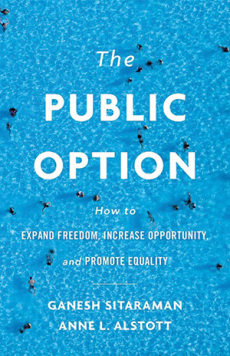
The Public Option
Ganesh Sitaraman & Anne Alstott
296 pages, Harvard University Press, 2019