


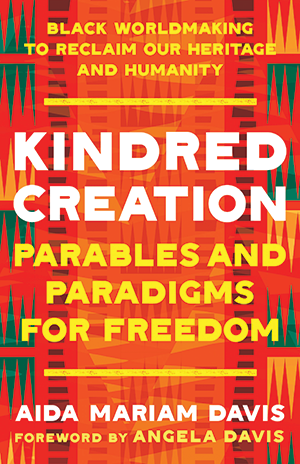
Kindred Creation: Parables and Paradigms for Freedom
Aida Mariam Davis
224 pages, North Atlantic Books, 2024
The past decade has brought real progress on racial justice in the United States. Americans have seen tangible policy wins: experiments to divest from policing and reinvest in communities; local and state policies on reparations; US President Joe Biden’s 2021 and 2023 executive orders focused on racial equity; and Juneteenth becoming a federal holiday in 2021.
Alongside these gains, progressive institutions are endeavoring to transform to better align their mission with their operational practices, and this goal requires individual healing for their members. As I wrote in “Building a Reparative Organization and Nation,” people in movement organizations who are building power—and therefore contending with the trauma historically associated with power—have work to do to heal from that trauma in order to learn how to possess, distribute, and wield power to achieve justice. This is a long road, because it forces us to operate on both the micro and macro levels. We must be intentional about healing ourselves as individuals, and we must transform institutions so that they do not perpetuate cycles of harm. Too often, this burden falls on those who bear the heaviest weight of structural oppression in society. Unlearning oppressive ways of operating, especially in our racial capitalist system, is constant, tiring work.
Writers like Prentis Hemphill and adrienne maree brown are blazing this trail, and Aida Mariam Davis’ first book, Kindred Creation: Parables and Paradigms for Freedom, continues in this vein. The book charts a path toward healing for Black and oppressed peoples through a collective process of challenging settler colonialism. The book “goes radically to the root to understand circumstances, create new kin, study and struggle together, and most importantly care for each other’s spiritual development,” Davis explains. Creating this kinship is “not about reforming or decolonizing design,” Davis adds, with a subtle nod to her work as the founder of the consulting firm Decolonize Design. Rather, “it is about reclaiming who we are … without the imposition of settler society, and it is about stewarding African Indigenous cultural practices and wisdoms.” In essence, this book reminds Black, Indigenous, and oppressed peoples how much agency we have over our own healing and how when we look within ourselves, the freedom we seek is ready to be cultivated.
The book’s tripartite structure—re-membering colonialism, refusing settler thinking and institutions, and reclaiming cultures and wisdoms to create new forms of kinship—presents a guide of freedom practices for Black, Indigenous, and oppressed people. Davis’ ideas are born from the texts of writers and thinkers across time, genre, and geography—she pulls from poetry and prose, parables and prophecies, as well as concepts from organizational design and leadership.
The first practice, re-membering, entails decolonizing our minds by learning from Black and Indigenous history and thought. Davis explains that the hyphen is “deliberate to demonstrate the word’s primary role—to bring together members or people of the event or experience being recalled.” In brief sections on land, language, lifestyle, and labor, she describes how deeply the settler-colonialist frame permeates our lives, while shining a light on new ways of knowing that re-membering offers. For example, she elucidates the role of re-membering in holding true reverence for land: “Land is the sacred regenerative ground that connects us to our ancestors, the home of our nonhuman kinfolk, our food and pharmacy, our library, and the source of all that sustains us,” she writes. The reconnection enables what she calls a “paradigm shift”—land is “cultural and reciprocal,” not “commercial and commodifiable.” It is hard to understate the potential impact of such a paradigm shift, especially regarding the natural world. Imagine, for example, how much easier it would be to address the climate crisis if global economic and democratic systems were built to reinforce land as cultural and reciprocal, rather than commercial and commodifiable.
Davis rejects the settler-colonialist table, believing it cannot be repaired. But is full rejection really possible?
Davis describes several strategies to practice re-membering, including upending the settler-colonialist frame on how individuals understand the world. “The history of enslavement and genocide should not be considered Black or Indigenous history,” Davis contends, “but rather white history, as it is the violent, horrific, and shameful past of white settlers.” This reframing of history is pedagogical and opens up a world of questions and possibilities: What if learning about enslavement and genocide were not relegated to Black History Month but instead centered in a curriculum whose sole purpose was to create agents of repair from that harm? What if they offered a pathway to disentangle whiteness from white supremacy?
Refuse, the second practice, invites the reader to take the harvest of their re-membering efforts to the process of resisting. This work begins by “defining yourself for yourself,” Davis writes. “No one has more proximity to your lived experience than you. No one understands the defining experiences, memories, trauma, joy, and circumstances that led to where you are today—no one but you.” If re-membering sets an aspiration for a new operating model, refuse elucidates the practices of turning away from the status quo and toward that aspiration. Refusing the status quo generates tension, and therefore requires an anchored, grounded sense of purpose that can only be achieved through an intimate understanding of oneself.
Davis offers a range of refusals, from resting to boycotting to allowing ourselves to feel the full spectrum of our emotions. She ventures into structural refusals by contending with frameworks like design thinking and diversity, equity, and inclusion, describing why they remain insufficient: This work is not merely about what we must dismantle, but also about what we must build. Davis describes that she herself had a revelation throughout the process of writing the book—which led to a title change, from Decolonize Design to Kindred Creation. The distinction is subtle but clear: Creating has a different, more future-oriented energy than decolonizing.
Combined, the work of re-membering and refusing creates the space to reclaim, Davis explains, not just in terms of “recover[ing] or return[ing] something that was stolen or lost” but also in terms of forward-looking cultivation. She describes critical ways to reclaim freedom through relationships, storytelling, and care.
The promise of Kindred Creation is in how it weaves design throughout. Davis powerfully illustrates a deeply underappreciated point: People designed our systems to be racist and supremacist, so people can be the agents to redesign them. Too often, we get mired in the belief that what is will always be—but history shows us nothing is set in stone. This book illuminates how our systems have been designed for domination. A depressing fact; yet, if we change the frame, it is also hopeful: It means we can design for repair and freedom.
For example, Davis describes how whiteness has been designed as a tool to hoard and maintain power—“It was a designed social construct to establish an assumed superiority of one group over others”—and separately describes how resistance of oppressed peoples facilitates “the restoration of dignity of the oppressor in allowing them to repair harm.” Connecting these dots provides a road map to uprooting internalized racism. For Black people trying to survive in systems built on white supremacy, it is the ultimate balm to remember: White superiority is farcical, albeit deadly, and holding up that mirror heals Black people and white people, too.
Although effective at pointing to examples of settler-colonialist thinking, the book lacks a deeper analysis about why certain examples are harmful. For example, Davis calls the Stanford d.school’s Designing for Belonging class “insulting” and “intellectually lazy” because it does not offer “care, intention, and rigor to those most harmed by subjugation, exploitation, and violence.” As a Stanford University grad, I am well aware of the institution’s problematic practices and legacy; for example, the founding president and chancellor, David Starr Jordan, was a prominent eugenicist. However, Davis doesn’t explain why or how the class is insulting, so the claim remains unsubstantiated.
In addition, this book is written expressly for Black, Indigenous, and other oppressed peoples, and very little real estate speaks to the role of people who are white or who descend from settler-colonizers. Davis’ scope is deliberate and admirable: Black, Indigenous, and oppressed people need works that are just for us, and that do not center oppressors. And yet this creates a fundamental tension, because who, in 2024 in America, is solely oppressor or oppressed? Following Davis’ direction to affirm all people’s whole and complex identities, it is difficult for me to categorize most people as solely one or the other.
Using myself as an example, the multitudes I hold as a Black, biracial, female nonprofit CEO complicate the oppressor/oppressed binary. I am racialized as Black in most spaces, and therefore I am a member of an oppressed people; yet I have light skin, which represents the whiteness of the oppressor. I hold positional power as a nonprofit CEO; yet I am constantly underestimated and undermined as a woman in leadership. I have to play the game to raise money in our current racial capitalist system in order to pay my staff and enable them to live; yet I run an organization focused on uprooting the anti-Blackness that racial capitalism so depends on to operate.
These realities create complex, tactical, consequential questions that I contend with every day. I try to do many of the practices that Davis espouses across remember, refuse, and reclaim: Re-membering looks like telling the truth about this country’s history and what is owed to Black people. Refuse involves rejecting status quo institutional structures and building an organization that reinforces the humanity, wholeness, and wellness of its people. Reclaim includes infusing care into everything we do at Liberation Ventures, a nonprofit accelerating the movement for racial repair. And yet all of this takes money, which takes work, which takes capacity, which takes staff, which takes money—and the exhaustion creeps back in. As someone very deeply in the pursuit of my own and others’ freedom, I continue to crave more space, depth, and support to contend with the fact that building a new world often requires perpetuating the old—and holding the liminal space open feels, at times, excruciating.
In her parable on the great table, Davis describes that the table represents broad societal systems and ways of thinking and knowing. She invites the reader into important questions: What purpose does a table serve, and what makes it worth joining? She describes her own desire to reject the settler-colonialist table but ends there. I was left wanting more: Is full rejection really possible? What other paths and roles exist? How do we play them? How can people in different roles work together?
To repair the world, I deeply believe that we need all of us, playing different positions. Some at the table distract our oppressors while chipping away at the wood from underneath. Some in the next room build a new table. Some design a structure that is not a table at all but something new. And we must be strategically connected and in deep relationship with each other, gaming out the moves we need to make, in order to achieve the freedom we all deserve.