


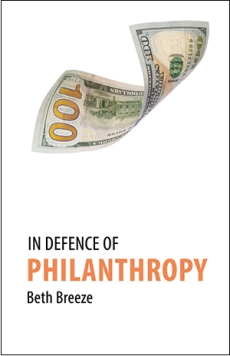
In her new book, In Defence of Philanthropy, Beth Breeze takes aim at the habitual pose of the philanthropy critic as brave and lonely truth-teller. The director of the Centre for Philanthropy at the University of Kent, Breeze argues that overzealous critiques of philanthropy have proliferated to the point that debates have become “one-sided.” The “generalized cynicism” about philanthropists she observes in social media and on op-ed pages receives “little pushback.” Given this climate, it is those who choose to defend philanthropy who take real reputational risks. “Simply noting that philanthropy can be a force for good,” she argues, “is to invite accusations of being a naïve apologist for the rich.”
Breeze is by no means an naive apologist, but at times her book seems driven by a compulsion to beat back every criticism of philanthropy. Yet Breeze’s apologetics is at its strongest when she does not mirror the absolutism of what she calls “philanthropy hyper-criticism” but instead concedes that “philanthropy is not perfect but has value distinct from that of government and the market that is worth defending and celebrating.”
Breeze’s embrace of nuance also helps to clarify the discursive imbalance that she is correcting with this book. Uncritical coverage of philanthropy is certainly not lacking in the media; celebratory profiles of mega-donors and front-page stories of nine-figure donations abound. But those accounts largely forego analysis regarding the role philanthropy plays in society and in relation to democratic norms and institutions, its ground for legitimation as both a social force and an expression of individual values. On the other hand, critics of philanthropy engage these issues explicitly, and so their views tend to dominate philanthropy analysis. Breeze provides an analytically rich defense of philanthropy that assumes its basic legitimacy but, she writes, “is more skeptical about skepticism.”
Breeze’s defense proceeds along two tracks: the substantive and the consequentialist. “Hyper-criticism of philanthropy,” she writes, “underestimates the complexity of its target and carries the significant risk of curtailing the philanthropic impulse.” To defend philanthropy, she first offers a detailed itemization of the varieties of critique prominent in public discourse, pinning them to the wall to analyze them and then subject them to focused, point-by-point rebuttals.
Breeze divides the critiques into three broad categories—the academic, the insider, and the populist—that can be understood in terms of challenges relating to the how, what, and why of giving, respectively. The academic critique homes in on the undemocratic consequences of large-scale philanthropy and the ways in which it both reflects and exacerbates inequality. The insider critique, which Breeze associates with the effective altruist and strategic philanthropy movements, regards philanthropy as fundamentally legitimate but claims its effectiveness is frequently undermined by givers’ impulses. Breeze defines the populist critique in terms of an emphasis on the bad motives of donors; it assumes that the giving of wealthy individuals is driven by hidden interests and is fundamentally hypocritical.
Breeze devotes a significant part of the book to engaging with the various strains of these three critiques. Not all of her takedowns are convincing. For instance, Breeze’s contention that “[t]here is no concentration of philanthropic power that would enable any private donor to exert untoward influence on anything but the narrowest of issues and for the briefest of time periods” would seem to be contradicted by the recent history of US education policy, over which large-scale philanthropy has certainly had a significant, sustained, and disruptive influence. But, collectively, her various challenges to the critiques serve as a disciplining agent, exposing the weakness of some and the soundness of others.
Several themes run through Breeze’s defense. Most prominent is her rejection of generalizations derived from a handful of the highest-profile donors. Breeze writes that she has “no wish to join an unproductive game of philanthropy tennis where I volley back the name of a ‘good’ rich donor in response to an egregious case of philanthropic bad behavior.” However, she occasionally does seem to trade baseline shots in this fashion. She counters the critique that philanthropy constitutes a power grab by the wealthy, for instance, by pointing to the support that Canadian philanthropist Willard Weston provided to upgrade bathrooms in a project serving homeless people. “Given how much philanthropy is concerned with funding extremely prosaic and mundane goods and services,” she argues, critics’ focus on inordinate philanthropic power is overstated. Pushing against the contention that philanthropy never seeks to shake the economic status quo, she calls attention to donors who have supported organizations that do precisely that—including MacKenzie Scott and Peter Buffett.
Philanthropy critique is richer when it is forced to engage with a defense of philanthropy grounded in history and animated by a belief in its value.
Admittedly, these figures are hardly representative. Most major donors do not in fact seek to undermine the foundations of the economic order that produced their wealth, and Scott and Buffett are exceptions to the rule of philanthropic practice. Ultimately, Breeze denies that there is such a rule governing all large-scale giving. From the critical heights, she suggests, generalizations about donor intent are easy to make. Much of Breeze’s perspective, on the other hand, derives from her proximity to donors—she interviewed more than a hundred for this book and largely takes them at their word—and at closer range, their variety is their most striking feature. Given that variety, she insists, it makes little sense to extrapolate from the Sacklers, or Bill Gates, or any of the major donors who attract disproportionate media attention, even if these figures hold disproportionate financial and philanthropic resources.
A second theme relates to the selectivity of critics. Not only does Breeze contend that they direct too much attention to a few megadonors, but also she rejects their hypercritical focus on the giving behaviors of the wealthy compared with ordinary individuals. “Media reporting of charity and philanthropy routinely holds up ordinary people and lower-level donors for applause while probing the motivations of richer donors,” she writes. Yet “[t]here is little evidence to show that the population of philanthropists has any greater or lesser quantities of positive or negative characteristics than the rest of the population.” It is unfair to cast aspersions on one class of donor and not another, just as it is unfair to restrict laudable motives to one set and not the other—a tactic she calls “virtue hoarding.”
Breeze also indicts the ahistorical nature of philanthropy critique, and specifically the thrust of contemporary critics that they have arrived at some novel attack on philanthropy and seem oblivious to the fact that “there is little to be said, either in favor of or against philanthropy, that has not already been said numerous times before.” But, somewhat paradoxically, she also points out how static many critics’ understanding of philanthropic practice tends to be and how impervious critics are to an appreciation of improvements in practice in recent decades—including more funders explicitly addressing wealth inequality and providing general operating support to grantees. With this point, however, Breeze is left to grapple with the fact that those improvements stem in part from the intensity of recent critiques. She settles on a middle ground in which she applauds the fact that philanthropy has shifted in response to recent critiques but warns that such progress could be thwarted if those attacks become too uncompromising.
Relatedly, a final theme of Breeze’s defense is that overly harsh criticism of philanthropy will demoralize donors and inhibit their giving. In the face of relentless critique, wealthy individuals might decide “not to stick their head above the philanthropic parapet” for fear of taking fire, and give less, or not at all. “We cannot knock donors without also affecting those they fund,” she warns. Yet, because Breeze does not provide evidence that a wealthy donor strike has occurred, it is difficult to know whether to interpret these concerns as augurs of an imminent danger or as idle threats meant to extort critics into tempering their attacks.
Breeze concludes her book by offering guidance on how to develop a “nuanced response to critiques of philanthropy.” To do so, she first seeks to understand the reasons for the recent surge in such critiques. Most prominently, she highlights the extent to which philanthropy has become entangled in broader debates over wealth and income inequality, in ways that other forms of conspicuous consumption, like “buying a private jet or super-yacht,” are not. Many of these critiques are not especially interested in the practice of philanthropy, she argues. “Philanthropists are often caught in the crossfire of these wide debates,” she explains, on “the ills of extractive and exploitative capitalism.” Recognizing this fact, she suggests, will help to “disentangle critiques of philanthropy from critiques of wealth and inequality.” A full disentanglement, of course, is not possible given the extent to which philanthropy reflects political economy. What Breeze seems to be calling for is a more honest reckoning of critics with the limits of philanthropy in addressing inequality.
She also contends that the increased attention directed to large-scale philanthropy has triggered a psychological phenomenon called “do-gooder derogation”—the tendency for groups to disparage the behavior of morally motivated people. Applied to large-scale philanthropy, it indicates that criticism of major donors stems from their breaking an unspoken norm about not establishing standards for generosity that others have difficulty matching. Breeze suggests that major donors generate contempt for the same reasons vegans often do: Both make others feel judged and, ultimately, morally inadequate. Depicting philanthropists as “illegitimate, ineffective, and unlikeable” is a “defensive reaction” by those who haven’t given as much to preserve their sense of their own moral standing.
The emphasis on “do-gooder derogation” represents one of the few false steps in Breeze’s book. It’s an analysis that, in its suggestion of ulterior motives, ironically mirrors the populist critique Breeze sets her sights on. Much as critics contend that donors give for selfish reasons that belie stated commitments to generosity, her assessment suggests that critics themselves attack philanthropy based on psychological needs far removed from articulated concerns with preserving democracy or correcting inefficient giving. In any case, invoking do-gooder derogation is the sort of rhetorical move, like citing fake news, that spoils the possibility of constructive debate.
The promotion of such debate is ultimately Breeze’s most significant contribution with this book. It does not deliver a final, unassailable vindication of philanthropy that obviates philanthropy critique. But it demonstrates that such critique is richer when it is forced to engage with a defense of philanthropy grounded in history and animated by a belief in its fundamental legitimacy and value.