


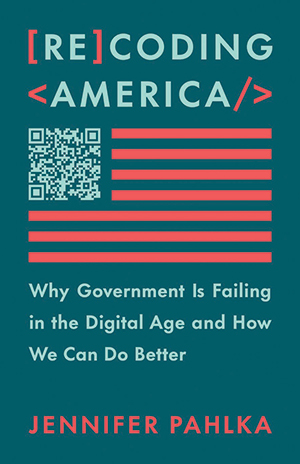
Recoding America: Why Government Is Failing in the Digital Age and How We Can Do Better
Jennifer Pahlka
336 pages, Metropolitan Books, 2023
As the deputy chief technology officer for President Barack Obama and founder of Code for America, Jennifer Pahlka has unique insight into how government has delivered on—or, rather, failed to deliver on—digital services to its citizens. In Recoding America: Why Government Is Failing in the Digital Age and How We Can Do Better, Pahlka recounts her experiences in both positions to draw a correlation between these failures and declining public trust in government. She argues that to regain public trust, the government must not only invest in the people who manage and implement our public services but also change deeply embedded beliefs about the role of implementation in an institution dominated by policy.
A significant part of the problem, Pahlka observes, is that technology has been misconceived as a tool rather than as an infrastructure that changes the very nature of policymaking. This misconception, coupled with complex and antiquated bureaucratic processes, has produced gaps between policies and their outcomes. The government’s tech infrastructure is as cumbersome as its bureaucracy. Pahlka describes how layers of technology have accumulated over time, the patchwork of improvements and updates straining the infrastructure. “Adding some new capability to the system … gets built in different technology paradigms from different eras,” she writes. “But every new piece depends on everything that came before, so each successive layer is constrained by the limitations of the earlier technologies. The system is not so much updated as it is tacked on to.” The resulting framework is, she explains, “enormously complex and fragile.”
Such convoluted design contextualizes Pahlka’s discussion of arguably the most notorious digital-services failure during her tenure: the rollout of HealthCare.gov in October 2013. Just three months into her new job as deputy CTO, she says, “I watched the much-heralded launch of HealthCare.gov, which would administer Obama’s signature policy initiative, the Affordable Care Act. The site immediately crashed. With millions to enroll and hundreds of thousands attempting to log on at any given moment, it managed on its first day to serve a total of eight people.”
HealthCare.gov was a government “mega-project” outsourced for its creation and management to a whopping 36 vendors. Pahlka describes how then-US CTO Todd Park sprang into action and recruited Silicon Valley engineers to help fix the site after its crash. One of the new recruits found a flaw in the code. Two slashes—which designates a line as a comment, not as part of the code—were the culprits. When asked why the slashes were there, the responsible vendor’s tech staffer admitted that he didn’t know what the slashes meant and just copied and pasted them from elsewhere.
Outsourcing is just one of the problems Pahlka identifies in her diagnosis of why the government has failed in its digital-services delivery to the public. Government officials and policy makers suffer a profound lack of know-how about technology. If government staffers could read and write code, Pahlka reasons, then the HealthCare.gov project might not have needed to be fully outsourced. Cutting out the middlemen would’ve streamlined the delivery process and assured quality control and government oversight over its own services.
“You need to own the code, and you need to be able to change it to meet your needs,” she directly advises those working in government. “You must have the core competencies to support a living, ever-adapting system.”
Pahlka asserts that outsourcing creates a “debilitating distance” between policy makers and the people who use digital services. Reliance on outsourced vendors’ code can also lead to failures in providing mission-critical public services. Pahlka recalls the horrific example of the US Border Patrol separating migrant children and parents in 2018 as another alarming system failure. The database for tracking cases had been designed to assign family members the same case number. However, when the Trump administration ordered children to be separated from their parents, the US Border Patrol did not know how to modify the database to maintain those relationships on digital record. So agents resorted to creating new case numbers for children—unrelated to their parents’ case numbers—and sticking Post-it notes on infants’ onesies. When the time came for the families to be reunited, the government was incapable of reuniting the children with their parents because the database was never programmed to establish these familial relations.
Pahlka recommends that government cease pouring money into outsourced mega-projects and instead focus on small-scale deliverables: “Like the venture funded startups—they get a small amount of money to learn, adapt, and then get more money when they’ve gained traction.” Because of their manageable size, these projects are able to prioritize the users’ needs and make adjustments to advance the government policy’s outcomes.
“You don’t have to be in tech to serve: our public institutions need all sorts of people who are patient, caring, and willing ...”
Yet, is this recommendation enough? Currently, government staff are comfortable with large technology vendors. These vendors lobby for mega-projects and then charge as much money as possible—and fixing bugs is part of their revenue model. And existing federal procurement policies give significant advantage to these large vendors to qualify for federal government contracts. The government has not yet created the structures to incentivize small-scale projects.
Pahlka calls for the government to overhaul its approach to delivering services to its citizens. “Building digital as a core competency of government may take changes in budgeting, rules, and oversight,” she contends, “but it is largely a matter of investing in people.” Ultimately, Pahlka is arguing for a culture shift in government, primarily by encouraging policy makers to eliminate this unhelpful dividing line in their work and that of the teams who implement it. They could, Pahlka suggests, invite the teams responsible for delivery to contribute to the crafting of law and policy. These delivery teams often understand both the needs of the public and the mechanism of implementation far better than policy makers and can help write law and policy that is both implementable and more respectful of its users.
Pahlka documents a government culture that has largely dismissed the needs of its users—ordinary Americans who need services delivered reliably. The government tends to look inward at the needs of its administrative and elected stakeholders instead of looking outward to the public and collecting citizens’ feedback. “The reality is that in our system as it stands today, there is little incentive for elected leaders to build twenty-first-century state capacity,” she observes. “Politicians don’t get reelected for simplifying and rationalizing the gargantuan maze of laws, policies, and regulations that govern service delivery.”
To prioritize the needs of citizens, Pahlka recommends extensive user testing and research—without which an agency’s digital services cannot be evaluated or improved. From my own experience providing digital communications solutions, user research is fundamental to how tech companies learn, pivot, and improve. Yet, even Pahlka notes that such research is tremendously difficult and time-consuming to conduct when regulated and managed by various government departments. For instance, approval from the White House Office of Information and Regulatory Affairs, she explains, “takes six to nine months, including several rounds of formally soliciting public comment, and requires a researcher to submit in advance every question that will be asked.”
The dearth of user research is especially problematic for government because it is the sole provider of many critical services to low-income, rural, elderly, young, disabled, non-English-speaking, and racially marginalized people. Many people in these groups face additional challenges with complicated government-enrollment processes, as they move frequently and do not receive mailed government notices. Recoding America would have benefited from more information specifically on the topic of digital equity and more details on how government can ensure access to its critical services—Medicaid, unemployment, student loan, disability, mental health, and small-business loan services—to underserved groups.
Pahlka argues that investment in people is also a two-way street, because the government is run by the people. Citizens, she contends, are equally accountable for effective digital delivery of government services. She suggests that this accountability work can happen through acts of public service. “I encourage anyone with tech and design skills to at least do a tour of service in government at any level,” she says, adding that “you don’t have to be in tech to serve: our public institutions need all sorts of people who are patient, caring, and willing to fight to make government make sense to a person.”
An influx of such acts of service could help resolve the staffing shortages at agencies across all levels of government. However, from what I’ve witnessed working in the nonprofit and public sectors, the government will have to undertake a herculean public campaign to fill its vacancies with qualified people and keep them in those positions. The government rarely does any recruiting at college campuses; candidates have to wait for months to be hired, and many agencies don’t have guaranteed funding for tech roles from year to year. The relatively lower salaries in the government sector also make finding and keeping qualified workers a challenge.
Recoding America is a well-written and engaging book that balances insider stories and analysis. Pahlka succeeds in providing valuable insights for government leaders as well as for general readers who are interested in learning the historical, cultural, and political contexts that inform how their government is—and is not—working for them.
Indeed, the problems Pahlka enumerates in her book have already been taken up at the federal level. In 2021, President Joe Biden signed an executive order, “Transforming Federal Customer Experience and Service Delivery to Rebuild Trust in Government,” to initiate his administration’s efforts to redress such problems. The order calls on the federal government to design and deliver effective and accessible digital services: “We must use technology to modernize government and implement services that are simple to use, accessible, equitable, protective, transparent, and responsive for all people of the United States.” Public trust in government can be regained, the order states, when the government demonstrates “that its processes are effective and efficient, in addition to being fair, protective of privacy interests, and transparent”—no matter if a process “involves renewing a passport or calling for a status update on a farm loan application.”
This order represents a significant step toward overhauling the system. Recoding America will undoubtedly inspire and inform those who will follow through on this step in working on behalf of improving the government’s digital-services delivery.