


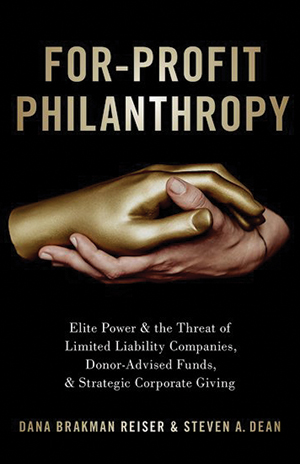
For-Profit Philanthropy: Elite Power and the Threat of Limited Liability Companies, Donor-Advised Funds, and Strategic Corporate
Dana Brakman Reiser and Steven A. Dean
344 pages, Oxford University Press, 2023
In For-Profit Philanthropy: Elite Power and the Threat of Limited Liability Companies, Donor-Advised Funds, and Strategic Corporate Giving, US legal scholars Dana Brakman Reiser and Steven A. Dean explain how the public’s trust in US philanthropy has declined and detail ways to recuperate that trust. While the coauthors yearn for an era of high public trust for elite giving in the United States that, arguably, never existed, they offer promising ideas for how to nurture public trust in elite giving today.
Brakman Reiser and Dean’s rose-tinted history begins in the early 20th century when mega-philanthropists like John D. Rockefeller and Andrew Carnegie and for-profit corporations established private foundations and nonprofits to organize their giving. The coauthors wax nostalgic about the decades of elite giving following the 1969 Tax Reform Act (TRA), which, they claim, represented a “Great Bargain … that enabled elite philanthropy to reassure the public that their purported altruism would indeed benefit ordinary Americans.” The TRA, they contend, satisfied the public’s desire for greater democratic oversight of philanthropy, and “in return for complying with those regulatory burdens, donors secured protection from a threat of taxes” and “retained substantial philanthropic autonomy.” Brakman Reiser and Dean contend that this bargain laid the groundwork for the trust that gave elites sufficient independence to continue their philanthropic work and satisfied a US public that otherwise would have brought an end to elite philanthropy by raising taxes.
According to the coauthors, the trust established by the “Great Bargain” was broken by structural changes in giving and the public’s increasing skepticism of philanthropists’ intentions, which the public suspected as having less to do with the public good and more with profit maximizing. Brakman Reiser and Dean locate this shift to the turn of the 21st century, when elite givers abandoned the Great Bargain by migrating from private foundations and nonprofits to in-house offices, LLCs, and/or donor-advised funds (DAFs).
The coauthors weave these three developing trends together to demonstrate why and how 501(c)(3) private foundations are no longer the primary choice for elite giving. For some time, for example, political scientist Sarah Reckhow has sounded the alarm on the decreased transparency and accountability requirements for LLCs compared with private foundations. She also has pointed out elite givers’ increasing preference for LLCs, choosing this latter corporate form to finance both political activity and varying forms of organizations beyond 501(c)(3)s, such as more politically active 501(c)(4)s and other LLCs. Brakman Reiser and Dean’s depiction of the philanthropic landscape explains why LLCs are attractive to elite givers: With LLCs, philanthropists can preserve the right to take back the funds they gifted the organization—a power that Brakman Reiser examines in her 2018 SSIR feature “The Rise of Philanthropy LLCs.” Such details described in For-Profit Philanthropy further cement the attractiveness of the LLC structure for wealthy philanthropists and indicate just how difficult it would be to persuade someone who sees value in these liberties to turn away from them for the sake of greater accountability.
Despite their comprehensive data and analysis of the reasons why elite givers have moved away from the nonprofit corporate structure, the coauthors overlook the long history of for-profit practices in nonprofit philanthropy—a history that dates back to Carnegie and Rockefeller. After all, these philanthropists organized their foundations to echo the structure of their own for-profit businesses to include boards of trustees peopled with industry colleagues. Acknowledging this broader history of for-profit norms in the nonprofit sector also would have helped the coauthors tease out exactly what is different about today’s muddling of for-profit and nonprofit practices. The reality is that—however similar and overlapping these two corporate forms might have been in practice—US law has increasingly treated each with different rights and responsibilities. We only need to see the distinct filing requirements of 501(c)(3)s, 501(c)(4)s, and LLCs to observe the US legal system’s distinct expectations (and distinct evolving jurisprudence) for varying nonprofit and for-profit corporate forms.
When today’s philanthropists choose to exercise their giving beyond private foundations, they are asking the US legal system to once again reconsider settled legal norms on the rights and responsibilities of nonprofit and for-profit actors. We saw this, for example, in Burwell v. Hobby Lobby Stores, Inc. (2014), in which the US Supreme Court determined that Hobby Lobby, a for-profit corporation, could exercise religion like a nonprofit church. Central to the court’s analysis in Hobby Lobby was the emergence of benefit corporations across US state legislatures, which, as I wrote in an SSIR article, was part of the Rockefeller Foundation’s vision at the time of blending the nonprofit and for-profit sectors, with one of its grantees—B Lab—taking the lead in helping to create this new corporate class.
Noting this national legislative trend, US Supreme Court Justice Samuel A. Alito explained on behalf of the majority in Hobby Lobby that “laws formally recognizing hybrid corporate forms” such as benefit corporations were gaining ground across the country and that this new corporate form was “a dual purpose entity that seeks to achieve both a benefit for the public and a profit for its owners.” Against this shift in modern corporate law to blur the line between for-profit and nonprofit organizations, Alito subsequently deemed it reasonable to blur the line between nonprofit and for-profit jurisprudence. In this case, the court reasoned that a for-profit like Hobby Lobby could exercise religion and subsequently limit its coverage of contraception for employees like a religious nonprofit.
If the coauthors—themselves two legal scholars—would have discussed how elite givers’ further blending of nonprofit and for-profit corporate forms has affected long-standing norms in nonprofit and for-profit jurisprudence, what the US public is losing in the process would have been much clearer—beyond some nebulous sense of decreased trust in elite givers. After all, as Hobby Lobby illustrates, we are very visibly losing settled norms in the US Supreme Court’s understandings of our distinct constitutional rights and responsibilities in these two distinct corporate forms.
The coauthors are optimistic that it is indeed possible to create a world where elite givers can give greater accountability to the US public.
Moving beyond an analysis of contemporary practices in elite giving, For-Profit Philanthropy claims that the US public frowns upon these trends and that it subsequently has lost a trust for elite giving that it had in the past. To this point, the coauthors argue that the TRA represented a Great Bargain—“the last major US effort to broker a truce between elites and the public.” Arguably, it was never a bargain in the first place. The coauthors even admit that the legislation was “not the product of formal negotiations.” Rather, they argue, the TRA represented a Great Bargain because the “contours of the Act indicate clear victories and concessions for both elite donors and the public at large.” But what would it mean for the US public and elite givers to have come together to negotiate and subsequently consent to the TRA? In his 2020 study of whether elites consented to the TRA, legal scholar James J. Fishman argued that the TRA’s “initial impact was a sharp decrease in the foundation birth rate and an increase in their death rate (termination).” Beyond US Congress members voting on this legislation, who else really consented to its passage? It is dubious that the TRA reflected a consensus among elites and the US public and, thus, that this definition represents a democratically accepted form of elite giving.
Furthermore, the coauthors present little evidence for their related claims that the TRA led to greater trust from the US public toward elite philanthropy and that the US public is experiencing decreased trust in relation to elite givers’ increased blending of for-profit and nonprofit corporate forms and goals. Additional proof would have substantiated the authors’ central argument that elites can regain—and not simply gain—the public’s trust.
As with any discussion of public trust toward elites, it also would have been helpful for the authors to present data on how specific demographic groups have viewed elite givers since the age of Rockefeller and Carnegie, because not every group of Americans has viewed elite—and predominately white—givers and their grantmaking practices with the same forgiving eyes. It also raises the question of what it means to trust elite givers collectively, rather than specific groups of elite philanthropists within or outside of our communities, at different moments in time and by their specific and varying grantmaking practices.
For-Profit Philanthropy stands on firmer ground when the coauthors step away from grand historical analyses and lean into their study of contemporary trends in philanthropy and offer possible policy routes for elite givers to gain the public’s trust. Brakman Reiser and Dean do this even though they admit to having little hope that philanthropists can be convinced that private foundations—rather than LLCs or DAFs—are the best avenues for organizing their giving. Instead, the authors suggest
ways that elite givers increasingly forming LLCs or channeling their giving through DAFs can re-create some of the accountability measures so central to the Great Bargain and, in the process, reestablish the necessary trust with the US public that is essential to the “entire enterprise of elite philanthropy.”
Brakman Reiser and Dean propose targeted regulatory interventions as well as possible routes for self-ordering solutions for elite givers. For self-ordering solutions, they recommend that a “tailored corporate governance scheme could impose targeting limitations on strategic corporate philanthropy conducted through a dedicated subsidiary.” And, to strengthen public trust, they point to ways that elites and the US public can come together to achieve systemic change. They suggest public policy to overhaul “election and campaign spending law to reduce elite influence and enhance participation by marginalized communities,” thus attacking “political inequality head-on.” Brakman Reiser and Dean describe such systemic reforms as a “More Perfect Bargain,” whereby changes to corporate law could also require “participation by workers and other stakeholders in corporate governance” as “preconditions for corporate political spending.”
Ultimately, the coauthors’ layered policy recommendations illustrate their optimism that it is indeed possible to create a world where elite givers can offer greater accountability to the US public, and the US public in turn can increase their trust in them. Granted, this optimism might be the very reason why the coauthors present a story of the past that is more wishful thinking than reality. But the past does not necessarily need to determine or guide our present or future. It can instead let us know how very revolutionary our own aspirations can be in the present.