


Social Innovations
The House That BRAC Built
Freedom from Want: The Remarkable Success Story of BRAC, the Global Grassroots Organization That's Winning the Fight Against Poverty by Ian Smillie
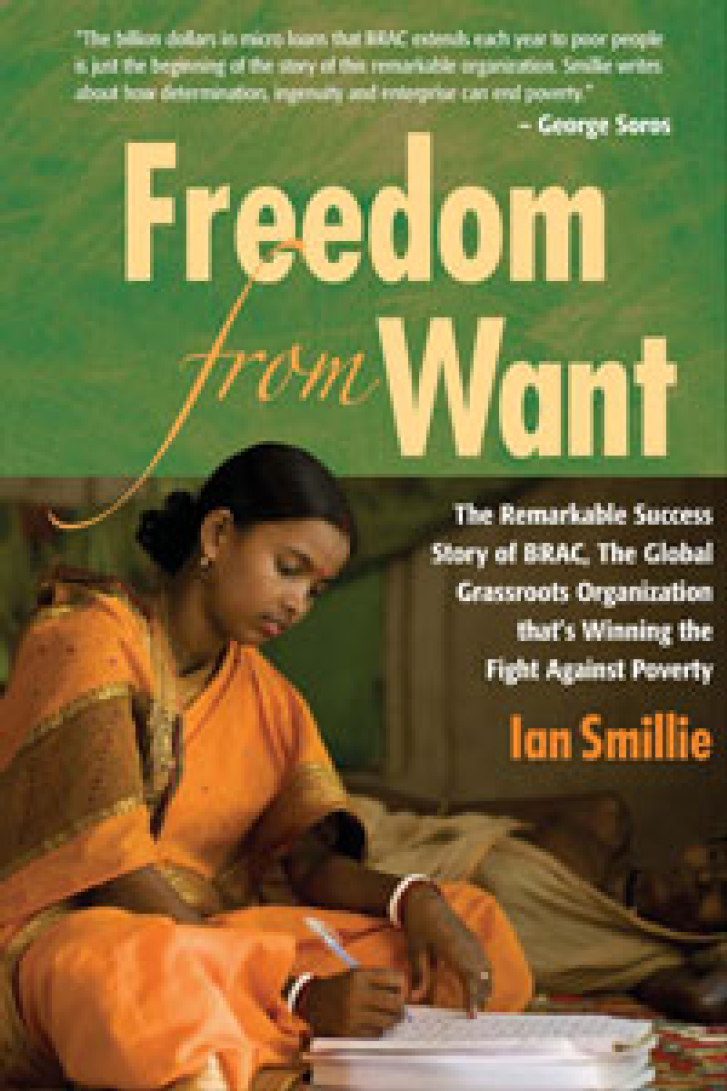
Freedom from Want: The Remarkable Success Story of BRAC, the Global Grassroots Organization That's Winning the Fight Against Poverty by Ian Smillie

Nonprofit management faces one of its biggest challenges in the arena of disaster relief. In this audio interview, Neal Denton, senior VP of government relations and strategic partnerships at the American Red Cross discusses the value of his organization's relationship to the Partnership for Disaster Response. He discusses plans for strengthening this relationship and the role of the private sector in disaster response.
The author uses the case of the Swine Flu to illustrate why non-global organizations matter.
Racism may have played a role in the government's delayed response to Katrina.

When an earthquake hits, what should you do? Should you get out of the house? The answer, says Elizabeth Hausler, founder of Build Change, depends upon where you live. In this audio interview with host Sheela Sethuraman, Hausler describes how the strategies of Build Change are helping villages in Indonesia and China to build earthquake-resistant housing.

When huge disasters like Hurricane Katrina strike, who better to help out than the companies that provide many of the goods and services that relief agencies depend on? In this audio interview, Eric Nee, co-host of Social Innovation Conversations, converses with Tom Lehner, manager of the Partnership for Disaster Response, on how business has been providing an organized response to some of the most disruptive natural catastrophes occurring around the world over the past four years.

Recent fires, floods, and foreclosures may be clear signs that we are caught in twin crises: economic downturn and environmental devastation. In this panel discussion from The Commonwealth Club of California, Van Jones and Darrell Steinberg offer a unique solution to this complex set of problems.
Serving more than 110 million people per year, BRAC is the largest nonprofit in the world. Yet it doesn't receive the most charitable donations. Instead, BRAC's social enterprises generate 80 percent of the organization's annual budget. These revenues have allowed the organization to develop, test, and replicate some of the world's most innovative antipoverty programs.

The Idea Village was launched in New Orleans by "five guys who wanted to change the world." The more modest goal of these entrepreneurs was to revitalize the city economically—a mission that became especially important when Hurricane Katrina hit in 2005. In this audio lecture, sponsored by the Stanford Center for Social Innovation, Tim Williamson shares how his nonprofit has been helping rebuild the devastated city economically, and the progress inspired through a powerful network of talented individuals.
Better practices in disaster relief involve market-orientated nonprofit organizations, or social-mission-orientated, for-profit companies, playing a more prominent role.