


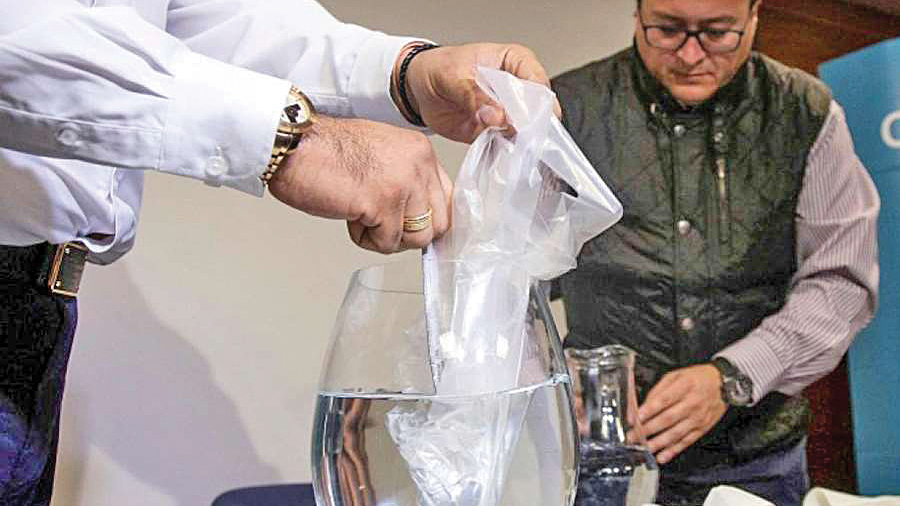
 Solubag co-founders Roberto Astete (left) and Cristián Olivares demonstrate the solubility of their biodegradable plastic bags. (Photo courtesy of Solubag)
Most plastic bags, bottles, and straws are used only once, but take centuries to degrade. Due to mismanaged consumer and industrial waste disposal, much of this material ends up in our oceans, contaminating wildlife habitats and affecting hundreds of marine species.
As recognition of a global plastic waste crisis grows, two Chileans have developed what they see as a promising solution: plastic bags that dissolve in water.
“We want to emulate one-time-use plastic products, transforming them into environment-friendly products that any person can eliminate at the end of their useful lifespan,” says Roberto Astete, cofounder and co-CEO of the Chilean company Solubag.
The answer came by accident. Astete and his co-founder Cristián Olivares, both industrial engineers, were trying to develop a biodegradable detergent when they realized they could use their product’s raw material to tackle plastic waste.
Solubags are made with polyvinyl alcohol (or PVA), a water-soluble substance that doesn’t contaminate the environment or its fauna. PVA is used as a coating in the pharmaceutical and food industries and can be made from several sources. “Since we wanted to create a product that doesn’t pollute the environment, we developed the bags using calcium carbonate and natural gas,” Astete says. While traditional plastic bags contain petroleum derivatives, which take up to 500 years to degrade, Solubags take only five minutes to dissolve when submerged in water. The water remains potable even after the bag dissolves.
“With Solubags you decide when you destroy the bag,” says Olivares. The company’s engineers made sure the products can withstand rain, setting the temperature of dissolution at 40 to 50 degrees Celsius.
There are two kinds of Solubags: those that dissolve in cold water and resemble the traditional plastic supermarket bag, and others that dissolve in hot water and resemble reusable shopping bags, many of which are also made of plastics, says Olivares. Both are intended for use by the general public.
“Solubag is changing the [Chilean] plastic industry,” where “there is no other packaging material with its biodegradable quality,” says Bárbara Silva, director of SingularityU Chile. Solubag won the SingularityU Chile Summit prize in 2018 for its potential to transform the country’s plastics market. This recognition earned the founders a spot in Singularity University’s incubator program for social ventures.
Solubags are not yet for sale (the company is testing the bags in the Chinese, Indian, and Chilean markets) but the founders expect them to be sold in major retailers later this year in Chile, Europe, and the United States. Solubag is currently focusing on perfecting the raw material to produce not only bioplastic bags but other objects, such as bottles and straws.
Solubags are not the first water-soluble bags but they will be the first intended for the general public. Their low cost also differentiates them in the market, Astete says.
Some environmentalists have doubts about the products. While such innovations should be celebrated, they don’t address the underlying problem, says Macarena Guajardo, executive director of Fundación Basura, a nonprofit working to promote a culture of zero-waste in Santiago, Chile. “Plastic is not the enemy until we use it to design single-
use disposable objects,” she says. “Every time we throw products in the trash, we discard the value stored in their raw materials, production processes, and workforce.”
Efforts to reduce single-use plastics are on the rise. In 2018, Chile became the first country in Latin America to ban the use of plastic bags in retail businesses. Canada is using its G7 presidency to push for a “zero plastics waste charter” hoping that other G7 countries and beyond adopt more ambitious waste reduction goals. And in the United States, California recently passed a law that bans plastic straws from full-service restaurants.
Solubag’s founders are not aiming to replace all plastic products, they write on their website. “We are oriented to those that, by their nature, are difficult to recycle and end up being garbage, affecting our seas, rivers, flora, and fauna.”
This article appeared in the Spring 2019 issue of the magazine with the headline: "A New Plastic Alternative."
Read more stories by Camila Cornejo Schilling.