


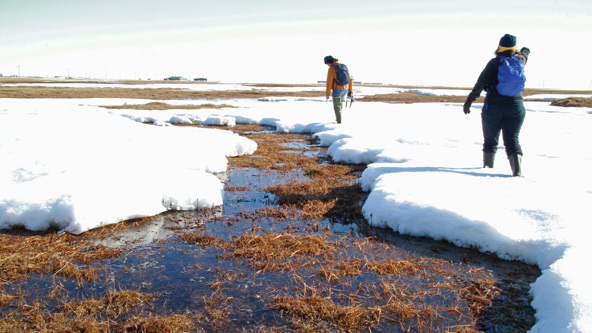
 Ice911 aims to restore and preserve critical sea ice by sowing reflective glass microspheres over strategic locations in the Arctic. Here, researchers visit a test site in Barrow, Alaska. (Photo courtesy of Ice911)
When it comes to addressing the climate crisis, loss of sea ice is one of the most pressing problems. Without sea ice, the ocean absorbs more heat, and ice that regrows disappears more quickly than what used to be there. Climate scientists estimate that the loss of Arctic sea ice contributes a quarter to a third of annual global temperature rise. What started out as an impact from climate change has now become a lever for even further climate-change effects.
“Bright reflective ice in the Arctic has been like having that area of the Earth wearing a bright white T-shirt in the hot summer sun,” says Leslie Field, an engineer and inventor. “We don’t have that anymore.”
Field is determined to reverse this. In 2014, she founded Ice911, a nonprofit that aims to restore and preserve ice by sowing glass microspheres over strategic locations to reflect sunlight and heat.
After more than a decade of testing materials to see what worked best to keep ice cool, Field identified the potential of the tiny silica spheres, each about the size of a fine grain of sand. Ecotoxicological testing found that the materials were not harmful to representative species of fish and birds.
Her team adapted an agricultural drop spreader for use with a snowmobile to test the materials in Alaska. They’re now seeking funding and Environmental Protection Agency permits to test on sea ice.
The goal is not to carpet the Arctic but to spread the material on 25,000 to 100,000 square kilometers in strategic locations like the Fram Strait, a narrow channel east of Greenland that is the primary passageway of sea ice out of the Arctic.
“If we can make ice last longer in that area, it turns out that can make a big difference in retaining ice and then, over years of reapplication, actually restoring ice,” Field says. In the lab, they’ve seen an at-least 20 percent delay of ice melt using these materials.
Employing them won’t come cheap. Full scale application might cost as much as $4 billion per year. Ice911 currently raises most of its funding from foundations and individuals.
Expense is not the only concern. Solutions from geoengineering—intentionally altering the Earth’s atmosphere using a variety of emerging technologies in an attempt to offset some of the impact of climate change—are risky and raise ethical qualms about environmental manipulation.
David Keith, director of Harvard’s Solar Geoengineering Research Program and author of A Case for Climate Engineering, doubts that Ice911’s idea makes sense. Even technically inert materials may have significant environmental impacts when distributed across large surface areas, and the machinery necessary to disperse material on sea ice would itself have a significant industrial footprint in the high Arctic, he wrote in an email.
Keith is leading his own moonshot effort, a research team preparing to do the first test of spraying particles into the stratosphere to reflect some of the sun’s rays back into space. He claims that Field’s approach will require much more material than aerosol injection to achieve the same climate-cooling effects.
Ken Caldeira, an atmospheric scientist at the Carnegie Institution for Science’s Department of Global Ecology at Stanford University, says Ice911’s climate impact “would be substantial if they could maintain the sea ice” but says he remains skeptical about the solution’s practicality.
“It’s not an area where I would put my research effort,” says Caldeira, who has coauthored studies simulating the contributions of sea ice and land snow on climate change.
But Ice911 Executive Director Steve Zornetzer says the publication of peer-reviewed papers about Ice911’s approach indicates that the scientific community “believe that this is valid research and the results are important.”
Zornetzer, who was previously associate center director for research and technology at NASA’s Ames Research Center in Silicon Valley, says efforts like Ice911 are critical at a time when few countries are taking a long-term view in their approaches to climate change mitigation.
Large-scale geoengineering will require buy-in from international stakeholders with competing interests, but Field argues that we can’t wait to get started.
Still, she’s conscious of the moral hazard in such technical solutions and acknowledges that more is necessary—shifts in energy production, removing carbon from the atmosphere—even if her intervention succeeds.
“Even if you’re making things much more habitable in the meantime, you still gotta do all that other hard work,” she says. “These things just have to happen or we’re cooked.”
This article appeared in the Summer 2019 issue of the magazine with the headline: “A Moonshot to Restore Arctic Ice.”
Read more stories by Eden Stiffman.