


 (Illustration by Adam McCauley)
Free association is one of the bedrock rights that Americans enjoy. In Democracy in America, Alexis de Tocqueville celebrated it as one of the country’s distinctive features, protecting its fledgling democracy from despotic government.
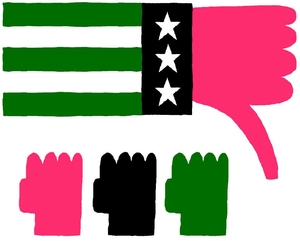
But in terms of gaining formal legal status, civil-society groups were able to enjoy corporate rights only if they had political views that lawmakers, judges, and government officials found palatable, according to new research by Ruth Bloch of the University of California, Los Angeles, and Yale University’s Naomi Lamoreaux.
Bloch and Lamoreaux reviewed hundreds of court cases and legal acts between 1750, when the British still controlled the American colonies, and 1900. They found that the government used its power to filter out incorporation requests from voluntary associations that were considered unsavory, and thereby to void the ability of these groups to own property, receive bequests, or conduct themselves as charities under the law. While Americans could form and join such groups, and frequently did, these organizations missed out on valuable benefits that accrued only to holders of official corporate charters.
“Organizations that were viewed by officials as socially or politically disruptive found themselves at a significant legal disadvantage,” Bloch and Lamoreaux write. “The net effect of this process was that the political judgments of government officials skewed the development of American civil society toward conservative and acquiescent groups at the expense of oppositional ones.”
To receive incorporation, it was helpful to be a Protestant church; espousing pro-labor views, by contrast, was disqualifying. In the late 1700s and early 1800s, for instance, mutual assistance groups based on trades and associations of ethnic minorities essentially could not become incorporated unless they were able to convince the government that their purpose was solely charitable. If the groups’ purpose was to take care of elderly tradesmen or their widows or children, a case could be made; if they were agitating for better working conditions or wages, incorporation would be withheld, the researchers found.
Over time, laws became standardized, with broader categories of associations receiving the right to incorporate. In New York, an 1848 general incorporation law became a model for the country as a whole, when other states soon adopted similar legislation. But while the laws said nothing about the political or ideological bent required to earn incorporation, in practice it was extremely difficult for groups deemed radical to gain this status. For instance, abolitionist associations in the North had to prove that their aims were charitable (helping freed slaves) rather than political (advocating the end of slavery).
“This tacit exclusion meant that such groups still needed to submit to the political judgments of elected officials by petitioning for special charters when they sought corporate rights,” the researchers write.
“It flies in the face of the idea that Americans are equally free to organize groups that are under their own control and that are equal private organizations,” Bloch says.
By the end of the 19th century, New York, and then other states, passed laws that established membership organizations’ rights without regard to their ideology. Over the course of 150 years, incorporated organizations received increasing numbers of rights. “You can almost anticipate the situation of today where private organizations have tremendous rights, including, today, political ones,” says Bloch, a professor emerita of history.
One consequence of this historical development, she says, is that religious organizations that were allowed to incorporate and own property early in the country’s history gained power unavailable to other groups. It partially explains why religion is so important in America.
“The voluntary sector is not this spontaneous organic thing that bubbles up from below, but is really shaped from legal rules, and those legal rules emerged from politics,” says Jonathan Levy, a history professor at the University of Chicago.
Although we think of the nonprofit world as existing in contrast to the state, it’s the laws that shape the nonprofit world, creating a “messy history,” he says.
When historians write about corporations, they typically mean businesses, but this research shows how much interest there was in early America from citizens who wanted to obtain corporate charters for churches and other civil-society groups, Levy says. The history of states allowing nonprofits and religious organizations to organize while denying those rights to explicitly political groups contributes to our thinking about how the government controls access to rights over time. That leads to today’s controversies such as the US Supreme Court decision in Citizens United v. FEC, he says.
Ruth H. Bloch and Naomi R. Lamoreaux, “Voluntary Associations, Corporate Rights, and the State: Legal Constraints on the Development of American Civil Society, 1750–1900,” from the forthcoming Organizations, Civil Society, and the Roots of Development (National Bureau of Economic Research Conference Report), Lamoreaux and Wallis, eds., Chicago: University of Chicago Press, 2017.
Read more stories by Chana R. Schoenberger.