


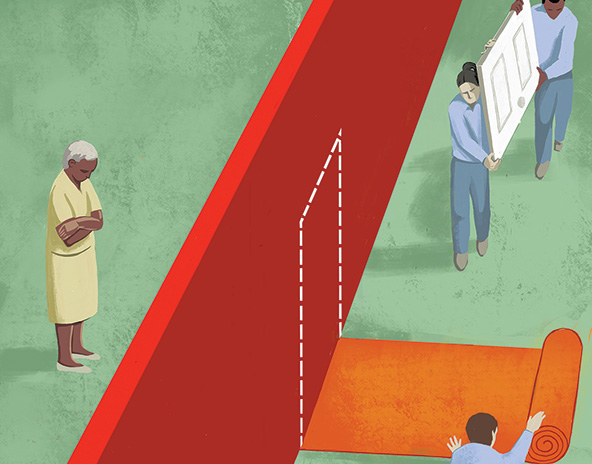
 (Illustration by John Oberlander)
Social isolation is a serious public health problem, with health impacts equivalent to those of chronic smoking or alcohol consumption. It has links to depression, poor sleep, accelerated cognitive decline, and impaired immunity, and increases the risk of stroke, coronary heart disease, and premature death. People who feel disconnected are less inclined to act in healthy ways or work with others to promote well-being for all.
By contrast, having strong social connections and networks promotes well-being. Research demonstrates that connectedness can boost a person’s life span by 50 percent. Older people with a strong sense of community belonging are more likely to be in good health, according to studies from Canada.
The COVID-19 pandemic has increased social isolation and its health impacts. The public health crisis led to a raft of systemic barriers to social connectedness—including shutdowns of nonessential businesses, restrictions on social gatherings, teleworking, and social distancing—whose impacts have manifested in many places through increased rates of alcohol and illegal drug use, increased reports of loneliness and depression, and higher rates of treatment-seeking for mental-health problems.
But the crisis of social isolation extends far beyond the pandemic. In the United States and globally, people of all ages, demographics, and identities experience social isolation. In 2018—before the pandemic—more than half of US adults reported having no one or only one person in their lives in whom they could confide. And only 19 percent reported having a strong emotional connection with their community.
Those who feel that they don’t belong because of their race, ethnicity, gender identity, or sexual orientation are especially susceptible to social isolation. Such vulnerability can be exacerbated by experiences such as long-term illness or disability, domestic violence, loss of a loved one, becoming a caregiver, having a baby, relocation, incarceration, homelessness, or being rejected by family and friends after coming out as queer. Often, the people most vulnerable to social isolation are also vulnerable to other health problems, and for the same reasons.
Currently, most strategies for tackling social isolation focus on providing programming, education, and other resources for individuals. While these efforts have benefits, we need to think more broadly, and focus on intentionally designing our communities for social connectedness. Socially connected communities are places where people know and trust each other, where they feel welcomed and see themselves represented, and where they are motivated and supported to be civically engaged.
It’s time to work across sectors and systems within the community to strengthen policies, structures, and norms that eliminate isolation, promote connectedness within the community, and improve public health. Specifically, we should take three steps.
Three Steps for Greater Connection
First, we must adopt a “social in all policies” mindset to guide efforts by policy makers, social change organizations, grant makers, and others who work on related issues. Social connectedness must be a foundational component across policymaking areas, including transportation, urban planning, and social services, and it should include approaches that address social injustice, inequity, and trauma.
This approach may be easier to implement than many might think. Improved social connectedness is already often a by-product of efforts to strengthen equity and well-being. For example, San Jose, California, set out to reduce disparities in broadband internet service. One city library has 3,000 hot spots available for 90-day check-out periods. Another 8,000 will be provided to students who need broadband connectivity. Although the initiatives focus on internet access, the ability to connect virtually is important for socializing, as the COVID-19 pandemic has underscored. Exchanging stories and experiences online can help connect people by building empathy, trust, and rapport. And libraries are places that are free and open to all people.
In another example, Sweden adopted a process called “gender-balanced budgeting” that revealed how snow-clearing practices disadvantaged women, who were more likely to walk than to drive. As a result, Swedish municipalities now clear walking and biking pathways, especially those near bus stops and schools, before clearing streets and highways. This effort to improve gender equity also helps women and their children stay connected with their communities and supports amid potentially severe weather conditions.
Efforts to address the impacts of trauma and build resilience also often strengthen social connectedness. People who have experienced trauma often self-isolate, avoiding social settings and interactions that contribute to trauma. Sitka, Alaska, is working to acknowledge and address historical injustices in many ways, including by incorporating trauma-informed joint planning and practices for state and tribal social services and courts in child-welfare cases. The resulting culturally sensitive process for supporting and strengthening Native families has significantly reduced the rate of child removal from those families. Stronger, more stable families contribute to more vibrant, connected communities.
Second, governments must increase their investments in social infrastructure—the physical elements of community that, according to sociologist Eric Klinenberg, act as a conduit to bring people together and build social capital. Social infrastructure may include everything from parks and libraries to public transportation and retail corridors. Such investments should be made while working across sectors and with communities to create places and programs that better connect people with each other.
For example, in Denmark, Copenhagen wanted to transform its abandoned industrial harbor into a place where people would want to come to enjoy the outdoors, mingle, and be active. The city has taken on a range of development initiatives, such as creating a floating community center with bathing and sauna facilities. With similar goals in mind, several US cities—including Atlanta and New York City—have adopted a practice started in Bogotá, Colombia, of closing off certain streets to motor vehicle traffic to create safe and inclusive spaces for people to enjoy a range of outdoor activities.
Third, social connectedness must be embraced as a community norm. Changing policies or practices can influence social norms, but hosting inclusive conversations where people can collectively create norms that support social connections tends to be more effective at eliminating harmful, isolating practices and policies and supporting new, inclusive ones. They also tend to be more sustainable.
Some cities, for example, have declared themselves compassionate or welcoming communities, resilient communities, or stigma-free zones. In the United States, a growing number of cities—including Detroit, Michigan; Dayton, Ohio; and Boise, Idaho—recognize the economic and social benefits of becoming welcoming communities and are taking steps to embrace and integrate new residents and help put them on a path to citizenship. By making historically marginalized segments of society feel welcomed and included, these localities are also strengthening social connectedness.
Making public spaces more welcoming to more people is another way of changing norms to promote social connectedness. In 2020, during the civil unrest following the murder of George Floyd, dozens of cities removed or renamed more than 160 Confederate monuments and memorials whose presence glorified a slaveholding past and disenfranchised and alienated Black Americans. Many of these cities are now working with residents to consider how best to replace these monuments to create public spaces that are welcoming and respectful to all.
Community Investing
Despite the significant benefits of social connectedness on health and quality of life, most initiatives to improve community well-being do not address it with intentionality. Yet, by the very nature of these efforts, doing so need not be difficult, and it may very well improve their success. As social connectedness becomes an intentional objective for social investment, it will be important to funders, government leaders, and others interested in seeing results to have community-level data that document changes.
In the meantime, leaders in government, philanthropy, business, academia, and the nonprofit sector can start by integrating social isolation into community health needs assessments to gain a better understanding of the problem. Fairfax, Virginia, for example, did so by promoting a sense of connection, belonging, and meaning as part of its Community Health Improvement Plan. The policy included critical strategies such as adopting community environmental designs that foster connection and engagement.
In addition to community health needs assessments, leaders can incorporate social connectedness into the work they’re already doing, and they can adopt social connection metrics into their policies and programs. The Canadian Index of Wellbeing is a good example: It tracks such quality-of-life measures as “community vitality,” “democratic engagement,” and “leisure and culture.” Encouragingly, in the United States, state and local coalitions are forming around the goal of reducing social isolation and loneliness and building connection. Examples include Massachusetts, Texas, Connecticut, Georgia, Michigan, and California.
To surface truly effective and inclusive solutions, we must cocreate them with communities affected by social isolation. In 2021, Healthy Places by Design, the nonprofit consultancy I lead, published Socially Connected Communities: Solutions for Social Isolation with support from the Robert Wood Johnson Foundation. The report offers in-depth guidance for creating community-led change that builds social connectedness. Our research was informed by a social isolation learning network of participants from diverse places and organizations who candidly shared their efforts to reduce social isolation and identified gaps in the national conversation that underscored the need to address social isolation more systemically. The lessons and recommendations in the report are meant to inspire collective action to address this complex problem.
We must recognize social connectedness as a public health priority and as a tool for healing and rebuilding. We can start by ceasing to think of social isolation as a personal problem and address its root causes with intentionality in the systems, norms, policies, and historical injustices of our communities. Socially connected communities are healthy, resilient, and cocreated with purpose. Investing in social connectedness is an investment in community health and well-being, and, ultimately, more and better opportunities for all.
Read more stories by Risa Wilkerson.