


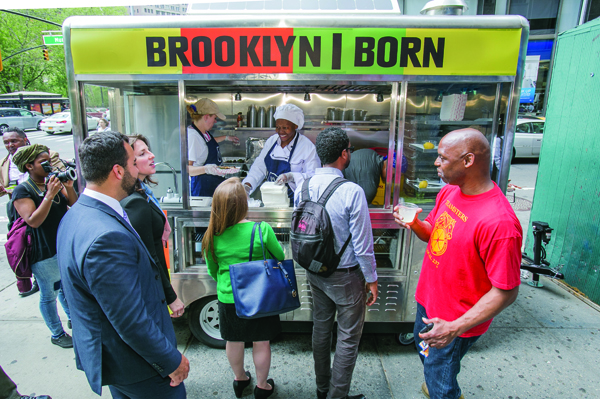
 In May 2015, patrons gather around a new food cart, one of a fleet of solar-powered carts that Move Systems is rolling out in New York City. (Photo courtesy of Move Systems)
The 5,000-plus food carts that operate in New York City deliver a movable feast. They serve an estimated 1.2 million meals each day and offer menu choices that range from hot dogs to halal plates. In recent decades, moreover, street eats have evolved to reflect the tastes of immigrants and the talents of a new breed of foodie entrepreneur. Yet the carts themselves still run on dirty propane and noisy generators.
A start-up called Move Systems aims to bring longoverdue upgrades to the mobile part of the mobile food industry. “We want to dramatically reduce emissions and improve on safety,” says James Meeks, CEO of Move. To further that goal, his company is introducing a new fleet of eco-friendly food carts. The first Move carts started rolling out in September, and the company expects 500 of them to land on Manhattan sidewalks by the end of 2016. (Other cities have expressed an interest in the concept as well.)
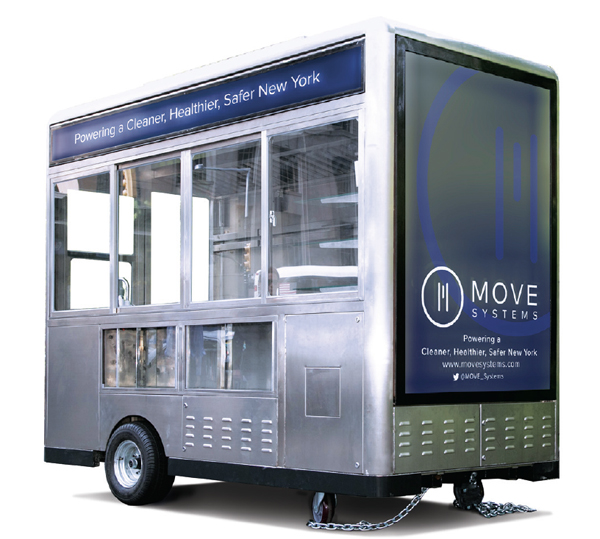
The redesigned cart, known as the MRV100, is currently in its pilot phase. It uses compressed natural gas (CNG) and solar power. (Clean Energy Fuels, a CNG supplier, is a partner in the project.) Meeks, citing a report from Energy Vision, a US environmental group, says that replacing an old cart with an MRV100 model “is like taking 200 automobiles off the road in terms of reduction in particulate matter.” By replacing diesel generators with solar-and battery-powered electrical systems, the Move cart also has the potential to decrease urban noise levels.
During the design phase, Move asked vendors to weigh in on everything from kitchen layout to the use of electronic sensors for monitoring food temperatures. The result is a sleek-looking rig with big windows, stainless steel siding, and built-in refrigeration and sink fixtures. The cart’s L-shaped kitchen has plenty of elbow room, and vendors can configure it to make anything from stir-fry dishes to smoothies.
Move, based in Queens, N.Y., is also introducing less visible innovations. It’s partnering with First Data, a financial services company, to provide a point-of-sale system that allows vendors to swipe credit cards and to manage inventory electronically. In addition, Meeks is encouraging mobile app developers to create tools that will help customers locate the nearest cart—or even place an order.
For now, Move aims to minimize the cost to vendors for using its carts. Vendors must pay for CNG resources that they use, but revenue from sponsorships and advertising is covering the cost of building and maintaining Move equipment. In the first phase of its pilot, Move is providing 100 carts to military veterans at no charge. Meeks, a former US Army officer who served two tours of duty in Iraq, is especially keen to serve that group. “This isn’t just about food carts. It’s urban innovation,” he says.
 (Photo courtesy of Move Systems)
One of the first people in line for a Move cart is Mike Cook, a 62-year-old disabled US Air Force veteran who served in Vietnam. He’s planning a menu of vegan and vegetarian wraps and mock-meat burgers for his cart, and he expects to open for business in the Union Square neighborhood of Manhattan by the end of 2015. The design of the MRV100 “allows us to deliver more restaurant-quality food,” Cook says. “Most health food items are time- and temperature-sensitive.”
To get his new enterprise off the ground, Cook has taken advantage of a business boot camp that Move is supporting, and he has enrolled in an entrepreneurship program for vets called First Data Salutes. He also meets regularly with other veterans—people who have served in Iraq, Afghanistan, and Vietnam—who now run street food businesses. “Move is making it easier for veterans to find their way,” he says.
Brian Hoffman gives walking tours of the New York street food scene for Turnstile Tours, a social enterprise. In his tours, he dwells as much on the stories behind the carts as on their diverse menu choices. “Vendors contribute something special to the city,” he says. “For immigrants, food carts have always been a way to get your foot in the door.” But although Hoffman appreciates the clean energy benefits that the new carts will bring, he doubts that they’ll do much to curb street noise. “This is New York City. There’s noise everywhere,” he says.
Read more stories by Suzie Boss.